
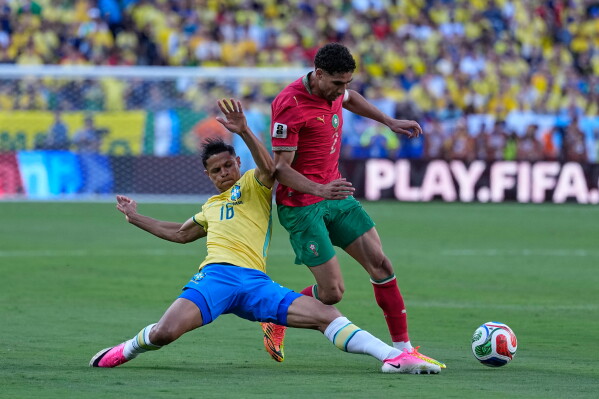
Morocco’s 1-1 draw against Brazil in its opening 2026 World Cup match has only sharpened the country’s ambitions for the tournament it will co-host in 2030.
Alongside Spain and Portugal, the North African kingdom will stage the 2030 World Cup, a prize it secured from FIFA in December 2024 after five unsuccessful bids.
For Morocco, the significance of hosting extends far beyond ninety minutes of football on a global stage.
Observers say the tournament is regarded as one of King Mohammed VI’s most important prestige projects and a cornerstone of the country’s comprehensive modernization strategy.
“The World Cup serves as a catalyst for Morocco’s economic development,” said Steven Hoefner, director of the Konrad Adenauer Foundation’s office in Rabat, noting the country is undergoing profound structural change.
With agriculture losing ground to drought and climate change, Morocco is actively expanding its industrial base, services sector, and tourism industry to compensate.
Isabelle Werenfels of the Berlin-based German Institute for International and Security Affairs agrees the tournament carries significance well beyond sport, saying the government is using it “to boost its modernization policy and legitimize major domestic investments.”
Morocco is currently investing billions in stadiums, airports, rail lines, and roads, with a study by the Spanish think tank Real Instituto Elcano describing the 2030 World Cup as an instrument of Moroccan soft power.
The tournament is intended to improve the country’s international image, attract investment, and strengthen Morocco’s position across Africa, with the stated goal of projecting “an open, tolerant, and up-and-coming country capable of managing projects at the highest level.”
Hoefner, who recently authored a study on Moroccan soccer policy, described international visibility as “a central objective of the Moroccan leadership,” noting the kingdom lacks large oil or gas reserves and is relying increasingly on political and cultural influence.
The planned Hassan II Stadium near Casablanca, set to become the world’s largest soccer stadium with approximately 115,000 seats, has become a focal point of both national pride and public scrutiny.
Thousands of Gen Z Moroccans protested against the World Cup plans last year, arguing that money directed toward stadiums and prestige infrastructure was being diverted from education and healthcare.
Werenfels recalled that “these protests were directed specifically against large-scale infrastructure projects,” reflecting a broader public debate about national spending priorities.
Hoefner views the protests as less about the World Cup itself and more about whether stadium construction should take precedence over social investment, predicting long-term acceptance will hinge on whether ordinary citizens benefit.
An analysis by the Carnegie Endowment for International Peace found Morocco has made significant progress over 25 years, with rising life expectancy, income, and educational attainment, and the country now standing as Africa’s largest automotive exporter.
However, the same study cautioned that high youth unemployment, regional inequalities, and shortcomings in education remain serious obstacles, concluding that “Morocco’s successes to date are undeniable, but the road ahead will be fraught with obstacles.”
Werenfels noted that “many people complain about the rising cost of living, but are also proud of the visible changes in their cities,” capturing the contradictions running through Moroccan public opinion.
Environmental pressures add another layer of complexity, with Werenfels pointing out that “Morocco is facing significant water problems” that raise questions about the long-term sustainability of expanded tourism.
The Real Instituto Elcano drew a historical parallel between the 2030 World Cup and the 1992 Barcelona Olympics, suggesting the tournament could reposition Morocco internationally in a similarly transformative way.
Whether those expectations are met will ultimately depend on Morocco’s ability to balance economic modernization, social progress, and the political vision underpinning what has become one of the kingdom’s most consequential national undertakings.
