
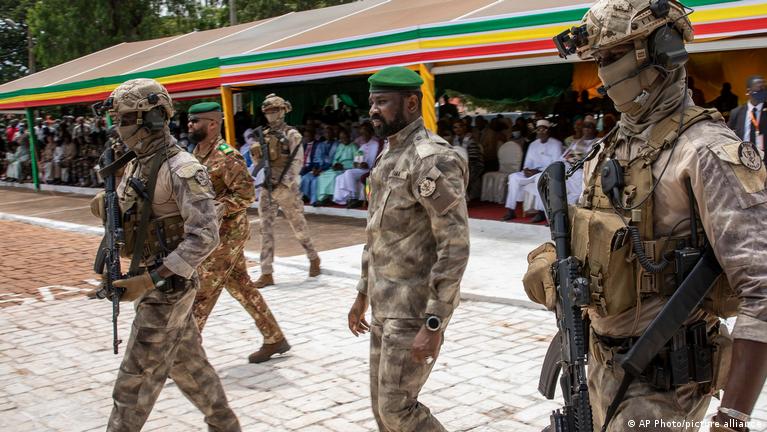
Since the wave of coups that swept Mali, Niger and Burkina Faso between 2020 and 2023, military rulers have imposed sweeping criminal defamation and antiterrorism laws enabling the arbitrary detention of journalists, bloggers and activists.
The juntas have also ordered the systematic shutdown of independent radio stations and online platforms, leaving citizens with few outlets for free expression or political dissent.
“It has become more repressive. It’s no longer as easy to speak out,” said Ulf Laessing, former director of the Konrad Adenauer Foundation’s Sahel program in Mali.
Laessing added: “That is clearly a point of criticism against the government,” reflecting a broader erosion of civil liberties that has accelerated across the three nations since the coups.
In Mali, General Assimi Goita seized power through two military coups in 2020 and 2021, and in 2025 the National Transitional Council passed a draft law securing his rule for another five years.
Laessing noted that while security conditions initially improved in some parts of Mali, jihadist insurgents still control portions of the country, and he sees little prospect of lasting peace regardless of future political changes.
The populations of Mali’s major cities remain caught between a repressive military government and the prospect of an even more Islamist successor, with Laessing noting that the people of Bamako want neither Sharia law nor the Islamists in power.
In Burkina Faso, Burkinabe human rights activist Binta Sidibe-Gascon described conditions as even more severe, telling reporters that “public space no longer exists at all.”
“Everyone is forced into silence and pressured to self-censor. Anyone who dares to speak out about the national situation is sent to the front lines,” said Sidibe-Gascon, who is president of the NGO Observatoire Kisal and a member of the Citizens’ Coalition for the Sahel.
Burkinabe President Ibrahim Traore, who seized power in a coup in September 2022, made his position on democratic governance explicit in early April, declaring on national television: “People need to forget about democracy.”
Traore went further, stating: “If an African tries to talk to you about democracy, you should run away. Democracy kills,” remarks that drew widespread international condemnation from human rights organizations.
Sidibe-Gascon described the full scope of the rollback under Traore’s rule, saying: “All the rights of the Burkinabe have been seized and are now in the hands of a single man who makes all the decisions. Civil rights, human rights, property rights — even the right to life.”
She added that the reinstatement of the death penalty represented “a step backward for Burkina Faso,” underscoring how comprehensively the junta has dismantled constitutional protections since taking power.
According to Reporters Without Borders, cases of intimidation against media workers in Burkina Faso have increased in recent years, and a dozen journalists have been forced into exile, while at least ten foreign outlets including Jeune Afrique, Deutsche Welle and the Guardian were suspended in 2024.
The May arrest of Imam Mohamed Ishaq Kindo, a prominent Sunni religious leader who reportedly criticized a law regulating religious practices, sparked rare unrest in the capital Ouagadougou, with hundreds of supporters clashing with police and dozens arrested.
For Newton Ahmed Barry, a Burkinabe journalist living in exile, events like the arrest of Kindo reflect a deliberate governing strategy rooted in fear and control.
“This is the logic of this junta and its leader: The more people are afraid, the more they buy their way out of trouble. They instill fear and terror in everyone in order to keep them under their control and thus rule in peace,” Barry said.
Mahamadou Idder Alghabid, deputy secretary-general of the Alliance of Sahel Democrats, argued that the juntas’ early appeal to sovereignty and anti-imperialism has given way to broken promises, saying: “Today, all these promises to the people of the Sahel — whether they come from Burkina Faso, Niger or Mali — have proven to be false.”
Ilaria Allegrozzi, a Sahel researcher at Human Rights Watch, called on the international community to act, warning that “silence and ambiguity ultimately always legitimize authoritarian excesses” and that Burkina Faso’s partners can no longer treat condemnation of the junta as counterproductive.
