
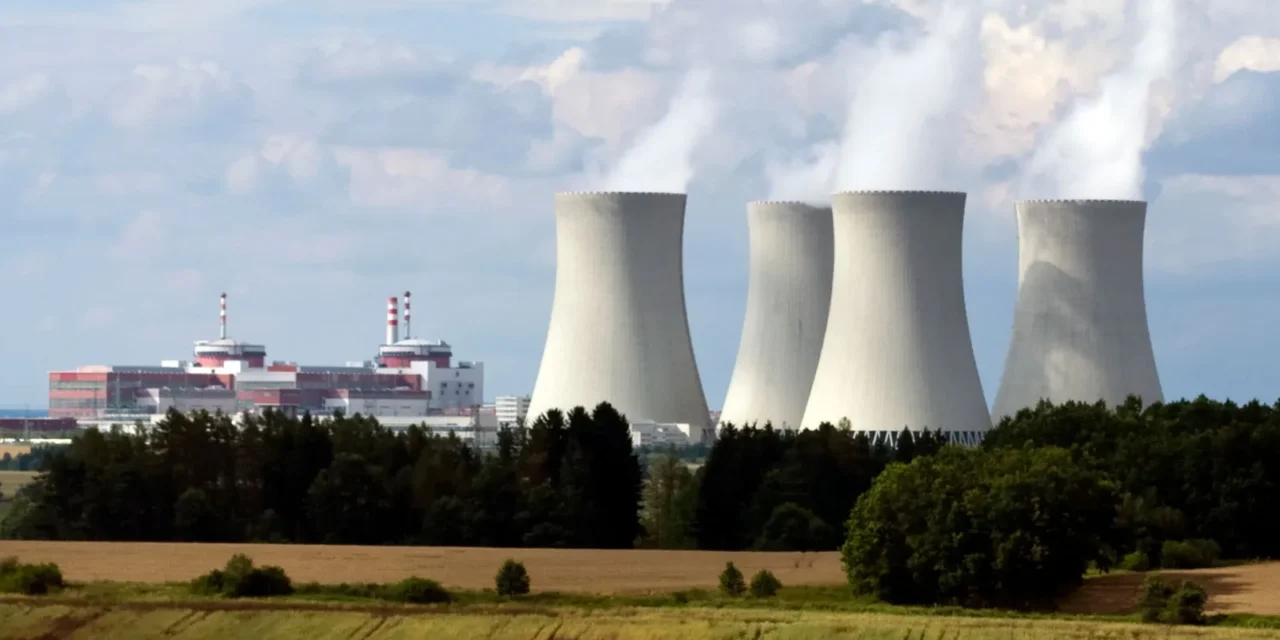
Thirty-eight countries have pledged to triple nuclear capacity by 2050, shifting nuclear energy from theoretical ambition to binding financial commitment backed by serious capital.
Long-term uranium pricing sits near $91.50 per pound, the highest reading since 2012, while spot prices have climbed 34% year over year to $88.49 per pound.
Meta has signed agreements for up to 6.6 gigawatts of nuclear power, and the U.S. Department of Energy is offering up to $26.5 billion in loan guarantees to revive the domestic fuel cycle.
Cameco (NYSE: CCJ) is widely considered the cleanest large-cap proxy on the contract-coverage thesis, trading around $101 after a pullback of more than 13% over the past month.
Despite that recent weakness, shares remain up 49% over the past year, sitting well below the 52-week high of $135.24 and back in a range where the contract book looks compelling.
Cameco’s first-quarter results told a strong operating story, with uranium segment revenue rising to $510.46 million, sales volume climbing 13%, and adjusted net earnings nearly tripling to $145.59 million.
The company maintained full-year 2026 revenue guidance of $3.13 billion to $3.37 billion, with 29 to 32 million pounds of uranium expected to be delivered at a realized price of $85 to $89 per pound.
Cameco’s contract book includes roughly 230 million pounds committed under long-term agreements, with average annual deliveries of more than 28 million pounds projected over the next five years.
The company’s 49% Westinghouse stake and a Brookfield and U.S. government partnership targeting at least $80 billion in investment for AP1000 reactor deployments add meaningful upside to the vertically integrated nuclear platform.
Analyst consensus on Cameco stands at nine strong buys, ten buys, and five holds with no sell ratings and a price target of $129.01, though the trailing price-to-earnings ratio of 96 leaves limited room for guidance disappointment.
A $559 million CRA transfer pricing dispute remains unresolved, and a Key Lake mill bridge collapse combined with an extended third-quarter maintenance shutdown creates near-term supply uncertainty.
The Global X Uranium ETF (NYSEARCA: URA) offers investors diversified one-ticket access to the uranium sector without taking on single-mine operational risk.
URA tracks the Solactive Global Uranium and Nuclear Components Total Return Index, carries a net expense ratio of 0.69%, and traded around $45.50 on June 12, up more than 26% over the past year.
Over a five-year period, the basket returned more than 94%, reflecting a broad re-rating of uranium miners and fuel cycle companies as the sector emerged from a decade-long bear market.
URA captures the same structural tailwinds powering individual names, including long-term pricing momentum, the 38-country tripling pledge, and AI and data-center power-purchase agreements, while diversifying across geographies.
A roughly 16% drawdown over the past month is a reminder that broad-basket exposure does not insulate investors from sector-wide selloffs tied to spot uranium volatility.
Centrus Energy (NYSE: LEU) is the only U.S.-based commercial uranium enricher, positioning it at the center of the domestic high-assay low-enriched uranium mandate for advanced reactors and data-center power demands.
Centrus posted a standout first quarter, with adjusted diluted earnings per share of $1.05 against a 27-cent consensus estimate, representing a 289% earnings surprise on revenue of $76.70 million.
Technical Solutions segment revenue rose 47% on HALEU contract expansion, and management raised full-year revenue guidance to a range of $450 million to $500 million.
CEO Amir Vexler said the company has “switched to full execution mode to accelerate our build-out” and has “already identified approximately $300 million in cost reductions” through the Palantir partnership.
Centrus holds a backlog of $3.8 billion extending to 2040, including a $900 million Department of Energy HALEU task order, with the NNSA notifying intent to sole-source certain enrichment activities to the company.
Shares traded around $162 on June 12 against a 52-week high of $464.25, with analyst consensus skewing bullish at two strong buys, nine buys, and five holds with a price target of $284.64.
Execution risk on the Piketon and Oak Ridge buildouts, dependency on DOE appropriations, and Russian LEU policy decisions remain material concerns that keep the stock volatile quarter to quarter.
Cameco’s second-quarter 2026 results due July 31 will offer the next read on realized pricing and Westinghouse contribution, while a Certified for Construction package release represents the next major catalyst for Centrus.
