
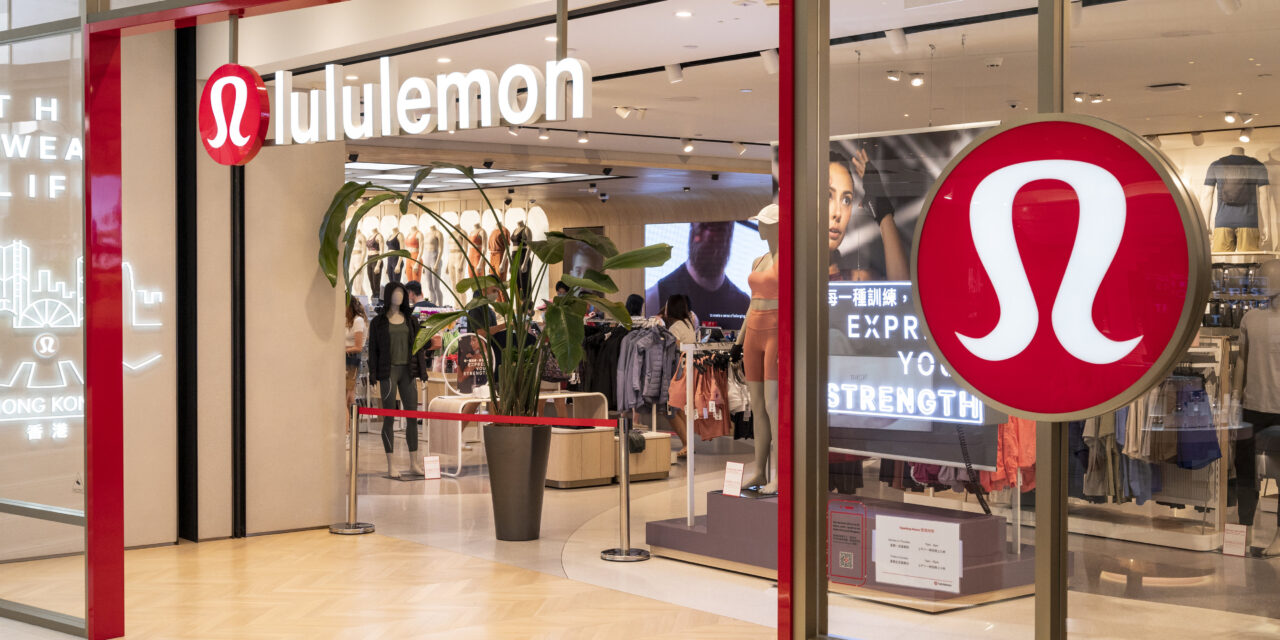
Lululemon Athletica (NASDAQ: LULU) shares tumbled more than 12% following its fiscal first-quarter earnings report on June 4, pushing the stock to its lowest level since 2018.
The company posted revenue of $2.47 billion for the quarter ending May 3, up from $2.37 billion in the same period a year ago.
Despite modest top-line growth, the cost of goods sold jumped 14% year over year, dragging gross profit down by more than 4% compared to the prior year period.
Selling and general expenses also rose 12.4% to $1.05 billion, compounding the pressure on the company’s bottom line.
Net income fell 38% to $195 million, with earnings per share coming in at $1.69, sharply lower than the $2.60 reported in the same quarter last year.
Gross margin declined 410 basis points to 54.2%, with 280 basis points of that contraction attributed to tariff headwinds and the remainder to fixed cost deleverage from weakening comparable sales in North America.
Comparable sales fell 5% in the Americas, while international markets posted a 13% increase in same-store sales, partially offsetting the domestic weakness.
China was a bright spot, with revenue soaring 30% and same-store sales climbing 13%, contributing to overall international revenue growth of 22%.
Despite the relative international strength, Lululemon cut its full-year sales forecast to a range of $11 billion to $11.15 billion, representing a 1% decline to essentially flat growth versus the prior year.
The company cited moderating sales trends late in the quarter, negative press and social media commentary, and underperforming product launches, including its New Look of Yoga campaign, as contributing factors to the revised outlook.
Full-year North America revenue is now expected to decline in the high single digits, with U.S. performance described as “slightly lower” than Canada, reflecting persistent challenges in the company’s core region.
Operating margin guidance for the second quarter was lowered to approximately 11.6%, compared to 20.7% in the prior year quarter, as lower sales and rising expenses continue to squeeze profitability.
Leadership uncertainty has added to investor unease, with the company currently operating under a pair of interim co-CEOs following the departure of former CEO Calvin McDonald.
Heidi O’Neill, a longtime former Nike executive, is set to take over as CEO on September 8, leaving several months of interim management before a permanent strategic direction can be established.
Adding to the turbulence, the company recently resolved a very public proxy fight with founder Chip Wilson, who holds nearly 9% of the company’s stock and had accused management of squandering “billions of dollars in brand power.”
Wilson had also been openly critical of incoming CEO O’Neill, but as part of the settlement reached just days before the earnings report, he agreed to an 18-month non-disparagement clause.
Lululemon also agreed to add two of Wilson’s candidates to its board of directors as part of the resolution, drawing a line under what had become an increasingly damaging public dispute.
With the stock now down 43% year to date and trading at a forward price-to-earnings ratio of under 10.5 times, the valuation may appear attractive on the surface, but significant execution risk remains before any recovery thesis can be confirmed.
A wait-and-see approach until O’Neill assumes leadership and outlines her strategic plan appears prudent, given the unresolved headwinds around tariffs, North American sales weakness, and ongoing leadership transition.
If Lululemon can return to the growth trajectory that defined it for much of the past decade, there is meaningful upside potential in the stock, but that outcome is far from guaranteed at this stage.
