
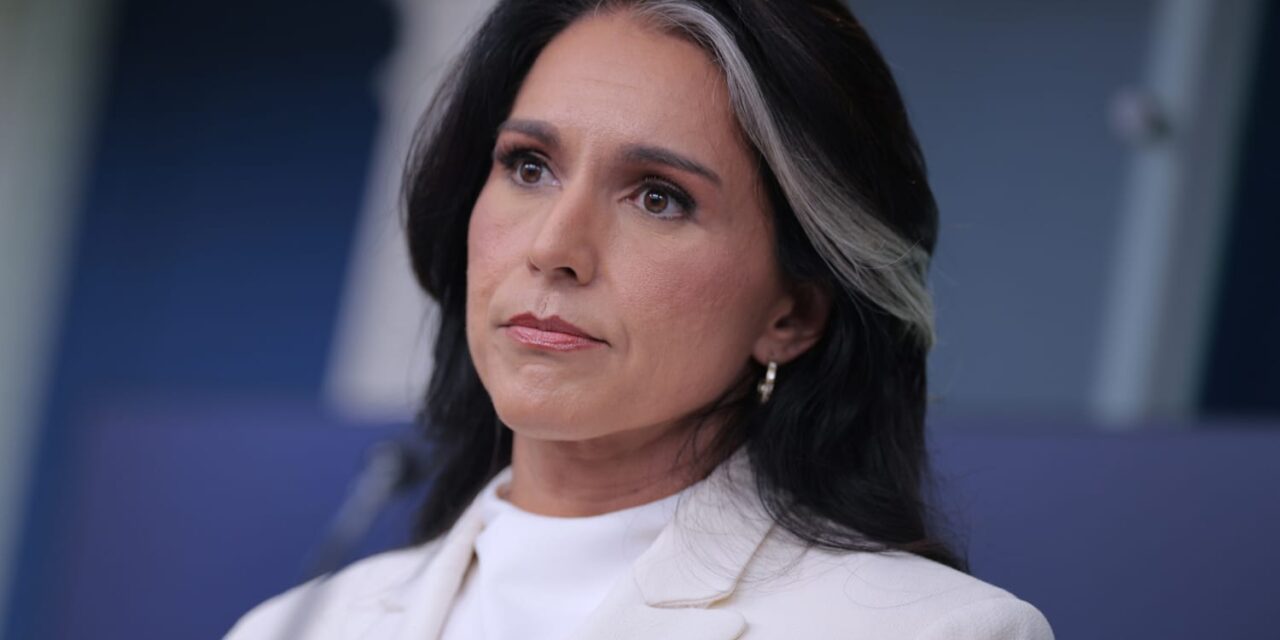
Amaryllis Fox Kennedy, a senior Trump administration intelligence official and one of Director of National Intelligence Tulsi Gabbard’s closest allies inside the government, has resigned from two of her three administration roles, with sources telling the Washington Post that her departure was driven in part by her personal opposition to Trump’s military involvement in Iran.
Kennedy, a 45-year-old former CIA undercover officer and author of a widely read memoir of her time in the agency, had been simultaneously holding three intelligence positions: deputy to Gabbard at the Office of the Director of National Intelligence, associate director at the Office of Management and Budget overseeing classified intelligence budgets, and a seat on the President’s Intelligence Advisory Board.
She will vacate the ODNI and OMB roles effective this week but wrote in an internal May 8 email reviewed by the Washington Post that she hopes to retain her position on the advisory board.
The email cited family priorities as the stated reason for her departure, with Kennedy writing that motherhood is “God’s greatest gift” and that after two years on the campaign trail and a year in government, she needed to ensure her family had what it needed, adding that she would be moving to the private sector.
Five people familiar with the matter confirmed her departure to the Washington Post, with one of those sources saying the Iran war was also a factor, placing Kennedy in a growing category of Trump administration officials who have broken with the White House over the military campaign that entered its 12th week at the time of her resignation.
Joe Kent, director of the National Counterterrorism Center, resigned in March over the Iran conflict, publicly stating that Trump had been pushed into the war by “pressure from Israel and its powerful American lobby,” a statement that drew significant attention given the sensitivity of the claim.
Kennedy’s personal opposition to the war, if accurately reported, would mark another departure from the anti-interventionist wing of the MAGA coalition, a faction that had coalesced around figures like Gabbard, RFK Jr., and Vance during the 2024 campaign on a platform of ending foreign wars, and that now finds itself navigating the political reality of a conflict many of them privately opposed.
Kennedy is the daughter-in-law of Health and Human Services Secretary Robert F. Kennedy Jr., having married his eldest son Robert F. Kennedy III in 2018 on Cape Cod, and her family connections to the broader Kennedy political network made her appointment to multiple intelligence roles one of the more unusual hires of the administration.
Her bid to become deputy director of the CIA early in the administration was blocked following pushback from Republican senators who worried she would impose disruptive changes at the spy agency, a sign that her profile was already a source of institutional anxiety before she settled into the ODNI and OMB roles.
Inside the administration, Kennedy had been working across human espionage, East Asia policy, and technology development for intelligence operations, and had been centrally involved in the push to increase Trump’s budget request for the ODNI by 20%, a bid to expand Gabbard’s office whose fate in Congress remains uncertain.
Kennedy also helped lead the effort to declassify historical documents related to the assassinations of President John F. Kennedy, Senator Robert F. Kennedy, and Martin Luther King Jr., and was present at a surprise ODNI visit to a CIA facility where classified assassination-related documents were taken and transferred to the National Archives.
Gabbard praised Kennedy’s departure in measured terms, saying the ODNI had “successfully aligned the Intelligence Community agencies with the Administration’s and ODNI’s goals” under her leadership and wishing her well, a statement that contained no reference to the Iran war and gave no public indication of the internal tensions that sources described.
The departure is the latest indicator that the coalition Trump assembled in 2024 around promises of restraint abroad is fracturing at the senior staff level under the weight of an active military conflict that many of those officials never expected to be managing.
