
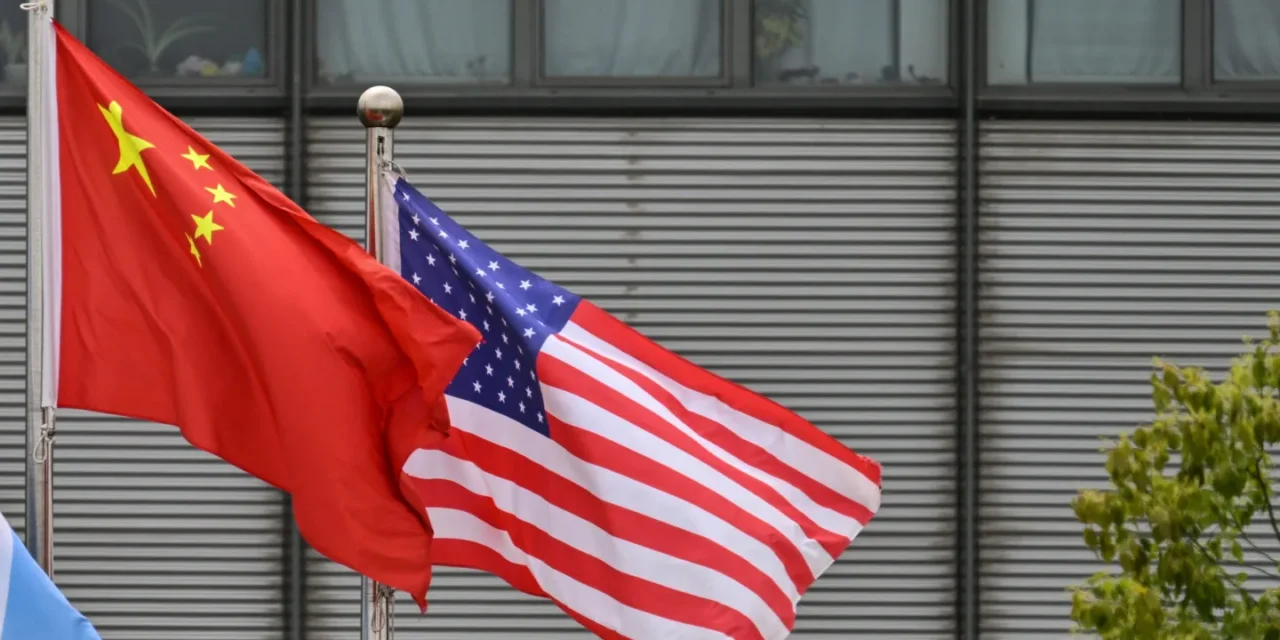
China has pushed back against mounting Western criticism of its trade practices, with the Chinese Embassy in Washington telling the Foreign Policy Journal that Beijing does not intentionally engineer a trade surplus and remains committed to open, rules-based global commerce.
The remarks come as the trade row between Beijing and Washington enters a new chapter. President Donald Trump, who has long characterised China as the world’s foremost export-driven economy, has repeatedly cited its surplus with the United States as evidence of what he calls unfair and predatory trade.
His administration has made reducing dependence on Chinese imports and reshoring American manufacturing a central tenet of its economic agenda, framing tariffs as a corrective measure against an economy built on export dominance.
China’s trade surplus surged to a record of almost $1.2 trillion in 2025, a figure that handed the Trump administration fresh ammunition for its protectionist stance. But Beijing flatly rejects the characterisation that it engineers that outcome.
“China does not deliberately pursue a trade surplus,” Chinese Embassy spokesperson Liu Pengyu told the Foreign Policy Journal on Tuesday.
“It is willing to be not only the ‘world’s factory,’ but also a ‘world market.'”
The Embassy pointed to the China International Import Expo as evidence of that openness, noting that last year’s eighth edition drew 155 countries, regions and international organisations, alongside 290 Fortune Global 500 companies — with the number of participating firms rising by more than 600 on the previous year.
The Embassy also noted that China has actively reduced its own tariff barriers as part of broader opening-up measures, bringing its overall tariff level down to 7.3 percent — close to the rates maintained by developed economies. From May 1 this year, Beijing has implemented a zero-tariff policy covering 53 African nations with which it maintains diplomatic relations.
On the wider question of protectionism, the Embassy was direct: “Protectionism cannot preserve competitiveness. Decoupling only cuts off the mutual benefits that come from exchange and cooperation.”
It warned that erecting trade barriers against affordable Chinese goods ultimately raises costs for businesses and consumers in the importing countries themselves, while destabilising global industrial and supply chains.
The Embassy characterised the current state of China-US relations as standing at an important crossroads, calling on both sides to “draw lessons from the past, work in the present to stabilise and improve the relationship, and look to the future by finding the right way to get along in a new era.”
It outlined four priorities it says must be addressed for the relationship to move in a healthy direction: developing a sound strategic understanding of one another; approaching competition with a mutual-success mindset rather than zero-sum rivalry; defining the boundaries of national security clearly so that economic and technological cooperation can resume on rational terms; and breaking free from the chilling effect that has constrained bilateral exchanges.
Tariffs between the two countries briefly escalated to extraordinary levels in 2025, with Beijing and Washington eventually arriving at a truce that reduced new levies to 20 percent. Despite the relative détente, tensions over China’s export volumes and trade practices have continued to simmer.
The Embassy acknowledged that Beijing has taken countermeasures in response to US tariffs and restrictions imposed since 2018, but said China has simultaneously engaged in multiple rounds of economic and trade talks with Washington.
“China has consistently maintained that differences should be addressed through dialogue and consultation,” the spokesperson said, adding that last year’s five rounds of consultations, guided by common understandings reached by the two presidents, produced outcomes that brought “greater certainty and stability to bilateral economic relations and to the world economy.”
Pushing back against the broader Western narrative of Chinese mercantilism, the Embassy urged all parties to “move beyond zero-sum thinking” and to maintain an open global economic environment rather than erecting barriers to obstruct normal trade flows.
“The China-US relationship is the most consequential bilateral relationship in the world today,” the spokesperson said. “If the relationship slides into conflict and confrontation, the consequences will be felt far beyond the two countries.”
