
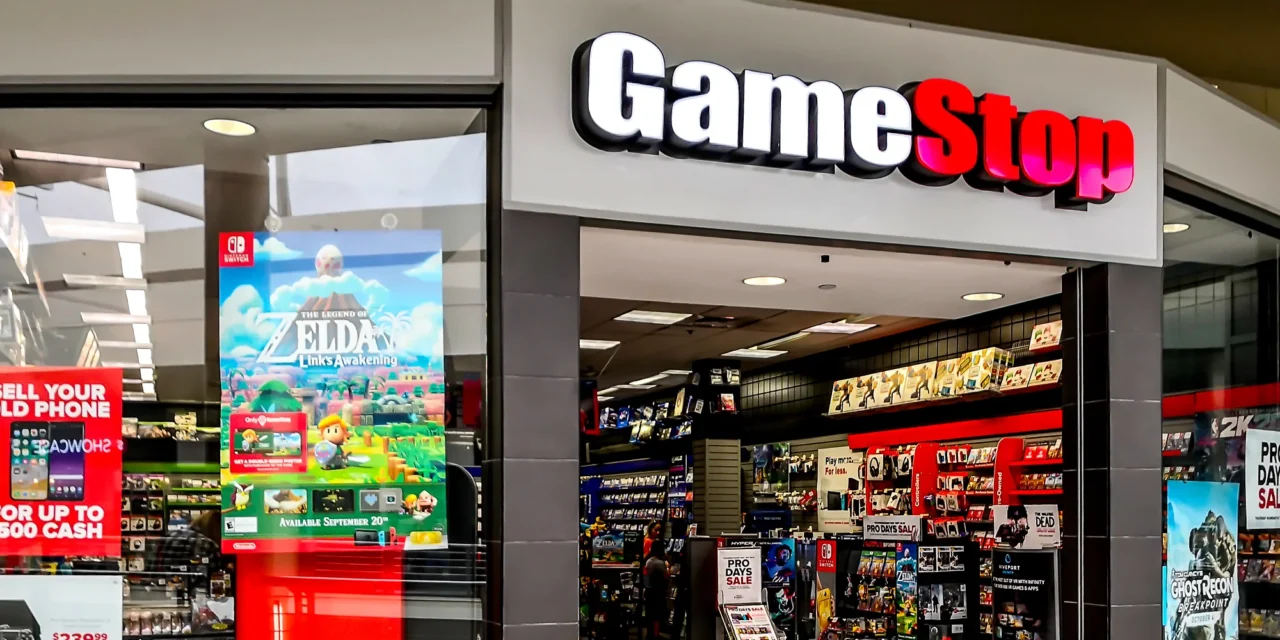
Few comparisons in the current market capture the sheer range of ways investors choose to speculate on the future quite like putting GameStop Corporation (NYSE: GME) next to Oklo Inc. (NYSE: OKLO) on the same page. One is a nearly 30-year-old video game retailer sitting on a mountain of cash and waiting for its CEO to pull off the most ambitious holding company transformation in retail history.
The other is a pre-revenue nuclear startup that has never operated a commercial reactor but is partnering with Nvidia and Los Alamos National Laboratory to help power the AI infrastructure of the next decade. They share a love of volatility, retail investor devotion, and the quality of being genuinely difficult to value using conventional analytical frameworks.
GME is trading around $25 as of late April 2026, having closed at $25.01 on April 23 and edging back toward $25.22 in pre-market on April 24, against a 52-week range of roughly $17.50 to $36.00 that captures a period shaped more by sentiment around CEO Ryan Cohen’s acquisition ambitions than by the underlying trajectory of the retail gaming business it was built on. Year-to-date the stock is up approximately 21 percent through late April, with the trailing one-year return at a loss of roughly 8 percent and the five-year return showing a loss of about 42 percent from the post-meme-squeeze heights, which is the broader picture that bull case analysts tend to de-emphasise.
OKLO closed at $71.00 on April 24 after a 7.14 percent pullback from an intraday high of $81.50, itself a partial reversal of the 15 percent surge seen on April 23 when the Nvidia and Los Alamos partnership was announced alongside HSBC initiating coverage with a Buy rating and a $96 price target. The 30-day return heading into that week was approximately 39 percent, the one-year return has been approximately 214 percent, and the 52-week range of $22.52 to $193.84 tells you that this is a stock whose price is primarily a function of news flow, narrative intensity, and sentiment rather than any earnings-based valuation anchor.
The first thing to understand about GME’s current investment thesis is that it has nothing to do with video games anymore in any meaningful financial sense. Revenue from hardware fell 31.7 percent year-on-year in the most recent annual period, the core software business continues to contract as digital downloads displace physical media, and the company now operates approximately 2,206 stores versus several thousand locations from its peak years.
What Ryan Cohen has built instead is a cash pile that a consistently positive Motley Fool noted reached approximately $9 billion in cash and marketable securities alongside another roughly $370 million in Bitcoin holdings, structured against nearly $4.2 billion in convertible notes that carry zero percent interest and can be settled in stock, giving the balance sheet a genuinely unusual look for a company of GameStop’s heritage.
Cohen described a planned acquisition of a “very, very, very big” publicly traded consumer company in a CNBC interview in January 2026, calling the prospective deal “transformational” and comparing his ambition to Berkshire Hathaway’s trajectory, except compressed into a much shorter timeframe. He described the new plan as “way more compelling than bitcoin” when asked whether GameStop might sell its BTC holdings to fund the deal, declining to confirm whether a liquidation was coming but making the strategic hierarchy clear enough.
His compensation structure reinforces the conviction: 171.5 million stock options that vest only if GameStop’s market capitalisation hits tiered targets starting at $20 billion and scaling all the way to $100 billion, a structure that aligns Cohen’s personal wealth so completely with shareholder outcomes that there is no rational version of his behaviour that involves running the company for anything other than maximum value creation.
The most constructive fundamental data point working in GME’s favour right now is the collectibles business, where revenue surged 54.6 percent year-on-year in the most recent period and where the deal with card-grading company PSA to become an authorised card dealer has provided a real commercial tailwind in a trading card market that remains highly active. GameStop is launching its Power Packs digital card platform, allowing buyers to purchase PSA-graded card packs ranging from $25 to $2,500 that are digitally opened and stored in the PSA vault, a product that sits at the intersection of collectibles and the digital ownership trend that has attracted significant consumer interest across demographics well outside GME’s traditional gaming customer base.
The bear case on GME from the single analyst maintaining active coverage is straightforward and is reflected in the Sell rating with a $13.50 target: the company is trading at roughly 26.7 times earnings on a P/E basis, above the specialty retail industry average of around 20.9 times and significantly above the peer average of roughly 16.4 times, which is a premium multiple for a business whose core revenue streams are in secular decline and whose transformation thesis depends entirely on an acquisition that has not been announced, not been confirmed as realistic in scope, and for which no specific target has been named.
Simply Wall St’s DCF model, working from free cash flow of approximately $595 million, arrives at a theoretical intrinsic value of around $162.93 per share, which would make GME dramatically undervalued, but the model depends on extrapolations out to 2035 that rely on assumptions about the acquisition succeeding that have no empirical basis yet. A simpler earnings-adjusted approach using the enterprise value rather than the market cap to account for the cash position produces an EV-to-earnings multiple of roughly 15.5 times, which for a declining-revenue business is not cheap on any traditional framework.
OKLO’s investment case operates at a completely different level of speculative abstraction because there is no revenue to discount back, no earnings multiple to compare, and no traditional valuation anchor beyond the $2.5 billion in cash and marketable securities the company holds alongside a pre-commercial operating profile. What investors are buying when they buy OKLO is a bet on the convergence of three powerful macro narratives simultaneously: AI data centres running out of reliable baseload power, the US government and private sector racing to build advanced nuclear capacity, and Oklo being well-positioned with its Aurora sodium fast reactor and Pluto fuel programme to capture a meaningful share of that demand.
The Nvidia partnership is the most recent and most impactful catalyst in Oklo’s recent momentum and deserves to be understood at the right level of specificity. The collaboration involves using Nvidia’s AI infrastructure alongside Los Alamos National Laboratory’s nuclear science expertise to accelerate reactor design, fuel validation, and materials science modelling, with specific application to Oklo’s Pluto reactor fuel programme under the Department of Energy’s Reactor Pilot Programme. No financial terms were disclosed and this is not a power purchase agreement or a revenue-generating customer contract. It is a research and development acceleration partnership that gives Oklo access to best-in-class computing tools and the credibility of being associated with the most important brand in AI infrastructure, both of which have real strategic value even if neither translates into revenue in the near term.
The regulatory milestones are the more immediately consequential data points from an operational perspective. The Department of Energy’s Idaho Operations Office approved a Nuclear Safety Design Agreement for the Aurora powerhouse at Idaho National Laboratory in March 2026, described by analysts as a meaningful step in the federal pilot authorisation process and necessary for Oklo’s target of first commercial power generation before the end of 2027. The company has purchased land in southern Ohio for future Aurora facilities, has non-binding letters of intent from clients including Equinix and Diamondback Energy, and has a customer commitment pipeline that most analysts characterise as commercially credible at the macro level even while noting that the conversion from non-binding intent to executed power purchase agreements is the step that truly transforms the investment thesis from speculative to operational.
The analyst community’s view of OKLO is constructive in aggregate but not uniformly bullish. Nine Buy ratings and five Hold ratings produce a Moderate Buy consensus with an average price target of approximately $91.50, implying roughly 26 to 29 percent upside from the April 24 close of $71.00. HSBC’s $96 target is the most recently published and one of the more thoughtful initiations, built around Oklo’s owner-operator model and the structural demand for reliable clean energy from AI infrastructure customers who cannot rely on intermittent renewables for the kind of around-the-clock baseload power their facilities require.
The bear case, captured in Morningstar’s quantitative fair value estimate of $76.22 with Very High uncertainty, essentially argues that at $71 the stock is approximately fairly valued on the most optimistic reasonable scenario and that the downside from execution failure or regulatory delay is substantial.
Comparing the two stocks for investment purposes requires accepting that they are in very different categories of speculative bet. GME is a bet on one person’s ability to allocate $9 billion of capital more effectively than the consensus expects, in a company where the existing business is contracting but where the cash fortress creates a genuine cushion against the kind of existential risk that would otherwise make the stock uninvestable at current multiples. OKLO is a bet on a technology working, a regulatory timeline being met, AI infrastructure power demand remaining intense, and a pre-revenue company making the transition from credentialed startup to operating commercial utility without the capital or timeline overruns that have characterised most major nuclear projects in the modern era.
On momentum alone, OKLO has decisively outperformed GME over the past year and has significantly more narrative velocity heading into the second half of 2026, with catalysts including the DOE licensing timeline, potential announcement of binding power purchase agreements, and any update on the Pluto fuel programme through the Genesis Mission all capable of generating material price movement. GME’s near-term momentum depends almost entirely on whether Cohen announces the acquisition, names a target, or provides enough specificity about the deal to re-energise a retail investor base that has been holding through a largely sideways price over the past several months while waiting for a move that was described as imminent in January.
The one thing both stocks share with certainty is that neither will move gradually when something important happens. They are binary-event vehicles dressed up in the daily clothes of ordinary listed equities, which is exactly what makes them fascinating to watch and genuinely difficult to size for anyone managing risk with traditional position management tools.
