
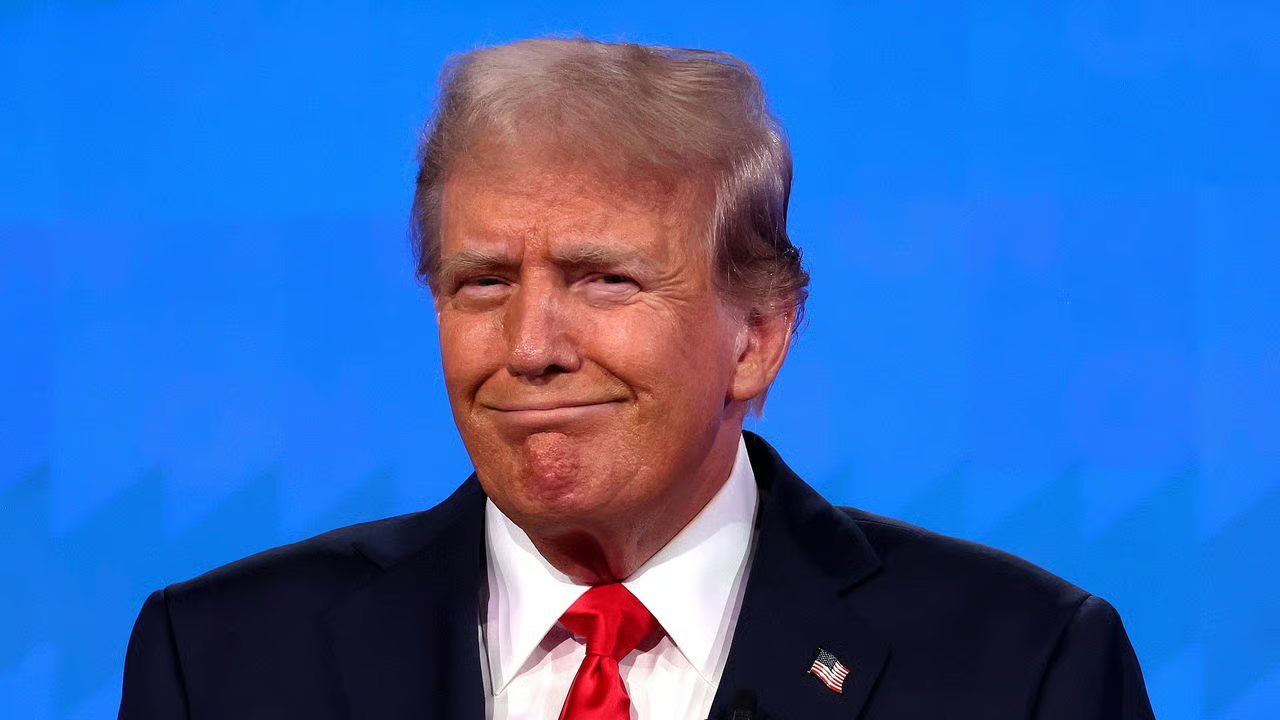
President Donald Trump is entering mid-April 2026 with an approval rating hovering near the lowest sustained levels of his second term. A Quinnipiac University poll of 1,028 registered voters conducted between April 9 and April 13 put his overall approval at 38%, with 55% disapproving. That matches an all-time second-term low for Trump in Quinnipiac polling, first recorded in March 2026.
The YouGov and Economist tracking survey recorded net approval at minus 19 percentage points in early April, with 37% approving and 56% disapproving. A Reuters/Ipsos poll placed Trump at 36% approval. The RealClearPolling average, which blends multiple pollsters, stands at approximately 41.4% approval versus 56.1% disapproval.
A separate CNN poll conducted by SSRS found Trump’s overall approval at 35%, one point off his all-time low in that pollster’s history. His economic approval in the same survey fell to a new second-term low of 31%. Just 27% approve of his handling of inflation, down sharply from 44% a year ago.
The Iran war is the primary driver of the deterioration. YouGov and Economist polling recorded Trump’s handling of Iran at 30% approval in its most recent wave, down from 39% in early March. Quinnipiac found 36% approving and 58% disapproving of his Iran handling, broadly unchanged from the prior month’s survey but deeply negative on an absolute basis.
Gas prices have crystallised economic discontent. Sixty-five percent of Quinnipiac respondents said they blame Trump a lot or somewhat for the recent rise in petrol prices. Among independents, that figure rises to 73%. Even among Republicans, 22% said Trump deserves at least some of the blame, a notable crack in partisan solidarity on a pocketbook issue.
The Iran war generates particularly poor numbers across the public. Quinnipiac found 64% of voters consider Trump’s threat that “a whole civilization will die tonight” to have been unacceptable. Only 28% said the language was acceptable. Separately, 45% said the US is in a weaker global position as a result of the military action, against 30% who said stronger.
The erosion within the Republican base is meaningful. The share of Republicans who strongly approve of Trump’s job performance fell from 52% in January to 43% by April, per CNN polling. Trump’s economic approval among Republicans dropped 14 points over the same period. Among his 2024 voters, he is down 6 points to 76% approval over five weeks of the Iran conflict.
Among independents the picture is starker. YouGov and Economist polling recorded Trump’s approval with independents at 22% in its most recent wave, down from 25% in late February and 31% in early March. That sustained decline among non-aligned voters has direct relevance to the November 2026 midterm elections, where competitive House and Senate districts will be largely decided by independent turnout.
A UMass Lowell/YouGov survey released April 9 found 57% of respondents saying their lives had become somewhat or much more difficult over the previous six months. Sixty-seven percent said the country was on the wrong track, worse than the same poll recorded in October 2025.
Not every data point is uniformly negative. An Economist/YouGov survey taken between April 1 and April 9 showed Trump at 45% approval, a more favourable reading than other concurrent surveys. However, that poll straddled the ceasefire announcement on April 8, making it difficult to isolate whether the improved number reflected a genuine shift or a short-term relief bounce tied to the ceasefire news rather than durable sentiment change.
The White House has pushed back on the polling narrative, pointing to Trump’s 2024 electoral victory as evidence of durable underlying support. Administration officials have also noted that stock markets hitting record highs this week could shift the economic conversation if the Iran situation resolves cleanly. But with net support for the war running at minus 15 points, and economic approval at career lows, the structural headwinds for the Republican Party going into the midterms remain considerable.
