
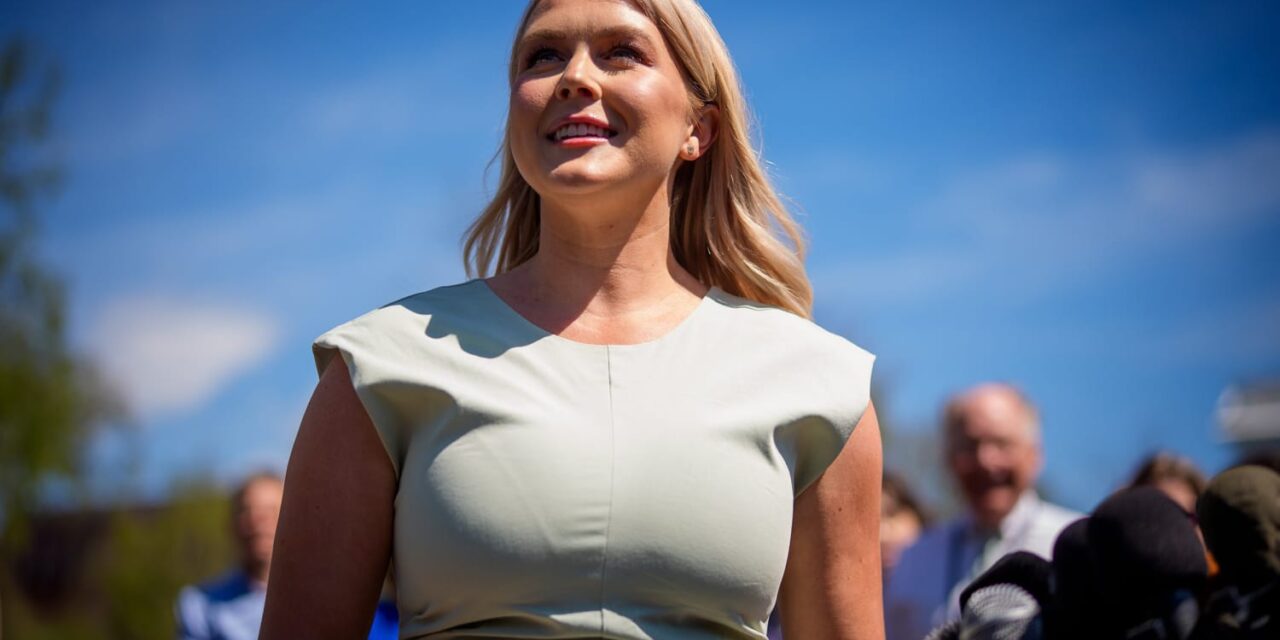
Karoline Leavitt stepped into one of the most combustible White House briefings of her tenure on April 8, tasked with defending a ceasefire that was already showing signs of collapse within hours of being announced, while simultaneously fielding sustained questions about whether the president of the United States had crossed a moral threshold by threatening the annihilation of 95 million people.
The 28-year-old press secretary, the youngest in the role’s history, delivered her responses with characteristic aggression, but the session exposed the limits of political framing in the face of facts that kept changing in real time.
The briefing opened with Leavitt attempting to declare victory over the Iran conflict, describing how Operation Epic Fury had struck more than 13,000 targets, destroyed more than 150 naval vessels and eliminated the vast majority of Iran’s drone and ballistic missile infrastructure over the course of 38 days of combat. She described the resulting ceasefire as confirmation of the president’s negotiating genius and credited his escalatory Truth Social posts with forcing Iran into the agreement.
“It was a very, very strong threat from the president of the United States that led the Iranian regime to cave to their knees and ask for a ceasefire and agree to reopening the Strait of Hormuz,” Leavitt told the room. “So it was a very strong threat that led to results. As the Secretary of War stated at the Pentagon this morning, it was not an empty threat by any means. The Pentagon had a target list that they were ready to hit go on at 8pm last night, if the Iranian regime had not agreed to open the Strait, which they did.”
The room was not willing to move past the civilisation threat without a confrontation. The Independent’s Andrew Feinberg was the first to raise it directly, noting that when the United States invaded Iraq in 2003, George W. Bush had explicitly framed the military action as directed against the Iraqi government rather than the Iraqi people, and asking how Trump’s threat to eliminate an entire civilisation could be reconciled with America’s self-image as a moral leader.
Leavitt’s response was immediate and uncompromising. “The president absolutely has the moral high ground over the Iranian terrorist regime, and for you to even suggest otherwise is, frankly, insulting,” she said. She then cited five decades of Iranian hostility toward the United States and its military as the context in which the president’s rhetoric should be evaluated.
The New York Times’ Katie Rogers attempted the same line of questioning from a different angle moments later, asking whether the president saw the United States as a moral leader given his language. Leavitt cut her off before she finished the sentence.
“I was asked this exact same question by your colleague Andrew in the back. And I think, again, the insinuation by anyone in this room that Iran somehow has the moral high ground is insulting.” The briefing room exchange was captured on video and widely circulated, drawing significant attention on social media for both the forcefulness of Leavitt’s delivery and the substance of what she was being asked to defend.
The more fundamental problem for Leavitt was that the ceasefire she was defending was already fraying. Reuters correspondent Trevor Hunnicutt confronted her directly, reporting that air defences had been activated in Iran and explosions had been heard in several cities including Isfahan despite the agreement being less than 24 hours old. “Who is bombing Iran right now?” Hunnicutt asked. Leavitt visibly paused.
“Obviously, I’ll have to go back and check with the national security team. I’m standing out here with all of you. But I will do that, and we will get you an answer,” she said. The admission that she was unable to verify whether the ceasefire was still operative while standing at the podium defending it was the session’s most damaging moment for the administration’s credibility.
Iran’s parliamentary speaker, Mohammad Bagher Ghalibaf, had also accused the US of violating three separate elements of Iran’s ten-point ceasefire proposal, including Israel’s continued attacks on Lebanon, the entry of a drone into Iranian airspace, and what he described as denial of Iran’s right to enrich uranium.
Leavitt responded by questioning whether Ghalibaf understood English properly, echoing a comment JD Vance had made the same day. It was a response that raised eyebrows even among observers broadly sympathetic to the administration, given that the Iranian official was commenting on a document his own government had submitted.
Leavitt also addressed NATO in the same briefing, confirming that Trump was still actively discussing the possibility of US withdrawal from the alliance in the context of what she described as NATO members’ failure to support the Iran operation. She said NATO Secretary-General Mark Rutte was due at the White House that afternoon and the question would be raised in those talks. When asked about Iran potentially charging fees for Strait of Hormuz passage, she described any such arrangement as unacceptable and incompatible with the ceasefire terms, despite reports that the deal itself may have contemplated exactly such a fee structure.
