
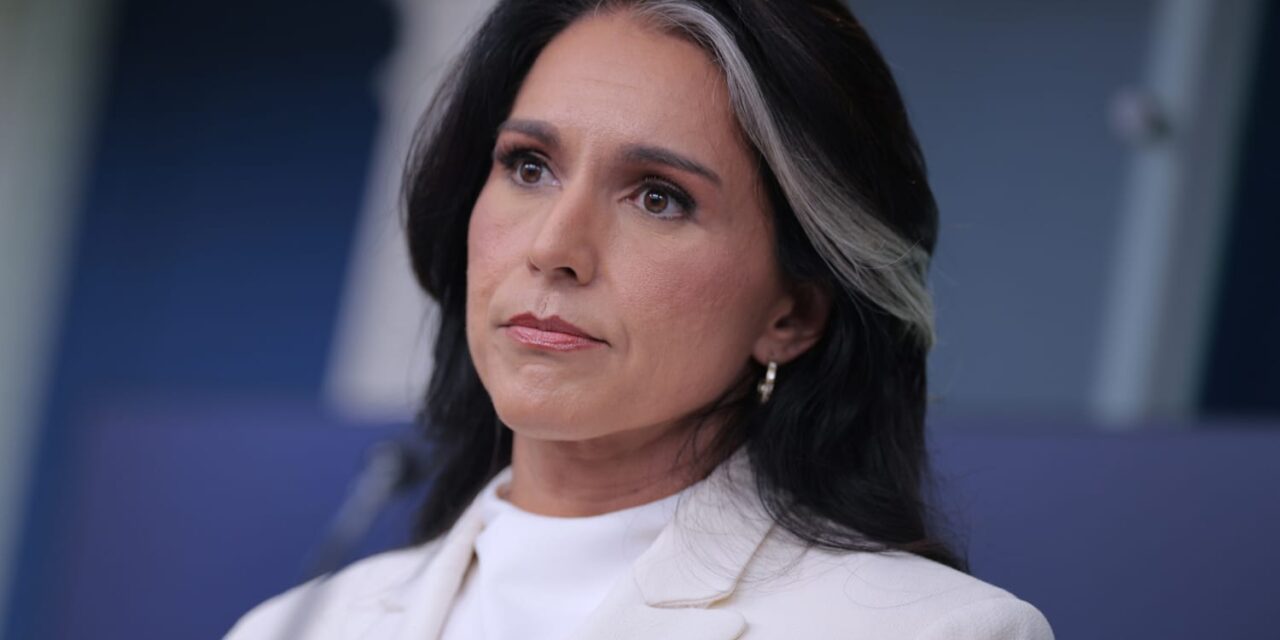
Tulsi Gabbard’s position as Director of National Intelligence was closer to the edge than the White House has publicly acknowledged, with reporting from Axios revealing that it was veteran Republican operative Roger Stone who intervened directly with President Trump to persuade him against firing the intelligence chief.
The episode offers a rare and unusually candid window into how personnel decisions at the highest levels of the Trump administration can pivot on informal back-channel conversations rather than formal institutional processes.
Trump had grown visibly displeased with Gabbard in the weeks following her congressional testimony on the annual worldwide threats assessment, during which she declined to endorse the Iran war with the kind of enthusiasm the president expected. The tension was sharpened by the resignation of Joe Kent, Gabbard’s former counterterrorism director, who quit in a headline-grabbing public departure and argued in his resignation letter that Iran “posed no imminent threat to our nation” and that the war had been initiated under Israeli pressure rather than a genuine assessment of danger to the United States.
According to five advisers and confidants who spoke with Axios, Trump scolded Gabbard in a private meeting shortly afterwards and questioned her loyalty over her failure to publicly condemn Kent’s position. The incident occurred at a moment of acute sensitivity — just before a major congressional hearing — and the administration’s internal view was that Gabbard’s handling of the situation had undermined the message campaign around Operation Epic Fury’s justification. Two other sources told Axios that Trump’s mood in the meeting was more sarcastic than furious, but the political damage was real regardless.
Stone, who has known Trump since 1979 and whose informal access to the president is widely described as unlike that of any other adviser in Washington, reportedly made the case for keeping Gabbard on four distinct grounds. He argued that she had been loyal, had conducted herself professionally in testimony and had never directly disputed the president’s positions.
He emphasised that she had not resigned like Kent and therefore did not deserve to be fired. Stone also warned that dismissing her would generate a damaging news cycle and — perhaps most pointedly — that firing her could transform Gabbard into a martyr figure within the segment of Trump’s base already uneasy about the Iran conflict, potentially positioning her as a credible Republican challenger in 2027 or 2028. “Roger sealed the deal. He saved Tulsi,” a source familiar with Trump’s thinking told Axios.
Stone confirmed on the social media platform X that he had intervened on Gabbard’s behalf, writing that he had “acted in time,” though he declined to comment directly to Axios on the substance of what he told the president. The White House, for its part, has maintained publicly that Gabbard’s position was never in serious jeopardy. Press Secretary Karoline Leavitt stated that Trump “believes Tulsi Gabbard is doing an excellent job on behalf of the administration. She is a key member of his national security team.” An ODNI spokesperson added that Gabbard “remains committed to fulfilling the responsibilities the President placed in her.”
The episode fits a broader pattern in the second Trump term where the boundary between formal cabinet authority and informal loyalist intervention is frequently blurred.
Gabbard is not the first senior official whose fate has apparently been shaped by conversations held outside the standard chain of command, and with Pam Bondi already fired as attorney general and Kristi Noem dismissed from the Department of Homeland Security in early March, the appetite within Washington’s media and political circles to identify who comes next has been considerable.
The intelligence dimension of this story carries its own significance that extends beyond personnel gossip. Gabbard’s congressional testimony included a written report asserting that Iran had made “no efforts” to rebuild its nuclear enrichment program following the 2025 US strikes — a finding she was notably reluctant to repeat verbally in the Senate hearing itself, creating an uncomfortable public record of the gap between what intelligence agencies formally assess and what the administration chooses to emphasise.
That gap is precisely the kind of institutional friction that has led multiple lawmakers from both parties to press for clearer answers about what the president was told and when in the weeks before Operation Epic Fury began.
For now, Gabbard retains her role, and the ceasefire’s fragile dynamics give the administration more pressing preoccupations than a DNI reshuffle. Whether she survives the rest of 2026 with the Iran situation unresolved and a midterm election approaching may depend as much on future interventions from Stone and others as on any formal evaluation of her performance.
