
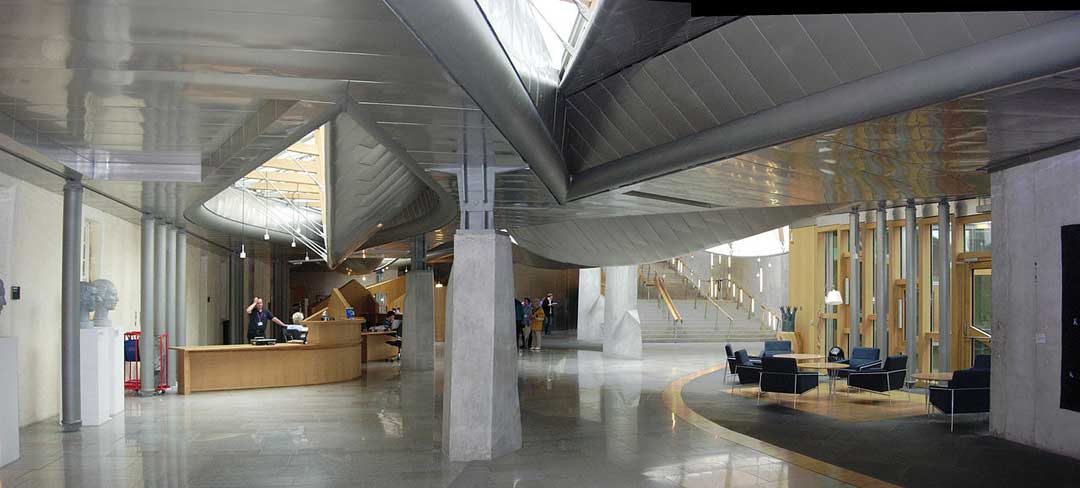
Sarah Williams Goldhagen explains in “Welcome to Your World: How the Built Environment Shapes Our Lives” how architecture subconsciously impacts us.
[amazon]
Of all the factors that impact our lives in major ways, with ripple effects into all corners of human existence, the question of how we build our built environment receives impressively little attention. We’re far more likely to hear what can be done with sleep, diet, switching to a civilized healthcare system, emphasizing education rather than incarceration, creating a sustainable local economy, or investing in trains instead of wars. OK, you won’t hear much about that last one, but you’ll hear even less about the impact of architecture on your physical and mental health.
 Sarah Williams Goldhagen’s book, Welcome to Your World: How the Built Environment Shapes Our Lives makes the case that buildings and urban spaces impact us whether we pay any attention to them or not — and impact us for the worse because we pay so little attention. She cites studies to document that people are actually more open to creative new concepts when they are in rooms with higher ceilings, that good design can create positive emotions and consequently positive human relations, can improve our physical health, childhood development, intelligence, life expectancy, and creativity.
The elements of a built environment that Goldhagen points to as impacting these things include visual elements, color, light, and the form of a structure, but also sound, smell, texture, materials, temperatures, incorporation of nature, and natural materials and forms, integration of architecture with landscape design, and the degree of crowding or lack thereof.
While a shack built of found materials in the median of a highway can be improved only so much, and a McMansion designed by a realtor can be only so horrible, Goldhagen makes a case that what she is advocating is not as much a question of cost as one might think, that better designs can cost as little as worse ones in many cases, and that today’s technologies make it far easier than it used to be to create buildings with well-designed and curving and irregular shapes rather than simple boxes.
It seems to me that we ought to be struck by and resentful of the fact that most new automobiles are created with well-designed and complex forms, while a Frank Gehry building still stands out as a sort of freak creation in the realm of permanent structures. There are many car bodies that, if I could enlarge them to the proper scale, I would much rather live or work in than in most buildings being put up in U.S. cities, towns, and sprawl. Goldhagen’s book provides numerous examples of good and bad design from around the world.
What does she propose that we do about it? She suggests that everything built be designed by a properly trained designer — a project that certainly cries out for an organization to get behind it and begin drafting legislation, codes, and standards. She also proposes that the lessons in her book be taught in design schools, and that the public at large learn these lessons so as to overcome the common preference for the familiar, which Goldhagen argues can sometimes override a preference for the demonstrably better.
Goldhagen’s arguments claim to rest on a body of knowledge that I lack any ability to judge because it’s neuroscience and I’m not a neuroscientist. However, I will dare to state what seems available to the outsider, namely that references to neuroscience are often both less necessary and less definitive than is imagined — and that seems to be the case here.
I think neuroscience is less necessary here than Goldhagen seems to believe, because the impact of the built environment is less inaccessible to our conscious minds than Goldhagen at times suggests. Goldhagen refers to “the cognitive revolution’s complete rethinking of human experience” before citing numerous examples of past architects apparently already understanding the future “revolution.” Our “surroundings,” she writes, “affect us much more viscerally and profoundly than we could possibly be aware of, because most of our cognitions, including those about where we are, happen outside our conscious awareness.” But that concept is not strictly new, and people’s levels of awareness of how the physical world is impacting them seems to vary a great deal, both from person to person and from moment to moment.
Alvar Aalto, Goldhagen writes, “intuited” that looking at a handrail made of wood can create a feeling of warmth. Because he didn’t observe this thought in a brain under a microscope, he merely “intuited” it in his own brain. Frank Lloyd Wright had similar intuitions about hexagonal spaces, Goldhagen tells us.
Many people, Goldhagen writes, dislike Yale’s Art and Architecture building because they “nonconsciously” imagine that its rough surfaces would hurt if brushed up against. That hardly strikes me as a thought that no one could become conscious of — and certainly not after Goldhagen has pointed it out. I also doubt she found it in a laboratory. Similarly, she writes that visitors to a church or a hotel may never become consciously aware of the sounds their feet are making because of the material chosen for the floor. Then again, they may.
I don’t mean to discount Goldhagen’s insights, but I’d like to see people encouraged to expand their awareness, more than to study the brain’s mysteries as taught to them by scientists. Those teachings may be less decisive than is often imagined. To treat a manner in which people experience the world as permanent simply because some of the locations in which it occurs in their brains have been identified, seems like a fallacy to me. Experiences change, and so does brain activity.
Richard Neutra’s theory about how signs of a building’s construction will be experienced by those inhabiting the finished project is “all but confirmed” by the discovery of certain neurons, Golhagen believes. But wasn’t the theory confirmed by Neutra’s clients? And didn’t we know their experience was happening in their brains, as opposed to in some other organ, even prior to naming some neurons?
We’re supposed to learn, as if brand new knowledge, from the “cognitive revolution” that surfaces and materials impact our “nonconscious and conscious cognitions about the built environment.” Fine. You’ll get no argument from me, primarily because I have to run change my kid’s diaper because he has no idea why he’s grumpy. Yes, of course, it’s more complex than that example, I just think there’s a little hyping being added to the insights.
Now, to a more serious problem. Goldhagen uses predictions of population growth and urbanization to predict that by 2050 an additional 2.4 billion people will need spaces built for them to live and work in. I find it hard to believe that any quality of design of which this species is capable can make that level of growth survivable. The accompanying destruction of ecosystems and climate seems insurmountable. That’s no argument for not trying to do the very best job of it possible, with an emphasis on the least damaging construction as well as on the best aesthetics. But it is an argument for putting a huge emphasis on preventing that population expansion.
This article was originally published at DavidSwanson.org on October 23, 2017.
Purchase Welcome to Your World: How the Built Environment Shapes Our Lives from Amazon.com

