
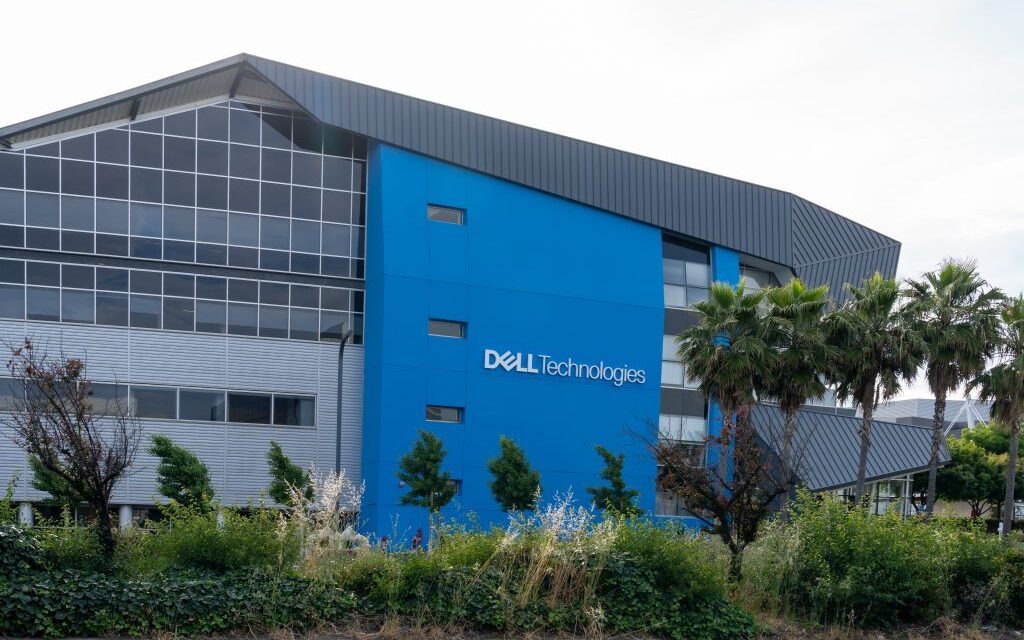
A $132.3 billion order backlog gave investors enough confidence to push Dell Technologies (NYSE: DELL) sharply higher even as reports surfaced of a halt to AI server shipments across parts of Southeast Asia.
The stock closed at $316.96 on the abbreviated Friday session after Thanksgiving, posting a 6.70% advance on roughly 9.25 million shares traded between $297.10 and $317.50.
The rally came despite Thanksgiving Day reports that Nvidia (NASDAQ: NVDA) had instructed partners, including Dell and Super Micro Computer (NASDAQ: SMCI), to suspend server deliveries to Malaysia, Singapore, Thailand, and Indonesia while the chipmaker conducts export compliance reviews.
The suspension stems from a U.S. licensing requirement that took effect November 19, covering advanced AI chip shipments to those four countries as well as Brazil.
Buyers in the affected markets were notified that their orders would not be fulfilled, though it remained unclear whether the halt is temporary or open-ended, and none of the three companies had issued public statements by Friday evening.
Singapore’s Deputy Prime Minister Gan Kim Yong acknowledged the uncertainty, saying “We are in the process of engaging our businesses,” without confirming whether a formal stop was in place.
A ratings agency separately warned that the regulatory environment could cause Asia-Pacific data center investment to “slow and become more selective,” adding a longer-term shadow over regional AI infrastructure spending.
Dell’s enormous backlog, built from $60.2 billion in AI orders booked during the third quarter of fiscal 2027, means a regional shipment delay pushes revenue into future quarters rather than eliminating it entirely.
Third-quarter results reported November 24 showed total revenue of $54.9 billion, up 103%, while AI-optimized server revenue surged 291% to $22.0 billion, and full-year guidance was lifted to $202.0 billion from a prior $192.0 billion.
Vice Chairman and COO Jeff Clarke underscored the trajectory, stating “Demand continues to accelerate and broaden globally,” a comment that investors appeared to weigh heavily against the near-term compliance disruption.
The broader technology market also advanced, with the PHLX Semiconductor index climbing 4.69%, the Nasdaq Composite rising 2.31% to 24,129.50, and the S&P 500 adding 1.60% to 7,297.49.
Hewlett Packard Enterprise (NYSE: HPE), with a market value of $56.27 billion, gained 4.75% to $42.76, while Nvidia itself rose 0.80% to $150.49 despite being at the center of the compliance issue.
Super Micro added 1.93% to $23.76, though its position is considered more exposed given its $15.66 billion market capitalization and a November decline of 27.9%, leaving it with less financial flexibility to absorb a prolonged regional freeze.
Dell’s own November trading has been turbulent, swinging from $278.02 on November 20 to a peak of $334.91 on November 23, before retreating to $295.28 on November 24 and $297.06 on November 25.
Despite Friday’s recovery, the stock remains down 25.3% from its October 30 close of $424.30, and sits 46.1% below its September 17 record close of $588.40, although it is still up 151.8% for the full year 2026.
At approximately 9 times forward earnings, the valuation already accounts for meaningful execution risk, and a $25 billion buyback authorization continues to provide share count support.
The most immediate watchpoints are any official statement from Nvidia, Dell, or Super Micro regarding the pause, and whether Monday, November 30, brings any license decision from Washington that could reopen shipments to the affected markets.
