
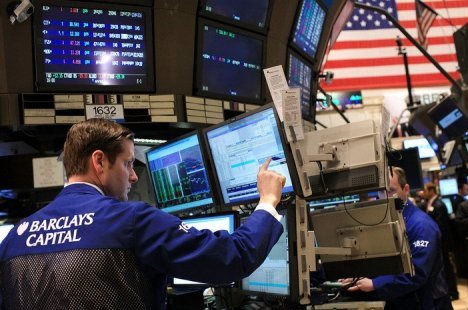
At one point Wednesday, the Nasdaq was down more than 4% on the session, a dramatic slide that threatened to deepen a broader selloff gripping technology and AI-related stocks.
Fresh US tariff proposals compounded anxiety already building from the unwinding of Monday’s sharp rally, which had been triggered by news that Nvidia’s CEO Jensen Huang was reinstated.
Dip buyers eventually moved in, drawn by signals of resilience in the American economy, pulling major indices well off their session lows by the closing bell.
The Dow Jones Industrial Average finished as the day’s standout, climbing 164.25 points, or 0.33%, to close at 50,182.95, the only major benchmark to end the session in positive territory.
The S&P 500 surrendered 18.31 points, or 0.25%, to settle at 7,182.78, while the Nasdaq Composite shed 147.73 points, or 0.62%, to finish at 23,585.80.
December E-mini S&P futures (ESZ26) declined 0.27%, and December E-mini Nasdaq futures (NQZ26) dropped 0.72%, reflecting continued caution heading into the next session.
Among S&P 500 sectors, technology and consumer discretionary each fell roughly 1%, dragging on the broader index, while materials and real estate posted gains and provided some ballast.
The session underscored a clear rotation away from growth-oriented positions, with the Russell 1000 value index rising 0.4% even as the Russell 1000 growth index slipped 0.8%.
Chipmakers bore the brunt of the damage, with Lam Research tumbling more than 7% to rank as the worst performer across both the S&P 500 and Nasdaq 100, and SanDisk losing more than 6%.
Global bond markets reflected the risk-off tone that dominated much of the day, with the 10-year UK Gilt yield dropping to a two-week low and both the German Bund and Japan’s JGB yields retreating to two-and-a-half-week lows.
Treasury notes pulled back from their session highs as equities recovered some ground, reducing the immediate appetite for safe-haven assets and easing pressure on fixed income.
Japan’s Nikkei Stock Index offered a sobering international backdrop, closing down 2.78% as the global rout in technology weighed heavily on Asian markets.
The day’s trading pattern illustrated a market caught between genuine economic optimism and persistent unease over AI valuations and the trajectory of US trade policy.
