
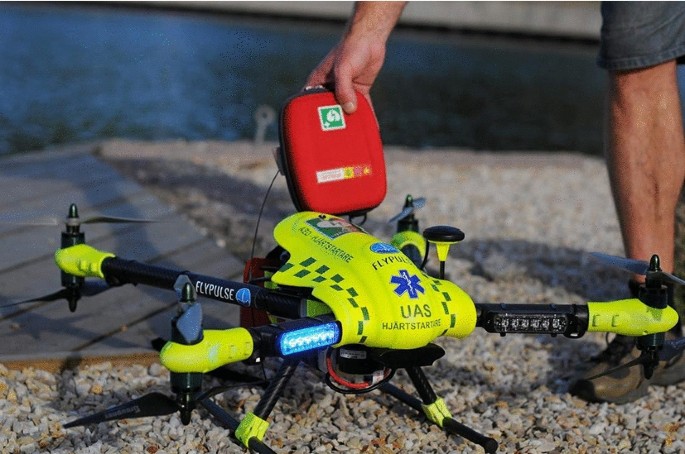
In just over three minutes, a drone changed what survival from cardiac arrest could look like, and American emergency planners are taking note.
That moment came in Trollhattan, Sweden, where a 71-year-old man named Sven, who had a history of heart failure, collapsed in cardiac arrest while shoveling snow outside his home.
A doctor who happened to be passing by immediately began CPR while Sven’s wife placed a call to emergency services, buying him the critical minutes his heart could not.
Within just over three minutes of dispatch, a drone landed carrying an automated external defibrillator, a device capable of analyzing heart rhythm and delivering an electric shock to restore a normal heartbeat.
The case was documented in a report published in the New England Journal of Medicine in 2022, and it has since become a reference point in debates over how drones could reshape emergency medicine.
Now, five years after Sven’s cardiac arrest, the United States is beginning to test whether that kind of response can be replicated at scale through its own pilot programs.
Those programs authorize drones to transport a range of critical medical items, which can include defibrillators, medicines, and blood, directly to the scene of emergencies.
The logic driving this expansion is straightforward: in cardiac arrest cases, every minute without intervention significantly reduces a patient’s chance of survival.
Traditional emergency response times in many American communities, particularly in rural or congested urban areas, frequently exceed the window in which an AED can make a decisive difference.
Drone delivery systems, if proven reliable, could effectively compress that window, placing life-saving equipment in the hands of bystanders before a paramedic unit arrives.
The Swedish case demonstrated that the technology is operationally viable, but scaling it across a country as geographically and logistically complex as the United States presents a distinct set of regulatory and infrastructure challenges.
Pilot programs represent the current frontier of that effort, with operators and regulators working to determine which emergency scenarios benefit most from aerial medical delivery.
Blood transport is among the more logistically sensitive applications under consideration, given the temperature and handling requirements that make it more complex than delivering a packaged defibrillator.
As these programs gather data and public health researchers track outcomes, the question is no longer whether drones can deliver emergency medicine, but how quickly American systems can be built to make it routine.
