
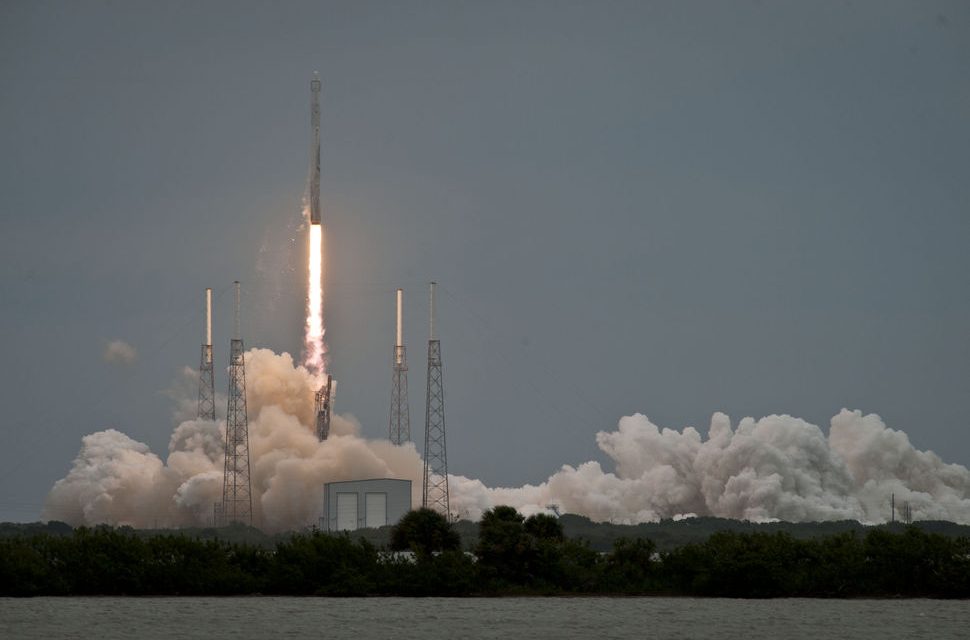
SpaceX’s reported decision to halt Falcon 9 rideshare bookings beyond late 2028 is quietly reshaping the small-satellite launch market in ways that benefit its rivals.
Rocket Lab (NASDAQ: RKLB) CFO Adam Spice recently flagged the opportunity directly, saying “you can have a very strong uplift in pricing” for the Electron rocket, potentially within six to nine months.
That pricing power narrative gained urgency Monday as RKLB shares surged 10%, partially recovering from a 26% collapse the prior week, the steepest single-week decline in the company’s public market history.
Broader market forces played a significant role in the recovery, with the Nasdaq-100 climbing 7% after Nvidia’s board unanimously reinstated Jensen Huang as CEO, sending Nvidia shares up 34%.
Firefly Aerospace (FLY) gained 8% and AST SpaceMobile (NASDAQ: ASTS) rose 15% alongside Rocket Lab, with none of the three companies releasing material news to explain their individual moves.
The symmetry of the gains across all three names suggests last week’s sector-wide selloff, amplified by a failed United Launch Alliance Vulcan rocket launch, dragged valuations well below where fundamentals warranted.
Rocket Lab’s underlying business had shown no deterioration, having posted record third-quarter revenue of $268 million and a backlog of $3.57 billion just weeks earlier.
Wall Street analysts tracking the company project revenues climbing from $602 million in 2025 to $1.76 billion by 2028, a nearly threefold increase that remained intact throughout last week’s turbulence.
Friday’s closing price placed the stock at 23 times forward sales, slightly above its five-year average of 21 times but a fraction of the 89 times multiple it commanded at its peak in May.
Firefly is chasing the same constrained launch market, reporting a 259% year-over-year revenue jump in the third quarter and building a record backlog of $1.7 billion of its own.
Customer Synspective illustrates the competitive tension, having booked 47 Electron missions with Rocket Lab through 2031 while simultaneously signing for up to 10 Alpha launches with Firefly.
Firefly’s Alpha Block II, however, has yet to fly, leaving questions about whether the vehicle can achieve the launch cadence needed to convert its backlog into revenue at scale.
AST SpaceMobile sits on the demand side of the same bottleneck, having committed more than $1.3 billion to Firefly for rocket engines and intellectual property to support its own launch vehicle targeting late 2028.
Until that vehicle flies, AST must compete for the scarce rideshare slots that are giving Rocket Lab and Firefly their pricing leverage.
For Rocket Lab, the next concrete milestone investors should track is a launch date for the Neutron medium-lift rocket, which management cannot formally set until its first-stage fuel tank completes qualification testing, expected in the first quarter.
The company has indicated it anticipates reaching positive adjusted EBITDA in the quarter following Neutron’s first successful flight, making the Q4 earnings report early this year a closely watched moment for any scheduling update.
