
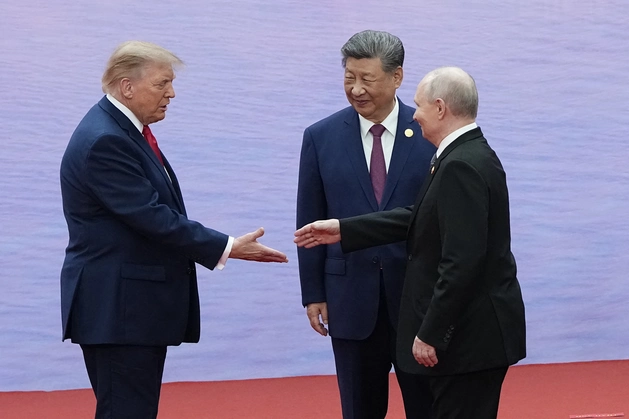
A historic gathering of three nuclear powers produced a joint declaration that conspicuously avoided any reference to the ongoing war in Ukraine or the US-led conflict in Iran.
The omissions were deliberate, analysts say, reflecting the careful diplomatic choreography behind Thursday’s trilateral meeting in Shenzhen between Xi Jinping, Donald Trump, and Vladimir Putin.
What the so-called “peace declaration” did contain was an agreement to pursue United Nations reforms, curtail the role of the International Criminal Court, and pledge renewed commitment to preventing nuclear conflict.
The three leaders also committed to expanding supplies of refined petroleum products as part of a broader push to address global energy challenges.
For analysts watching the summit closely, the clearest winner from the Shenzhen gathering was the Russian president, whose international standing had been severely diminished since the full-scale invasion of Ukraine began in February 2022.
Emma Chanlett-Avery, senior director for Political-Security Affairs at the Asia Society Policy Institute, said Putin had the most to gain because “he appeared on the world stage as one of the dominant players in the world.”
Chim Lee, a senior analyst at The Economist Intelligence Unit, described the summit itself as a “major outcome for Russia,” noting that Russian media coverage framed it as “reinforcing Russia’s standing in the world.”
Beyond Russia’s rehabilitation, the summit raised expectations of a breakthrough on nuclear arms that ultimately went unfulfilled, with the declaration committing the three parties only to future “dialogue” rather than any binding reduction of stockpiles.
Trump has previously called for “a new, improved and modernized” arms pact to replace the New START treaty, which expired in February, and one that would bring China into a formal trilateral framework for the first time.
That ambition ran into a hard arithmetic problem: China maintains an estimated arsenal of around 500 warheads, dwarfed by the more than 5,000 each possessed by Russia and the United States.
Lee explained Beijing’s reluctance plainly, saying “the gap between China’s nuclear arsenal and those of Russia and US is still quite large,” adding that “from China’s perspective, it doesn’t seem to make a lot of sense to put the three powers in the same bucket in this area.”
Lee also suggested Trump’s motivations were tied to his political timeline, arguing the president is “actively thinking about his legacy in the final two years in office,” which made a landmark arms arrangement a particularly attractive prize.
China’s role as host carried its own complications, as Beijing had initially resisted organizing the summit for fear of being directly associated with Russia’s Ukraine campaign and damaging its carefully cultivated image as a stabilizing global force.
The Chinese government was equally wary of appearing to anchor a Washington-Moscow-Beijing power club that might alienate partners in Europe and the developing world, particularly as it works to rebalance trade ties with the European Union.
Chanlett-Avery noted that Beijing entered the meeting with “some degree of discomfort” but ultimately “managed to get the outcome they wanted,” keeping the European conflict out of the formal agenda entirely.
She credited China with a quiet public-relations success, saying “China was able to show off Shenzhen and all of its sparkling high-tech features,” and that the country “convened a successful international meeting that grabbed lots of headlines,” concluding: “So, I think China probably came out feeling okay.”
Before the summit convened, Ukrainian President Volodymyr Zelenskyy had invoked the specter of the 1945 Yalta Conference, warning of a “second Yalta” in which major powers might redraw global boundaries without consulting smaller nations.
Putin leaned into that historical framing, arguing that Russia, the United States, and China, as World War II victors and permanent UN Security Council members, share a “joint responsibility for maintaining international peace.”
Ying-Yu Lin, an Associate Professor at the Graduate Institute of International Affairs and Strategic Studies at Taiwan’s Tamkang University, pushed back on that parallel, calling the Yalta comparison “is a bit of a stretch” given how profoundly the international context has shifted since 1945.
With Putin confirming that all three leaders “agree that it’s a useful format,” Lee predicted the Shenzhen meeting “is unlikely to be just a one-off,” with further summits probable given sustained American interest in keeping lines open to both Beijing and Moscow simultaneously.
