
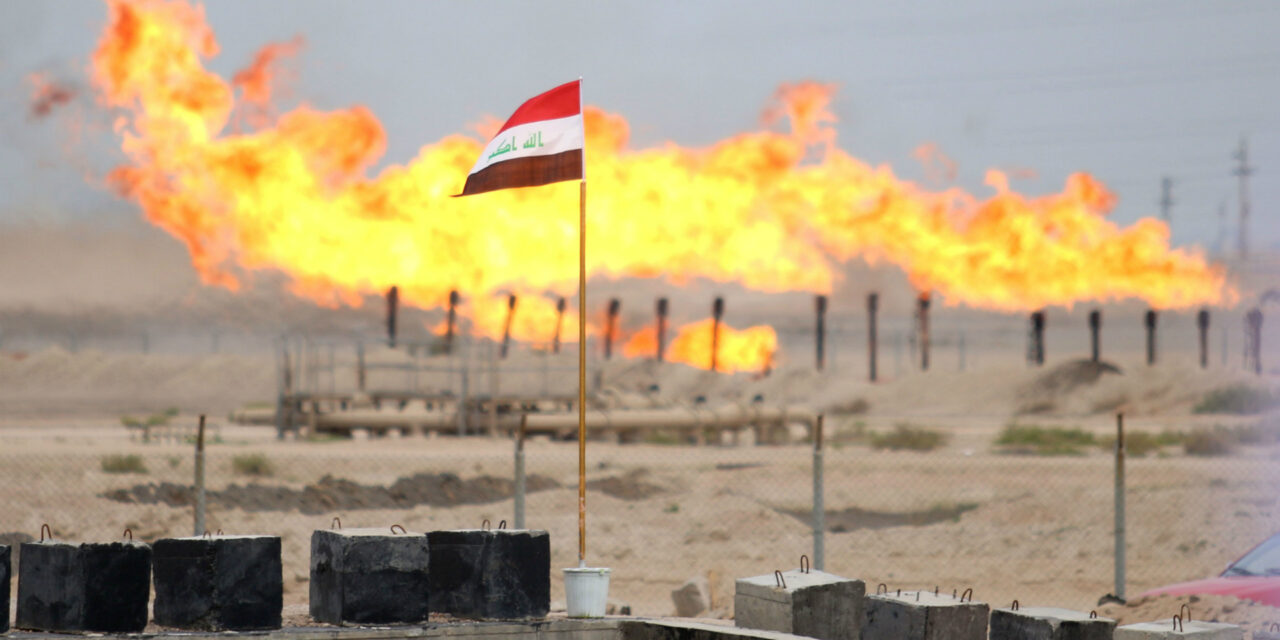
A government report alleging that Kataib Hezbollah siphoned hundreds of millions of dollars in state-owned oil since 2021 has ignited one of Iraq’s most serious internal security crises in over two decades.
The alleged theft, drawn from pipelines near the militia-controlled enclave of Jurf al-Sakhar roughly 50 kilometers south of Baghdad, prompted Prime Minister Ali al-Zaidi to order arrests and issue a withdrawal ultimatum to the group by November 20.
Kataib Hezbollah denied the oil smuggling allegations and flatly refused to comply, with a spokesperson declaring the group would not withdraw “not even over our dead bodies.”
Al-Zaidi responded by ordering state security forces to encircle the area, while the militia reportedly moved reinforcements into position, raising the prospect of open armed conflict between the Iraqi state and an Iran-aligned faction.
Observers quickly framed the confrontation as among the most consequential tests of Iraqi governmental authority against Iranian-backed armed groups in more than two decades.
Jurf al-Sakhar has been off-limits to Iraqi government troops and journalists for roughly 12 years, with allegations of secret prisons, weapons manufacturing, mass graves, and foreign nationals from Iran, Yemen, Bahrain, and Lebanon operating inside its boundaries.
The area, once home to an estimated 89,000 residents, saw its Sunni Muslim population largely displaced after the Islamic State’s rise in 2014, after which Kataib Hezbollah assumed control following the fighting and even renamed the territory Jurf al-Nasr, meaning “bank of victory.”
What makes al-Zaidi’s position particularly complex is that he was nominated to the premiership by the Coalition Framework, the parliamentary bloc that represents the PMF, the umbrella organization under which Kataib Hezbollah’s political party, Harakat Huqooq, operates.
Hayder al-Shakeri, a research fellow at Chatham House, argued that the prime minister’s actions nonetheless carry real weight, telling reporters, “Al-Zaidi appears serious about ending Kataib Hezbollah’s autonomous control of Jurf al-Sakhar. Deploying federal forces and now establishing a new security command there shows this has moved beyond rhetoric.”
Ulf Laessing, who leads the Syria and Iraq project at Germany’s Konrad Adenauer Foundation, offered a more cautious reading, saying, “It is a political signal that things will change, that he [al-Zaidi] wants to disarm militias, integrate them into state and claim back the state’s authority. But it’s a minefield and he needs to navigate carefully.”
Reports from the London-based outlet Amwaj Media suggested fractures are emerging within Kataib Hezbollah itself, with some senior figures open to a phased handover of parts of the area to federal forces rather than a total confrontation.
Reuters, citing three anonymous officials, reported late Thursday that all parties had reached a tentative agreement permitting government forces to enter Jurf al-Sakhar on Friday, suggesting a violent escalation had been narrowly averted.
Al-Zaidi has set a broader deadline of next June to bring all armed factions’ weapons under state authority, a timeline shaped in part by sustained pressure from the United States, whose tensions with Iran under the Trump administration have spilled directly into Iraqi domestic politics.
Whether the reported deal represents genuine progress, however, remains an open question, with al-Shakeri warning that replacing one militia’s control with another PMF faction’s influence would mean al-Zaidi “has redistributed armed influence rather than fundamentally resolved the problem.”
Al-Shakeri identified the central issue as whether any faction can continue exercising territorial and economic control beyond effective government oversight, a question that other Iraqi militias across the country will be watching closely as events unfold.
