
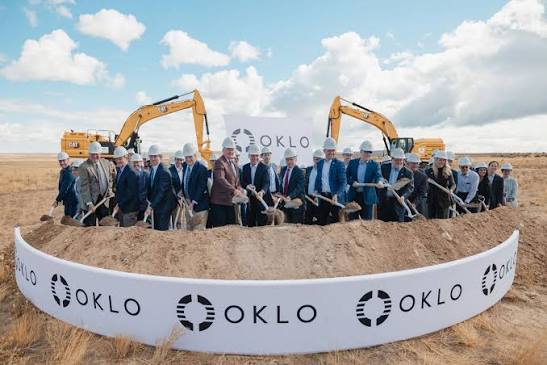
Wall Street’s consensus on Oklo (NYSE: OKLO) has shifted so dramatically that the firm most optimistic on the stock now sits barely above analysts who officially rate it a Hold.
Wedbush analyst Seth Basham reiterated an Outperform rating and a $36 price target on Nov. 9, following Oklo’s third-quarter earnings report, yet that figure is 35% below the Street’s average target.
For context, Citi carries a $33 target and Goldman Sachs a $30 target, both with Hold-equivalent ratings, making Wedbush’s bullish call look more like cautious skepticism by comparison.
The broader analyst community has been in full retreat, with the average price target tumbling from a January peak of $117 to $56 today, after sitting at $65 as recently as Nov. 3.
Since that early November date, Canaccord, Goldman Sachs, and Craig-Hallum have each trimmed their targets further, compressing the range from above and below simultaneously.
Basham himself inherited a $110 target when he took over Oklo coverage on Nov. 3, cutting it immediately to $36, a reduction that signals how sharply expectations for the advanced nuclear sector have recalibrated.
His rationale centers on market mispricing, writing that “OKLO shares, along with the broader advanced nuclear group, trade as if few or no reactors get built,” suggesting the $24 current share price understates the company’s long-term build-out potential.
The financial arithmetic behind that thesis, however, is complicated by Oklo’s aggressive stock issuance, with the company raising $2.3 billion through its at-the-market program during the first nine months of 2026 alone before launching a fresh $1 billion ATM facility on Sept. 11.
Those capital raises have left Oklo holding $3.1 billion in cash and securities as of Sept. 30, against a total market capitalization of roughly $4.7 billion, a ratio that looks comfortable until analyst models project approximately $5.7 billion in cumulative free cash flow burn between 2026 and 2030.
A stock trading not far above its cash pile can continue declining as that cash is deployed and replaced with dilutive share issuances, a dynamic Wedbush’s bull case does not fully address.
Revenue projections offer little relief, with analysts expecting just $4.32 million this year, $9.54 million in 2027, and $39.2 million in 2028, meaning Wedbush’s $36 target implies a multiple of roughly 735 times next-twelve-month sales.
The 2027 per-share loss estimate has also worsened, widening to $1.13 from $0.96 just three months ago, reflecting rising cost assumptions across the sector.
Piper Sandler raised its per-plant construction cost estimate in October to $7,000 per kilowatt from $4,000, a 75% increase that management has not yet addressed with official cost guidance for Aurora-Idaho, Oklo’s first planned power facility.
There were two developments that could shift sentiment: an official Aurora-Idaho cost figure at or below the $7,000-per-kilowatt threshold, or a signed power agreement for the 1.2-gigawatt Ohio campus Oklo is co-developing with Meta.
On a more constructive note, the Energy Department cleared Oklo’s Groves-1 facility for unrestricted operations on Nov. 11, a regulatory milestone that at minimum confirms the technology can move through federal approval processes.
Among the 23 analysts tracked on Oklo by TIKR, the distribution of Buy, Hold, and Sell ratings reflects a community that has grown increasingly divided about whether the company’s reactor ambitions will translate into shareholder returns before further dilution erodes the thesis.
