
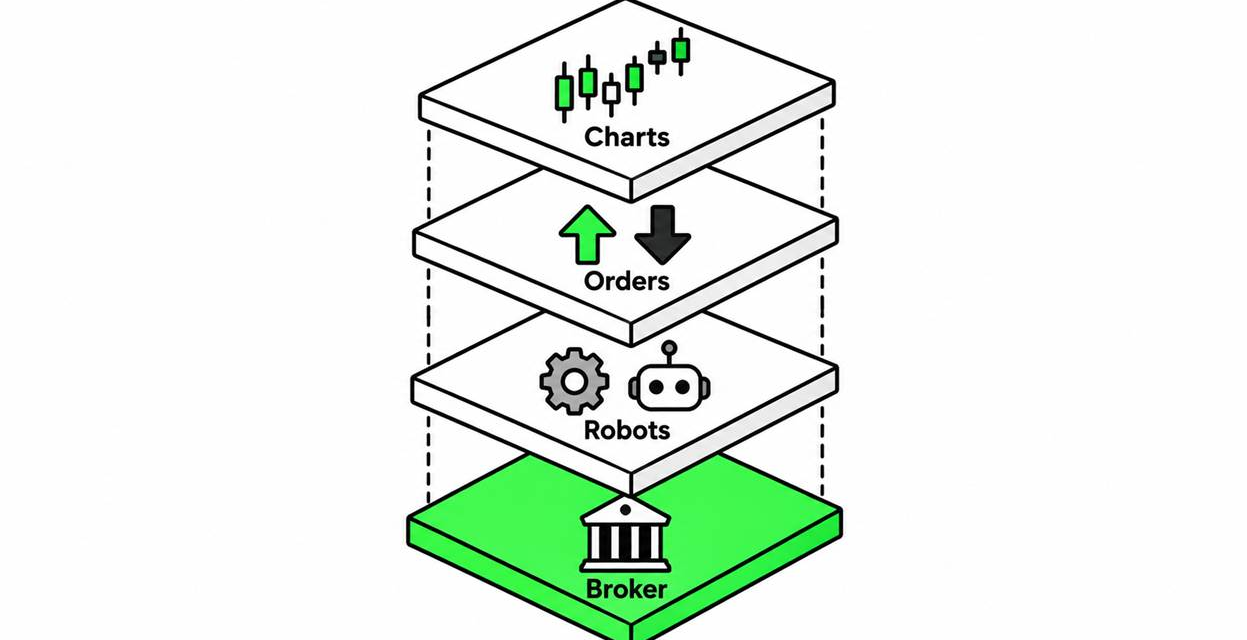
On a crypto exchange, you usually buy the coin, the exchange holds it, and the order book belongs to the exchange. Open an account with an MT5 broker and almost all of that changes. The software is MetaTrader 5, made by MetaQuotes, but the prices, the leverage, the costs and the safety of your deposit all come from the broker you connect it to. For crypto traders curious about trading forex, gold, indices or crypto CFDs through MT5, that distinction matters more than any feature list.
What MT5 is, and what it isn’t
MT5 is trading software. MetaQuotes describes its toolkit as 21 chart timeframes, six types of pending orders and 38 built-in indicators, along with support for both hedging and netting position modes. It also includes MQL5, a programming language for building automated strategies, known as Expert Advisors (EAs), and a strategy tester for running them against historical data.
What MT5 doesn’t do is hold your money or set your trading conditions. Two traders using the same MT5 software can face very different spreads, leverage limits and protections, depending on which broker sits underneath.
Inside one MT5 broker’s offer
Looking at a single provider’s terms shows the questions worth asking. easyMarkets offers MT5 to clients on its South Africa site, where the MT5 broker page lists more than 135 instruments across forex, metals, commodities, indices and cryptocurrencies. It advertises floating spreads from 0.6 pips on selected instruments, no commissions, a US$25 minimum deposit and negative balance protection. Expert Advisors are supported.
Two details deserve a closer look:
- Dynamic leverage. The page advertises up to 1:2000, but the ratio falls as your total position size grows. On major forex pairs, for example, it drops from 1:2000 at the smallest lot tier to 1:50 above 50 lots. The smallest positions get the highest leverage, and that’s where most new traders start.
- The contracting entity. The account is provided by EF Worldwide Ltd, licensed in the British Virgin Islands by the Financial Services Commission. The site says it doesn’t serve residents of several countries, including the United States, and isn’t aimed at residents of Japan or India. Depending on where you live, the account may fall under a Seychelles licence, which the site says has no investor compensation scheme.
None of this is unusual for international brokers, and it’s exactly the kind of small print to read before depositing anywhere.
The habits crypto traders need to unlearn
Crypto exchanges and CFD brokers look similar on screen, but several instincts don’t transfer.
You don’t own anything. A crypto CFD on MT5 is a contract with the broker that tracks a coin’s price. You can’t withdraw it to a wallet, stake it or use it on-chain.
The broker is your counterparty. On an exchange, you trade against other users through an order book. With a CFD broker, your contract is with the broker itself, so its financial strength and licensing matter directly.
Leverage behaves differently from perpetual futures. Crypto traders may be used to liquidation engines on perpetual swaps. On MT5, a broker’s margin call and stop-out levels decide when positions are closed automatically. Check both numbers before your first trade.
Markets have opening hours. Crypto never sleeps, but forex, indices and commodities close at weekends. Positions held over a weekend can open at a very different price on Monday morning, jumping straight past a stop-loss.
Automation cuts both ways. An EA will follow its rules exactly, including during news spikes, thin weekend liquidity or a data feed glitch. A strategy that looked good in the strategy tester can behave very differently in a live market, so run it on a demo account for a meaningful period first.
Frequently asked questions
Is MT5 better than a crypto exchange’s own app?
They do different jobs. An exchange app lets you buy and hold real coins. MT5 lets you trade price movements across several asset classes through CFDs, with more advanced charting and automation.
Can I use my exchange trading bots on MT5?
Not directly. According to MetaQuotes’ platform overview, MT5 automation is built around Expert Advisors written in MQL5, so a bot built for an exchange API would have to be rewritten or connected through separate bridging software.
What should I check first when choosing an MT5 broker?
Find the legal company behind your account and check its licence on the regulator’s own website. Then compare spreads, swap charges, leverage limits, margin call and stop-out levels, and the withdrawal policy.
Does negative balance protection make high leverage safe?
No. It stops your balance going below zero, but you can still lose your whole deposit in one move.
Conclusion
For a crypto trader, the switch to an MT5 broker means trading contracts rather than coins, with a regulated or offshore company as your counterparty. The software is the same everywhere, so judge each broker on licensing, costs, leverage and how it treats clients when markets move fast. Etherions’ checklist for choosing a regulated crypto exchange covers many of the same principles, starting with confirming who actually oversees your account.
Trading CFDs on margin carries a high risk of losing money rapidly. This article is general information, not financial advice.
