
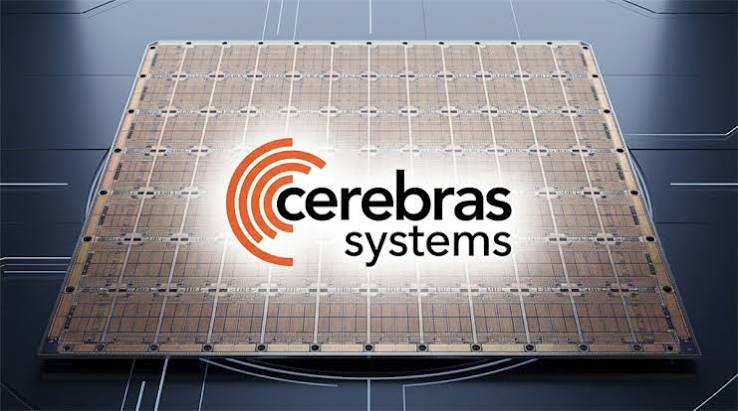
A contractual commitment from OpenAI to purchase 750 megawatts of AI inference capacity through 2028 has sharpened investor focus on Cerebras Systems (NASDAQ: CBRS) as a serious revenue growth candidate.
The deal, struck in late 2025, came alongside a $1.0 billion working capital loan designed to fund Cerebras’s manufacturing expansion, binding one of the world’s most prominent AI labs to a multi-year supply relationship.
Community investor BlackGoat, writing on Simply Wall St, framed the agreement bluntly: “In late 2025, Cerebras signed a transformative Master Relationship Agreement with OpenAI, contractually binding OpenAI to procure 750 megawatts of inference capacity through 2028 and backed by a $1.0 billion working capital loan to fund Cerebras’s manufacturing scale-up.”
Cerebras generates roughly $680 million in semiconductor revenue from its wafer-scale AI compute platform, which includes its CS-2 and CS-3 rack systems, and carries a market valuation of approximately $22.3 billion.
The central question hanging over that valuation is whether the OpenAI arrangement translates into durable margins or merely accelerates near-term revenue before competitive pressure sets in.
At the opposite end of the size spectrum, Forbright (NYSE: FRBT) offers a contrasting growth profile rooted in U.S. middle-market lending and digital consumer banking, with its Banking segment generating $332 million in revenue and a market capitalization of around $951 million.
The bank’s digital deposit platform, still being expanded with new promotional tools and a forthcoming checking product, sits at the heart of its growth thesis, with analysts noting that this infrastructure is “building a lower cost, granular funding base that can support asset growth and influence net interest margin and overall funding costs.”
For Forbright, the unresolved tension lies in how rapid loan book expansion will interact with funding costs as interest rate conditions shift, a dynamic that could either validate or complicate the digital banking model.
Rounding out the group is Tesla (NASDAQ: TSLA), the largest of the three by a considerable margin, carrying a market capitalization of roughly $1.49 trillion and generating $91.3 billion from its Automotive segment alone, with an additional $12.3 billion flowing from Energy Generation and Storage.
Simply Wall St community investor Robbo argued that Tesla’s appeal for growth-focused investors is less about any individual product cycle and more about the breadth of its ambitions, noting that “Tesla is pursuing a range of ambitious and, in some cases, speculative opportunities: AI leadership, robotaxis, humanoid robotics, and battery storage.”
What unites all three companies is a combination of strong insider alignment and revenue growth rates of at least 18%, a pairing that has historically attracted capital in momentum-driven markets.
The broader backdrop feeding appetite for these names is the scale of investment flowing into AI-adjacent businesses, illustrated by Anthropic’s planned IPO, which carries a potential valuation stretching into the trillions and has tens of billions of dollars in prospective capital attached to it.
Whether growth at this pace is self-sustaining or dependent on favorable financing conditions remains the central risk each of these businesses must eventually answer.
