
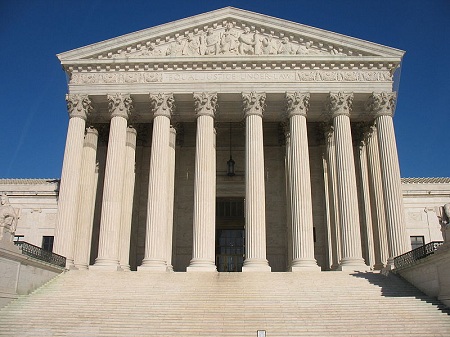
An overwhelming Supreme Court majority has cleared the path for a federally funded border security initiative to resume work across one of Texas’s most protected landscapes.
Backed by $1.7 billion allocated through the One Big Beautiful Bill, the project encompasses more than 500 miles of roads, cameras, vehicle barriers, and sensors stretching through Big Bend National Park.
Portions of the corridor will include a 30-foot border wall, though the Trump administration has stepped back from earlier plans to erect a wall directly inside the park itself.
The court’s lopsided ruling lifted an injunction imposed by a federal judge in Texas, who had suspended construction in October after finding the administration may have violated the Constitution.
At the center of that challenge was the administration’s decision to waive dozens of federal laws in order to accelerate the pace of construction along the remote stretch of border.
The justices rejected that legal theory outright, writing that “there is no such thing as a ‘constitutional’ major-questions claim” and affirming that the government holds “compelling interests” in matters involving border security.
Department of Homeland Security General Counsel James Percival wasted little time celebrating the outcome, pointing to the margin as proof the lower court had badly miscalculated.
“When we filed in the Supreme Court, I called the district court’s order halting wall construction ‘as unprecedented as it is flawed.’ We just won 8-1,” Percival wrote on X.
Environmental groups painted a starkly different picture of Monday’s decision, warning that irreplaceable public land would bear the consequences.
Laiken Jordahl, the Center for Biological Diversity’s national public lands advocate, said: “The Trump administration and its contractors are hellbent on destroying one of America’s greatest national parks, and the Supreme Court just gave them the green light.”
Crews had already moved into the park to clear land ahead of road and infrastructure construction before the October injunction froze activity, triggering protests and multiple legal challenges.
Opposition to the project has come from an unusually broad coalition, including conservationists, regional officials, and even some members of Trump’s own Republican Party.
The border wall push is among the most enduring commitments of Trump’s political career, first introduced as a central pledge during his 2016 presidential campaign and now embedded in a wider framework of mass deportation and immigration enforcement.
The Supreme Court’s emergency intervention ensures that litigation over the project’s legality will continue in the lower courts, even as construction moves forward once again.
