
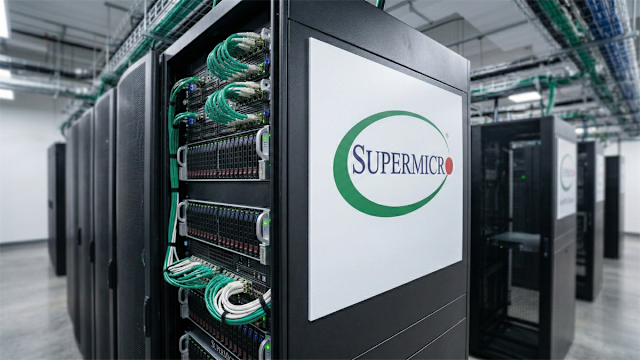
Thursday’s midterm-driven rout left Dell Technologies (NYSE: DELL), Super Micro Computer (NASDAQ: SMCI), and Hewlett Packard Enterprise (NYSE: HPE) each down between 34% and 42% over the prior month, making Friday’s partial recovery look modest at best.
Dell, whose shares touched $596 at their 52-week high, is now trading at $335.36, a 6% gain on the day that still leaves the stock far below where it was trading just weeks ago.
Super Micro has clawed back a similar 6%, putting shares at $28.73, while Hewlett Packard Enterprise is trailing the group with a more modest 2% rise to $44.86.
The November 5 sell-off was triggered by investor concern that Democratic control of Congress, combined with the policy direction of Texas’s incoming governor, could slow the pace of data center construction across the country.
Super Micro CFO Mark Long had flagged the broader industry’s physical limits just days before the political turbulence, warning on the company’s November 3 earnings call that “The binding constraints on AI build-outs across this industry right now are land, power, and data center shelves.”
A stronger-than-expected labor market has helped stabilize sentiment, with the latest jobs report showing 165,000 positions added, giving investors enough confidence to rotate back into beaten-down technology names.
Dell’s fundamental case centers on an unprecedented order pipeline, with the company booking a record $60.9 billion in AI orders during its second fiscal quarter of 2027 and carrying a $95 billion AI backlog into the coming months.
Management responded to that demand by lifting full-year revenue guidance to $192 billion, with AI server revenue alone forecast to reach $74 billion, yet Dell’s free cash flow fell 47% year over year to just $986 million for the quarter ended July 31.
That cash squeeze sits alongside $23.6 billion in net debt and a trailing gross margin of only 19.9%, giving bears enough ammunition to question whether Dell’s backlog will translate into meaningful shareholder returns.
Super Micro’s revenue story is arguably more dramatic, with Q1 FY2027 sales nearly quadrupling to $19.9 billion, though the company’s operations consumed $434 million in cash and inventory climbed past $15 billion ahead of anticipated shipments.
Management raised Super Micro’s fiscal 2027 revenue outlook to a range of $72 billion to $82 billion, and the company has secured an early-mover position by being among the first to ship Vera Rubin NVL72 racks paired with its liquid-cooling stack.
An additional layer of uncertainty surrounds Super Micro’s ongoing independent board review of certain transactions connected to export-control issues, a process that adds governance risk to an already volatile stock.
Concentration risk is another concern, given that a single large data center customer accounted for 44% of Super Micro’s first-quarter revenue, leaving the company exposed if that relationship shifts.
Hewlett Packard Enterprise is recovering more slowly than its peers in part because its revenue mix is more diversified, with triple-digit growth in private cloud AI orders during Q3 FY2026 offset by the heavier weighting of networking revenue following the Juniper Networks acquisition.
The split between AI server names and broader hardware stocks is stark, with HP Inc. (NYSE: HPQ) falling 1% to $29.04 and Cisco Systems (NASDAQ: CSCO) slipping 1% to $94.71 while the server group climbs.
Policy headlines out of Washington and Texas now represent a meaningful near-term catalyst for all three companies, since any signals about data center permitting or power infrastructure could either extend Friday’s recovery or reverse it quickly.
Dell’s next earnings report will be the clearest test of whether its record backlog is converting into cash, while for Super Micro the market will be watching inventory levels and cash consumption as the primary indicators of financial health.
