
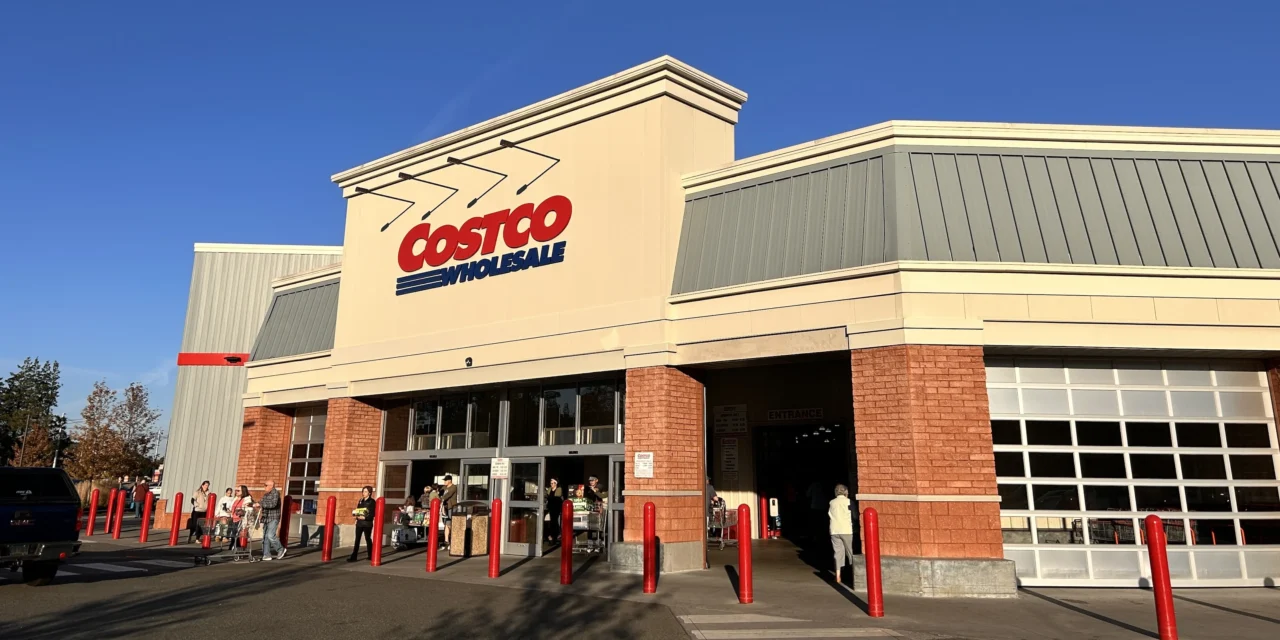
Across three separate Federal Reserve tightening campaigns stretching back to 2004, only one major consumer staples name outpaced the S&P 500 every single time: Costco Wholesale (NASDAQ: COST).
That historical pattern is drawing fresh attention now that prediction markets are pricing roughly 70% odds of another quarter-point rate increase at the Federal Reserve’s December 9 meeting, according to contracts on Kalshi.
The Fed already moved once, lifting its target rate to 4.00% on September 17, 2026, ending a nine-month pause during which rates had been capped at 3.75% since December 11, 2025.
A dividend-adjusted comparison of four consumer staples stocks against the SPDR S&P 500 ETF Trust (NYSEARCA: SPY) across the 2004-2006, 2015-2018, and 2022-2023 tightening cycles reveals a mixed but instructive record.
Costco posted gains of 53.6%, 35.8%, and 8.9% in those respective windows, against S&P 500 returns of 17.5%, 27.9%, and 7.4%, making it the only name to clear the benchmark each time.
Membership loyalty underpins that resilience: fee income climbed 7.3% to $1.85 billion in the most recent fiscal period, the worldwide renewal rate held at 89.8%, and comparable sales advanced 9.4%.
Fiscal 2026 earnings reached $20.76 per share, though investors are already paying a premium of roughly 51 times trailing earnings, and the stock dropped 19.1% during calendar 2022 even as the broader market also declined sharply.
Walmart (NASDAQ: WMT) presents a different kind of tightening-era case, one built on capturing budget-conscious shoppers who trade down from pricier alternatives when borrowing costs squeeze household finances.
Fiscal second-quarter adjusted earnings of $0.81 per share topped the $0.74 consensus estimate, global e-commerce surged 23%, and management raised fiscal 2027 EPS guidance to a range of $2.80 to $2.87, with CFO John David Rainey noting that “customers are making tradeoffs.”
Walmart’s historical returns of -11.4%, 72.5%, and 21.1% across the three cycles show enormous upside potential but also real downside risk, and more than $2 billion in incremental fuel costs above original guidance weighs on near-term margins at a stock already trading at 46 times earnings.
Procter & Gamble (NYSE: PG) offers steadier, if less dramatic, credentials, with a 70th consecutive year of dividend increases marked by its current quarterly payment of $1.0885 per share.
Fiscal first-quarter organic sales grew 4%, volume contributed 2.4 percentage points of that gain while pricing added just 0.4 points, and core earnings per share of $2.00 cleared the $1.89 analyst estimate.
Management flagged a roughly $1.4 billion after-tax commodity headwind and acknowledged that “the industry generally is pricing up” to offset rising input costs, a risk factor that could pressure margins as rates stay elevated.
Shares have gained 17.45% year to date and trade near 24 times the midpoint of fiscal 2027 core EPS guidance of $7.00, making P&G the most modestly valued name among the four on a forward basis.
Coca-Cola (NYSE: KO) delivered perhaps the clearest demonstration of pricing power in recent quarters, with third-quarter revenue rising 7.4% to $13.38 billion as pricing actions contributed 4 percentage points even while global unit case volume expanded 5%.
CEO Henrique Braun argued that the results confirm “the brands have the equity and the right to take price,” and the company lifted its free cash flow outlook to a minimum of $13.0 billion.
KO shares have surged 37.07% year to date and carry a 2.13% dividend yield, though the stock’s P/E of 31 reflects a market that has already rewarded the company’s defensive positioning ahead of any further tightening.
The calendar 2022 comparison remains the starkest argument for staples in a hiking environment: while the S&P 500 fell 18.2% that year, Coca-Cola gained 10.6%, Walmart slipped just 0.5%, and Procter & Gamble dipped only 5.0%.
History does not guarantee a repeat, and with Costco near 51 times trailing earnings and Walmart at 46 times, investors buying protection are paying a meaningful premium for it ahead of the December 9 decision.
