
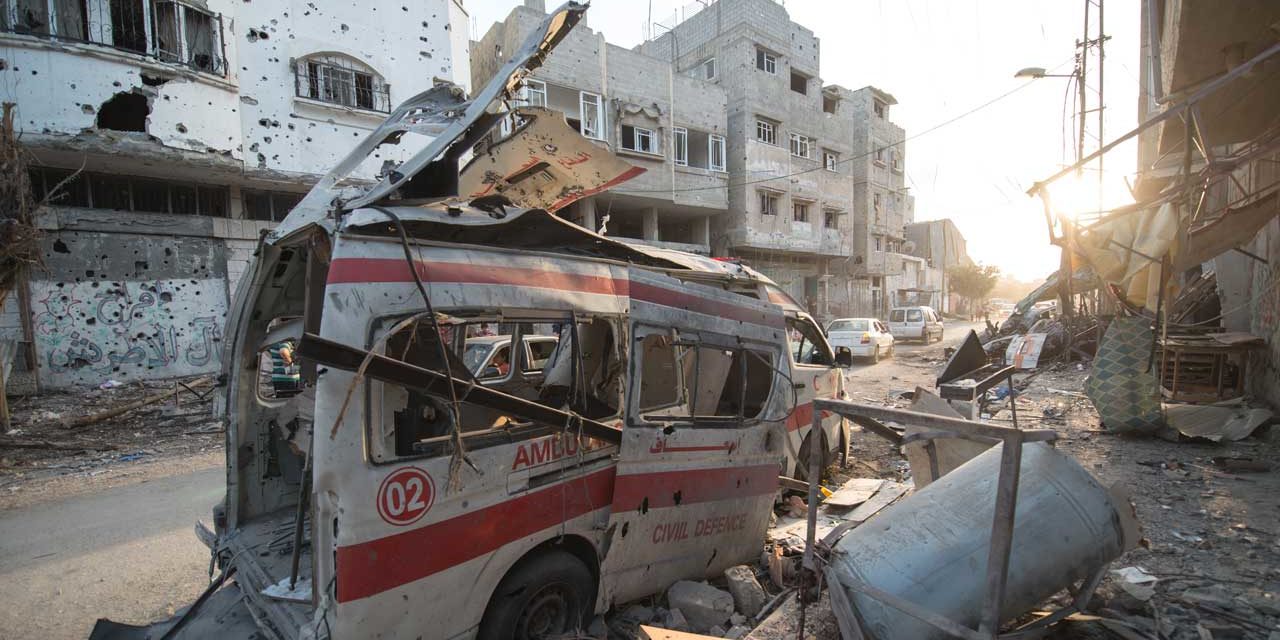
Germany’s Development Minister issued a stark warning about humanitarian conditions in Gaza even as Israel’s election results left the country’s political future deeply uncertain.
Reem Alabali Radovan, speaking from Lebanon where she is currently traveling, told Politico: “Winter is coming, and it will be difficult.”
Her concern centers on the risk that prolonged coalition negotiations in Jerusalem could stall progress on allowing aid organizations greater access to Gaza at a critical time.
Alabali Radovan also addressed a separate flashpoint, speaking out against Israeli settler attacks on Palestinians in the occupied West Bank and East Jerusalem in interviews with multiple broadcasters.
“The radical settler violence must be stopped. The Netanyahu government remains in office on an interim basis, and this means that this situation must still be brought to an end,” she said.
Two days after Israelis went to the polls, no governing majority has emerged, with incumbent Prime Minister Benjamin Netanyahu’s right-wing bloc ahead of the opposition camp led by former military chief Gadi Eisenkot, yet neither side commands a clear path to controlling the Knesset.
One of the more striking results has been the strong performance of Arab-majority parties representing Palestinian citizens of Israel, whose gains could thrust them into a kingmaker role during coalition talks.
Netanyahu’s bloc has flatly ruled out any partnership with those parties, while Eisenkot’s camp has yet to declare whether it would pursue such an arrangement.
United Arab List/Ra’am, which notably ran a Jewish candidate, has already signaled a willingness to back Eisenkot’s bloc as a means of ending Netanyahu’s tenure.
Jürgen Hardt, the Christian Democratic Union’s foreign policy expert in the Bundestag, told DW the outcome could yet produce a workable alternative, saying: “The major campaign carried out by Netanyahu’s camp, aimed primarily against Arab Israelis, greatly mobilized the opposition, to the point where his camp no longer has a majority.”
Hardt added that his preference was clear: “I think it would be best for Israel to form a government that is closer to the center of the political spectrum… But it’s encouraging that so many people participated in the election.”
Berlin has long hoped the next Israeli government would exclude far-right and religious extremist figures, including current Finance Minister Bezalel Smotrich, whose presence in the cabinet has complicated diplomatic relations.
Germany’s official public posture has been restrained, with Foreign Minister Johann Wadephul’s spokesperson Martin Giese declining to offer any assessment at Wednesday’s regular Berlin press conference.
Wadephul himself framed Germany’s stance in terms of historical obligation, stating that “the Jewish state and Germany are inextricably linked by our history, and we will do everything we can to work well with any future government.”
That relationship, rooted in Germany’s responsibility for the Holocaust, has historically made Berlin one of Israel’s closest European allies, though the German government has increasingly distanced itself from Netanyahu’s specific policies in its public statements.
After a major Israeli military operation near Hebron that displaced roughly 3,000 Palestinians following the reported killing of two Israeli soldiers, Wadephul stated plainly that under international law, Israel bears clear obligations to uphold Palestinian rights as well.
Germany has nonetheless maintained that it has no intention of recognizing a Palestinian state in the near term, distinguishing its position from several other European nations.
Omid Nouripour, the Green Party politician serving as vice president of the Bundestag, offered a more optimistic read on the election’s broader meaning, telling DW: “Frankly, after all the turmoil that has occurred — for example, regarding judicial reform — this is good news for Israeli democracy.”
