
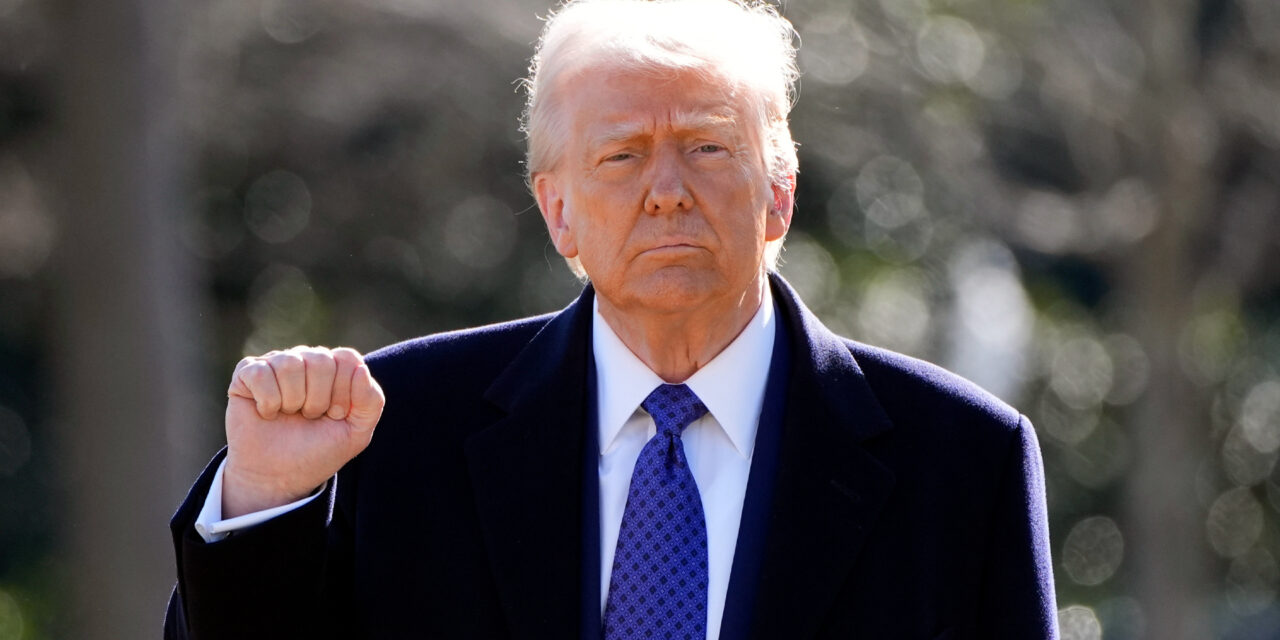
With midterm elections days away, President Donald Trump admitted Friday that he personally directed the Justice Department to file a federal lawsuit targeting Alaska’s Senate race certification process.
“I’m the one that said do it,” Trump told reporters in Florida, claiming direct ownership of legal action that critics have described as an attempt to pre-emptively contest an unfavorable electoral outcome.
The suit, filed late Thursday in federal court in Alaska and citing the National Voter Registration Act, asks that certification be withheld until the government investigates whether ballots cast for a similarly named candidate were actually intended for Republican incumbent Sen. Dan Sullivan.
At the center of the controversy is Daniel J. Sullivan, a retired schoolteacher from Petersburg, Alaska, whose name closely mirrors that of the senator facing Democrat Mary Peltola, a former congresswoman, in the Nov. 3 midterm contest.
Republicans have accused the schoolteacher of running as a deliberate spoiler, though Daniel J. Sullivan has denied any intention to mislead voters or draw support away from the incumbent senator.
Alaska has already moved to reduce potential confusion, listing the senator on the ballot as “Dan S. Sullivan,” identified as a registered Republican and the incumbent, while the other candidate appears as “Daniel J. Sullivan Jr.” with no party designation.
The gap between the two men is also substantial in electoral terms, with the senator having drawn more than 68,000 votes in August’s primary compared to just 4,107 for his near-namesake.
Alaska’s other Republican senator, Lisa Murkowski, publicly broke with the administration on the matter, posting on social media that the state had sufficiently distinguished the two candidates and that the department should never have pursued the case.
Attorney General Todd Blanche appeared on CNN’s State of the Union Sunday to defend the action, telling anchor Dana Bash that the department’s core demand was simply “to not certify if the law is broken,” and that Alaska and its courts would ultimately decide the matter.
Blanche framed the lawsuit as a constitutional question, arguing that an Alaska court ruling that kept Daniel J. Sullivan on the ballot had “explicitly didn’t consider federal law,” leaving the federal government with grounds to intervene.
“It is an obligation of the states to avoid confusion, among other things, confusion in the minds of voters in the election process,” he said, pushing back against characterizations of the suit as politically motivated.
The interview grew sharply contentious when Bash pressed Blanche on comments he had made earlier in the week suggesting the DOJ could intervene in certification in a “doomsday” scenario, and asked whether the Alaska case echoed the events surrounding the Jan. 6 Capitol attack.
Blanche dismissed the comparison with visible irritation, snapping, “Oh, you got to stop it with that. You are not being a real person. Come on, man,” and later calling it “so embarrassing” for CNN that the Jan. 6 comparison had been raised at all.
On the question of whether the administration was building a mechanism for Trump to challenge results he disliked, Blanche was categorical, stating, “President Trump is not trying to take over a state election in any way, shape, or form.”
The lawsuit was signed by Associate Attorney General Stanley Woodward, who, before joining the department, represented a number of individuals accused of taking part in the Jan. 6 assault on the Capitol.
The Justice Department has yet to explain how it would determine voter intent in any post-election review, given that ballots in American elections are cast in secret, a fundamental tension the suit does not appear to resolve.
The Alaska seat is considered crucial to Republican efforts to hold a Senate majority through the remainder of Trump’s second term, providing an obvious political backdrop to the administration’s sudden legal interest in the state’s electoral mechanics.
