
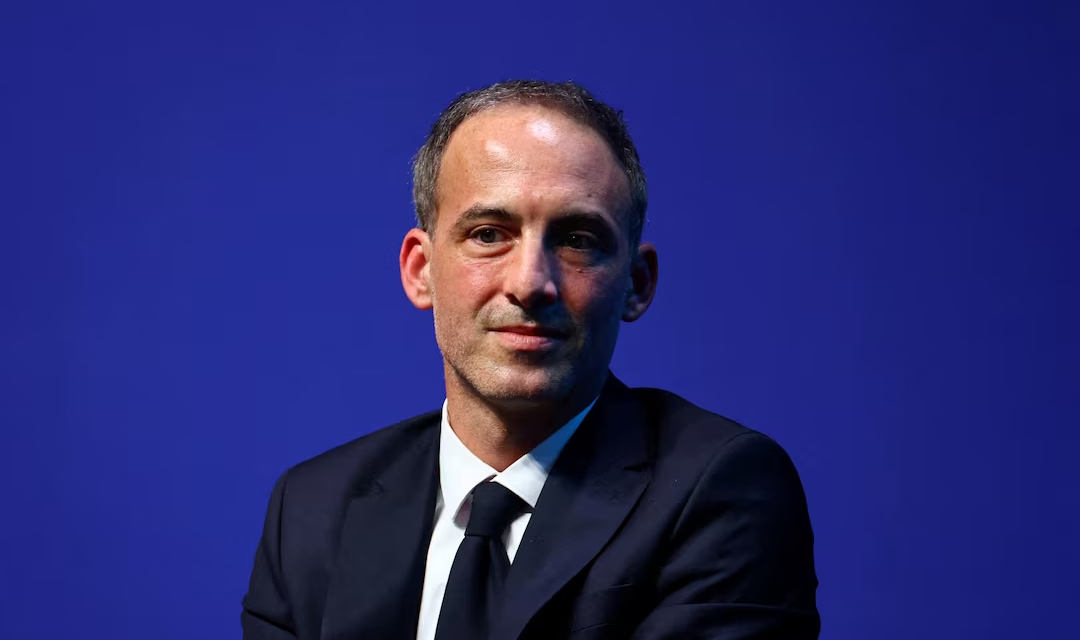
Raphael Glucksmann, a member of the European Parliament for France’s center-left Socialists, claimed victory in the party’s presidential primary on October 11 in the gentrified Parisian neighborhood of Belleville.
The 46-year-old son of philosopher and essayist Andre Glucksmann triumphed in the first round with a convincing 66% of the vote, skipping the anticipated second round entirely.
His victory celebration was marred when an unidentified assailant flour-bombed him as he left the Cantine de Belleville restaurant, immediately drawing attention to the deep divisions on France’s political left.
The following morning, Glucksmann called on far-left populist Jean-Luc Melenchon to condemn attacks carried out by his supporters, though it remains unclear whether the flour-bomber was in fact an LFI affiliate.
Glucksmann’s decisive primary win is widely interpreted as a vote in favor of a clean break with Melenchon’s La France Insoumise movement, rejecting the more conciliatory position held by Socialist Party leader Olivier Faure.
His candidacy drew criticism from former presidential contender Segolene Royal, who compared his bid for the Elysee to that of an “intern” wanting to take charge of a company, citing his lack of government or local executive experience.
A poll by Toluna Harris Interactive, published the day after his primary win, projects Glucksmann would take just 10 to 11% of the vote in the presidential election, while Melenchon sits at 18%.
That figure would still represent a significant improvement over the Socialists’ disastrous 2022 showing, when their candidate Anne Hidalgo received just 1.75% of the national vote.
Complicating matters further, Glucksmann is not even a member of the Socialist Party, belonging instead to a small center-left movement called Place Publique.
The challenge of winning over young voters looks particularly steep, with an Ipsos survey from September showing Melenchon commanding 41% support among French voters under 25, compared to 20% for Marine Le Pen’s far-right nationalist camp.
Melenchon has been actively rallying alongside students whose protests have drawn international attention, expressing solidarity with their movement at a gathering near Clermont-Ferrand and reiterating calls to lower the voting age to 16.
Political scientist Antoine Bristielle, writing for the Socialist-aligned think tank Fondation Jean-Jaures, identifies a distinction between committed LFI loyalists and the broader left-wing electorate that Glucksmann could theoretically reach.
Melenchon’s most loyal base, Bristielle notes, tends to be young, educated city-dwellers under severe financial pressure, with four in ten households in this group living on a net monthly income of less than 2,000 euros.
Bristielle estimates that just under a third of the left-wing electorate cares more about securing a left-wing victory than remaining loyal to any one party, and almost half of this group is under 35.
Glucksmann has put forward a platform that includes reducing France’s CSG social security tax on earned income while raising taxes on inheritances worth more than 2 million euros.
On foreign policy, he presents himself as a committed pro-European and a firm supporter of Ukraine, contrasting sharply with Melenchon, who has described the EU as a neoliberal institution and whose LFI MPs voted against the French-Ukrainian security agreement in 2024.
LFI MEP Manon Aubry has stated that her party supports military assistance to Ukraine only under specific conditions, including that aid must not enable strikes deep inside Russian territory and must not weaken France’s own defense capabilities.
The political fault lines were on display again when LFI MP Sebastien Delogu posted a declaration of support on X for the taxi driver who would have to clean up after the flour attack on Glucksmann.
Gender dynamics among young French voters add another layer of complexity, with political scientists Anja Durovic, Nonna Mayer and Noemie Piolat finding that young French women were not significantly more likely to vote left or less likely to vote far-right than men of the same age in the 2024 elections.
Glucksmann’s path to the Elysee ultimately hinges on his ability to peel away a substantial portion of Melenchon’s voter base, a task that is likely to prove far more difficult than simply drawing a line between himself and his rival.
