
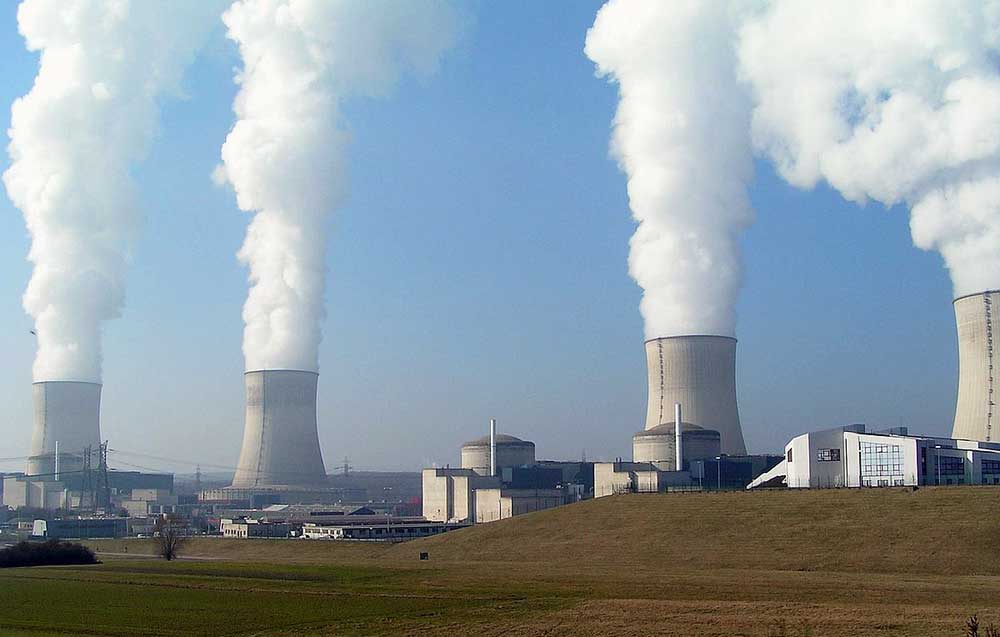
Nuclear energy stocks have endured punishing losses over the past year, even as technology giants pour billions into securing nuclear power for AI data centers.
The Global X Uranium ETF (NYSE: URA) has shed more than 20% over the past 12 months, while the Energy Select Sector SPDR Fund (NYSE: XLE) posted gains exceeding 40% over the same period.
Investors have grown increasingly wary of valuations, financing requirements, and the long development timelines facing companies that generate little to no meaningful commercial revenue.
NuScale Power Corp. (NYSE: SMR) has collapsed roughly 82% over the past year, Oklo Inc. (NYSE: OKLO) has fallen around 75%, and Nano Nuclear Energy (NASDAQ: NNE) is down nearly 68%.
All three are developing technologies designed to meet enormous future demand for nuclear power, but the market is no longer willing to pay a steep premium for revenues that remain years away.
Uranium fuel suppliers and miners have fared little better, with Centrus Energy Corp. (NYSE: LEU) dropping roughly 62%, Uranium Energy Corp. (NYSE: UEC) falling around 32%, and BWX Technologies (NYSE: BWXT) losing approximately 27%.
For investors seeking nuclear exposure without the risk of pre-commercial developers, established utilities present a compelling alternative, already generating and selling nuclear electricity to some of the largest customers in the market.
NextEra Energy Inc. (NYSE: NEE), the world’s largest electric utility holding company by market capitalization, operates seven nuclear units across four locations, generating over 6,000 megawatts of carbon-free electricity through its subsidiaries.
NextEra is currently working to restart its 615-megawatt Duane Arnold Energy Center in Iowa, backed by a 25-year power purchase agreement with Google (NASDAQ: GOOG) and a $1.9 billion Department of Energy loan, with operations targeted to resume in early 2029.
The company is also evaluating adding up to six gigawatts of new small modular reactor capacity at existing nuclear sites or greenfield locations to serve the surging power demands of artificial intelligence data centers.
Constellation Energy Corporation (NYSE: CEG), the largest producer of carbon-free energy in the United States, operates a generation fleet of approximately 55 gigawatts spanning nuclear, hydroelectric, wind, solar, geothermal, and natural gas facilities.
Constellation currently operates the largest nuclear fleet in the United States and has secured major long-term clean power purchase agreements with several of the world’s biggest technology companies and hyperscalers.
Earlier this year, Constellation signed a 20-year power purchase agreement with Google for 890 megawatts of new nuclear capacity, alongside a 15-year energy supply deal covering 2,700 megawatts of operating generation in the PJM Interconnection grid.
Constellation has also signed comparable 20-year power purchase agreements with Microsoft (NASDAQ: MSFT) and Amazon (NASDAQ: AMZN), cementing its position as a preferred clean energy supplier to the digital economy.
Vistra Corp. (NYSE: VST) manages approximately 44,000 megawatts of generating capacity across natural gas, nuclear, coal, solar, and battery storage facilities, powering over 22 million homes across the United States.
Vistra operates six nuclear reactors across four U.S. plants, producing over 6.5 gigawatts of zero-carbon electricity, making it the operator of the second-largest competitive nuclear fleet in the country.
In January, Vistra entered into a 20-year power purchase agreement with Meta to provide over 2,600 megawatts of zero-carbon energy, including 2,176 megawatts of operating generation and 433 megawatts of new combined nuclear uprates.
The U.S. Department of Energy subsequently announced a $4.2 billion loan package to Vistra to finance upgrades, modernization, and life extensions of up to 20 years across its nuclear fleet in Pennsylvania and Ohio.
With long-term contracts in place, government financing secured, and electricity already flowing to major customers, these three utilities offer a structurally different risk profile than the speculative developers that have dominated nuclear headlines.
