
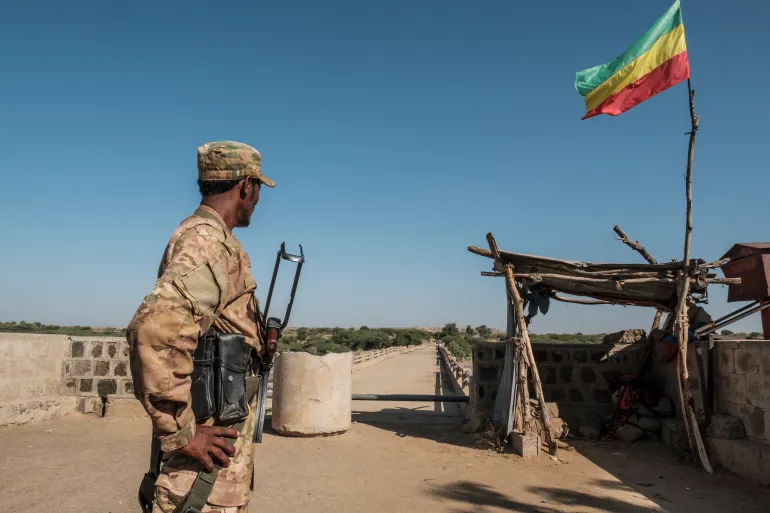
Ethiopia’s escalating conflict with Eritrea has drawn international alarm, with multiple sources confirming the presence of thousands of Eritrean soldiers inside Ethiopian territory.
An AFP report, citing a foreign security source speaking on condition of anonymity, estimated that between 5,000 and 8,000 Eritrean troops are currently deployed in Tigray, Ethiopia’s northernmost state.
Ethiopia has formally escalated the dispute at the United Nations, writing to the Security Council to demand the immediate withdrawal of Eritrean forces from its soil.
In a letter dated October 8, Ethiopian Foreign Minister Gedion Timothewos stated that the presence of Eritrean troops left his country “no option but to defend itself against Eritrea.”
Eritrea’s Minister of Information, Yemane Meskel, fired back on October 7, accusing Ethiopia of “incessantly beating the drums of war” in a post on X.
Two days later, Meskel wrote in Tigrinya that “the sovereign state of Eritrea is bound by blood and law,” adding a stark warning: “woe to those who touch it.”
Tensions sharpened further when Prime Minister Abiy Ahmed, sworn in for another five-year term, declared sea access a national priority, fueling speculation that Ethiopia may seek to seize Eritrea’s strategic port of Assab by force.
Some analysts believe Ethiopia deliberately triggered the current escalation, pointing to its recent expulsion of diplomats from both Egypt and Eritrea, which caused Eritrea to sever diplomatic ties entirely.
On the ground, the Ethiopian National Defence Forces, supported by the Tigray Peace Force militia, have made notable advances, recapturing the Tigray federal state capital of Mekelle.
Opposition to the federal government has simultaneously coalesced into a new formation called the Tsimdo movement, a term drawn from Tigrinya loosely translating as “engagement,” which has reorganized into a broader coalition of ethnic-based groups.
“The Tsimdo concept initially surfaced through cross-border peace initiatives involving activists, religious figures, and local communities in the Tigray and Eritrea border villages in 2025,” said Dr. Jalale Getachew Birru, senior East Africa analyst with US-based conflict monitor ACLED.
The movement gave rise to the Ethiopian Peoples’ Forces Alliance for Survival, proclaimed in September, which according to Dr. Jalale aims at removing the current government and initiating a constitutional dialogue.
Abdurahman Sayed, an analyst at the Horn of Africa Centre for Regional Integration, described the alliance as a reflection of Ethiopia’s long and unresolved history of internal conflict.
“The fighting inside Ethiopia has never stopped,” Sayed told DW, noting decades of conflict with the Oromo Liberation Army and years of fighting with Amhara forces.
Sayed added that the Pretoria agreement signed roughly three years ago “was just a cessation of hostility that would have led to some kind of sustainable peace by addressing the root causes of the conflict — but it failed to do that, so they’re back to the conflict situation now.”
ACLED data shows that of the seven groups within the Alliance for Survival, only three have been actively involved in recent fighting: the Tigrayan Defence Forces, the Amhara Fano National Movement, and a recently formed ethnic Afar group called Ugugumo.
The alliance’s prospects depend heavily on external backing, with Sudan, Egypt, Eritrea, and Somalia all identified as potential supporters, each carrying its own grievances against Abiy Ahmed’s government.
“The Egyptians have issues with the Nile River and how it should be administered, including the dams that are already there and those planned to be built around the Nile River,” Sayed explained.
On October 4, the leaders of Sudan, Egypt, Eritrea, and Somalia issued a joint declaration stressing the importance of sovereignty and territorial integrity, and asserting that “the governance of the Red Sea is the exclusive responsibility of the littoral states.”
While the four nations pledged to promote “peaceful solutions to conflicts,” the rapidly deteriorating situation across the region suggests that diplomatic commitments may struggle to hold against the pressures now building on multiple fronts.
