
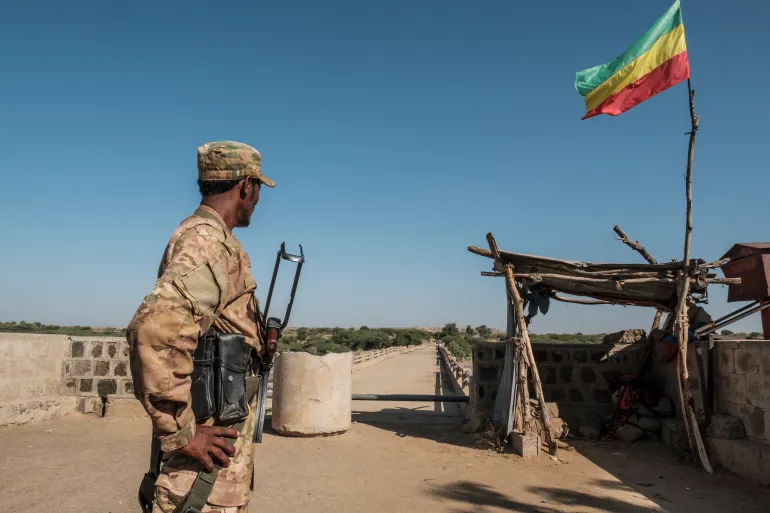
Four years after the Pretoria Peace Agreement halted one of Africa’s deadliest conflicts, large-scale fighting has returned to northern Ethiopia, threatening fresh catastrophe across the Horn of Africa.
In the days before full-scale hostilities resumed, several armed groups that had previously been enemies formally announced a coalition with a single stated objective: toppling Prime Minister Abiy Ahmed’s federal government.
Negash Mohammed, a journalist with DW’s Amharic department, argues the 2022 peace deal carried fatal structural weaknesses from the moment it was signed, overlooking three critical actors in the original war.
The Pretoria agreement failed to account for Eritrea’s role in the conflict, where it had fought alongside Ethiopian federal forces against the Tigray People’s Liberation Front, according to Mohammed.
The deal also sidelined Amhara militias known as Fano, who felt excluded from negotiations, and hardliners within the TPLF who interpreted the peace agreement as a military defeat rather than a political settlement.
Tensions deteriorated further when Abiy’s government moved to forcibly disarm Fano militias rather than engage with their underlying grievances, a decision Mohammed says proved deeply counterproductive.
“The federal government has its own shortcomings,” said Mohammed. “Instead of convincing the other side, it went on to aggravate the grievances they [already] had.”
The current rebel coalition is a broad and ideologically varied grouping, encompassing the Oromo Liberation Army, a faction of the Ogaden National Liberation Front, armed groups from the Benishangul-Gumuz region, and ethnic militant factions from Afar.
Eritrea, which previously fought alongside the federal government, is now believed to be providing support to the rebel alliance, though it has not formally joined it.
Patricia Rodrigues, a senior analyst at Control Risks, a global intelligence and security consultancy, described the level of strategic coordination among these groups as “quite significant” and “definitely alarming for the federal government.”
Rodrigues cautioned that the coalition’s durability is far from guaranteed, noting that “all of them have very different interests and represent very different ethnic constituencies.”
She assessed that fighting is likely to remain concentrated in Ethiopia’s northern regions along the borders between Tigray, Amhara, and Afar, with a nationwide spread considered unlikely given the terrain and fragmentation of opposition forces.
Rodrigues also pointed to the failure of sustained international engagement after 2022 as a driving factor behind the renewed conflict, with global attention having shifted away before implementation was complete.
Early signs of progress existed, including the TPLF’s surrender of heavy weaponry in 2022 and 2023, but both sides quietly rearmed once international scrutiny faded.
“It was more of a stopgap or a ceasefire, but people were quickly rearming in the background,” Rodrigues told DW.
The United States recently lifted sanctions that had been imposed during the 2020 to 2022 conflict, a move Mohammed says has weakened Western leverage over the warring parties at a critical moment.
Civilians are once again bearing the heaviest burden, with displaced persons still living in makeshift camps from the previous war and new waves of people now fleeing the resumed fighting.
Mohammed reported isolated incidents of drone strikes hitting civilian areas and rebel groups positioning military hardware inside schools and clinics, despite official assurances of civilian protection from all parties.
“Since 2020, they have not returned to their areas. They are still in makeshift IDP centers,” Mohammed said, while also noting that “words and practice are very contradictory.”
Communications infrastructure has collapsed in parts of Tigray and Amhara, with internet and telephone connections severed, electricity disrupted, and flights suspended to cities including Kombolcha and Lalibela.
UN Secretary-General António Guterres dispatched a special envoy to the region to mediate among the African Union, regional powers, and Egypt, many of whom were involved in brokering the original Pretoria agreement.
Mohammed cautioned that meaningful talks are unlikely to gain traction until at least one side “comes to understand that this violence will not help them to achieve what they want.”
Rodrigues shared that pessimism, saying she could not be optimistic about “an international or a regional mediation being the solution to the current fighting,” and forecasting that “intense, but geographically contained” hostilities will persist for the foreseeable future.
