
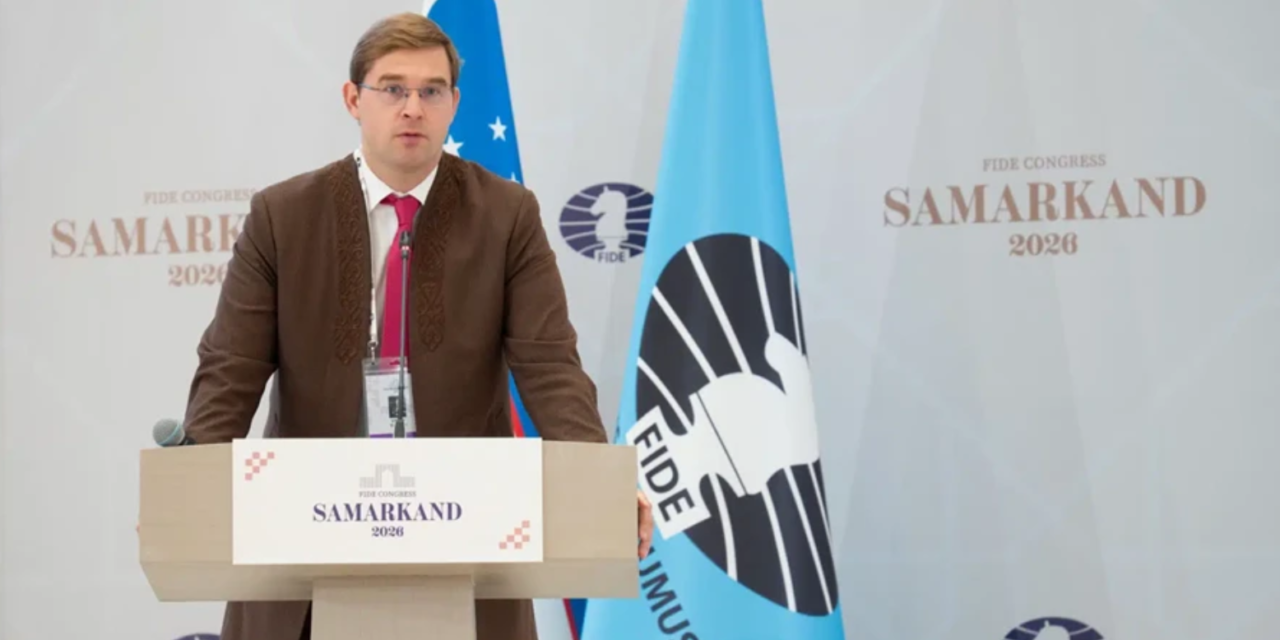
Timur Turlov, President of the Kazakhstan Chess Federation and CEO of Freedom Holding Corp., was elected President of the International Chess Federation (FIDE). The 38-year-old businessman and lifelong chess enthusiast, Timur Turlov is taking over the world’s chess governing body with an ambitious agenda, ranging from modernizing FIDE’s operations to expanding opportunities for players and national federations, backed by a nearly fourfold increase in development funding.
A New Leader for FIDE
The FIDE president is elected by secret ballot at the FIDE General Assembly once every four years for a four-year term. The 2026 General Assembly was held on September 26-27 in Samarkand, Uzbekistan, with the presidential election taking place on September 26. On the same day, the Federation announced on its official website that Timur Turlov had been elected FIDE President.
Timur Turlov won the second round with 110 votes to 85 for German candidate Wadim Rosenstein, an entrepreneur and chess promoter, founder of WR Group. The third presidential candidate, Jan Henric Buettner, a German entrepreneur and co-founder of Freestyle Chess, did not advance to the second round.
Timur Turlov thus became the eighth FIDE President, succeeding Arkady Dvorkovich, who served two terms from 2018 to 2026. At 38, Turlov is the second-youngest FIDE President ever elected. Presidential candidates run as part of a team with a Deputy President, forming a presidential ticket. Turlov ran with five-time world champion Viswanathan Anand as his Deputy President.
Kazakh business outlet Kursiv quoted Turlov as saying: “The greatest dream we all strive for is to move closer to the Olympic program. I want there to be harmony within FIDE, and for every federation to see the difference we can achieve together over the next four years. I want FIDE to become more digital, professional, and modern to enhance its prestige and influence, and to find its place in the digital world. I intend to apply my expertise in digitalization to FIDE’s operations, helping the organization build a robust digital platform and gain recognition as the leader and regulator of this game — which is both historic and modern.”
Alongside his business career, Turlov has built extensive experience in chess. A lifelong chess enthusiast, he has played an active role in promoting and developing the game. He has served as President of the Kazakhstan Chess Federation since 2023, as Founding President of the International School Chess Federation (ISCF) since 2024, and as Chairman of the Turkic Chess Association since 2025. Freedom Holding itself is also one of the world’s leading private supporters of chess development. Over three years, it invested approximately $30 million in chess development in Kazakhstan and supported the organization of more than 20 major international FIDE tournaments.
What Comes Next
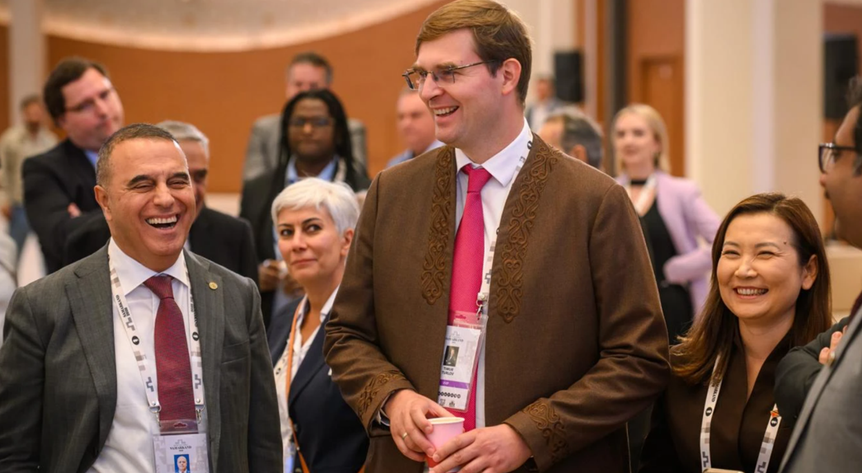
Timur Turlov sees four areas where his business and chess experience can shape FIDE’s future: digital transformation, chess in education, institutional development, and financial sustainability. These priorities form the foundation of his presidential program.
Digital transformation focuses on creating a unified digital platform for FIDE and equal access to modern digital tools (rating history, online competitions, educational resources, AI tools for game analysis, training, anti-cheating, coach education, and tournament administration) for every federation.
“I’m sure that we should continue working to make FIDE ratings almost real-time. If a tournament finishes, the rating should be updated immediately. There is little reason to wait a couple of weeks or months for a new official rating,” Turlov said.
Chess in education seeks to provide every national federation with practical educational methods and modern technologies to support the sustainable integration of chess into school education. This also includes supporting federations’ social programs to bring chess to every community, particularly women, people with disabilities and seniors, as well as expanding outreach to hospitals, correctional facilities, refugee centers and similar settings.
Institutional development calls for open and professional global governance at FIDE and greater confidence among Member Federations. This includes more transparency and accountability, in line with the highest standards of institutional governance, through regular public reporting on finances and major commercial agreements, independent external audits, less bureaucracy and faster access to FIDE services.
Financial sustainability prioritizes supporting federations with limited resources across all continents by guaranteeing three major open events each year with substantial prize funds in Africa, the Americas, and small countries; increasing FIDE’s Development Fund; and making the application process simple and transparent. It also calls for helping regional federations build sustainable income sources, identify local sponsors and prepare professional proposals, gain access to FIDE’s global partners, and provide assistance in engaging with national governments.
Funding the Game
Under the proposed framework, the Development Fund would have an annual budget of €6.2 million ($7.04 million), up from €1.6 million ($1.8 million) today. One year of funding under the new framework would exceed the total value of grants awarded between 2019 and 2025.
“All our development funds, the $7 million, will actually go toward helping to organize more tournaments and making sure that we prepare them well. We will build a proper database of chess coaches and arbiters. On this digital platform, we will try to provide some rotation opportunities for different specialists,” Turlov said.
The donation will be irrevocable, and FIDE will have full control over the funds. The aim is to make development funding less dependent on the World Championship calendar and sponsorship revenues. The next step is to bring in additional donors, including corporate partners, private donors, government programs in member countries, and international organizations.
The expanded fund would bring together support programs for competitions, chess in education, women’s chess, youth development, trainer and arbiter development, digital tools for federations, equipment, social programs and senior chess. Specific allocations include €1.1 million ($1.3 million) for youth development, covering individual grants, year-round training and travel to the World Cadet and Youth Championships. Annual funding for women’s chess would increase fivefold, from €100,000 to €500,000 (from $113,560 to $567,810). The plan would also provide grants of up to €60,000 for open tournaments, up to €30,000 for round-robin title-norm events, a higher cap for selected regional events, and up to €22,000 for a federation’s full domestic competition calendar.
The proposed system would make access to funding faster and less bureaucratic, especially for smaller grants. All applications would go through a single platform, with shorter forms and less documentation for grants of up to €5,000, a simplified review for requests of €5,000-€10,000, and a full assessment against published criteria for larger projects.
Another notable element of Turlov’s program is its approach to federations with accumulated membership fee debt. Rather than simply cutting off their access to funding, the proposal would give Level 4 and Level 5 federations a one-time opportunity to restructure their debt and, in justified cases, have part of it written off. Access to the Development Fund would be restored once an approved repayment plan is in place.
The day after his election, Timur Turlov wrote on LinkedIn: “During the campaign, I made many specific commitments to the national federations. Now it is time to deliver on them. There is a great deal of work ahead.”
