
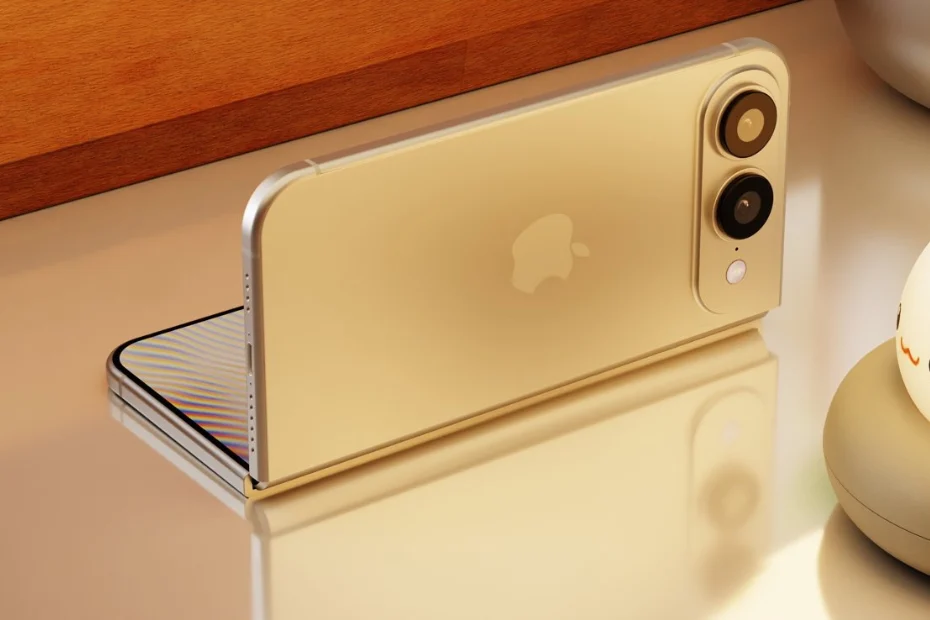
Apple Inc. (NASDAQ: AAPL) unveiled the iPhone Duo on September 9, 2026, marking the company’s first foldable smartphone and its most significant iPhone redesign in nearly two decades.
The launch was the first major product event led by new CEO John Ternus, who succeeded Tim Cook on September 1, giving him an immediate opportunity to stamp his authority on Apple’s hardware strategy.
The book-style, passport-shaped device opens into a 7.6-inch display, the largest Apple has ever shipped on an iPhone, and supports side-by-side multitasking for a tablet-like experience in a pocketable form factor.
Pricing starts at $1,999 for the 256-gigabyte model and climbs to $3,199 for 2 terabytes of storage, making the Duo the most expensive iPhone Apple has ever brought to market, with availability set for October 23.
The device ships with a titanium frame, a custom hinge, a scratch-resistant inner display, an IP68 water resistance rating, the A20 Pro chip, and Apple Intelligence features, giving consumers several reasons to consider the premium price point.
Analysts expect Apple to capture a meaningful slice of the foldable segment, with the company’s brand strength and large installed base seen as key advantages in accelerating consumer adoption of the new form factor.
However, the global foldable market is projected to account for less than 3% of total smartphone sales in 2026, according to Reuters, and analysts forecast initial Duo sales of only around 6 million units, limiting its near-term revenue contribution relative to Apple’s broader iPhone business.
Samsung and Huawei both hold established positions in the foldable category, with Samsung retaining particular advantages in manufacturing scale and foldable experience, meaning Apple must prove its late entry can generate durable competitive differentiation.
On the institutional side, hedge fund exposure to Apple remained broadly stable, with 169 funds holding positions in the second quarter compared to 170 in the first, though the combined value of those positions rose to $124.80 billion from $107.48 billion, according to Insider Monkey’s database.
The iPhone Duo represents a calculated long-term bet by Ternus rather than an immediate revenue catalyst, with investors likely to treat the launch as a test of whether Apple can establish a new premium upgrade cycle and build a lasting position in the next generation of smartphone design.
The Duo’s success will ultimately depend on whether Apple can convince its installed base and potential Android converts that the larger foldable display delivers enough daily utility to justify spending hundreds of dollars more than a conventional flagship iPhone.
If Apple manages to broaden the foldable market beyond its current niche status, the Duo could become the foundation of a new high-margin hardware category that strengthens the company’s ecosystem monetization through services and accessories over the coming years.
