
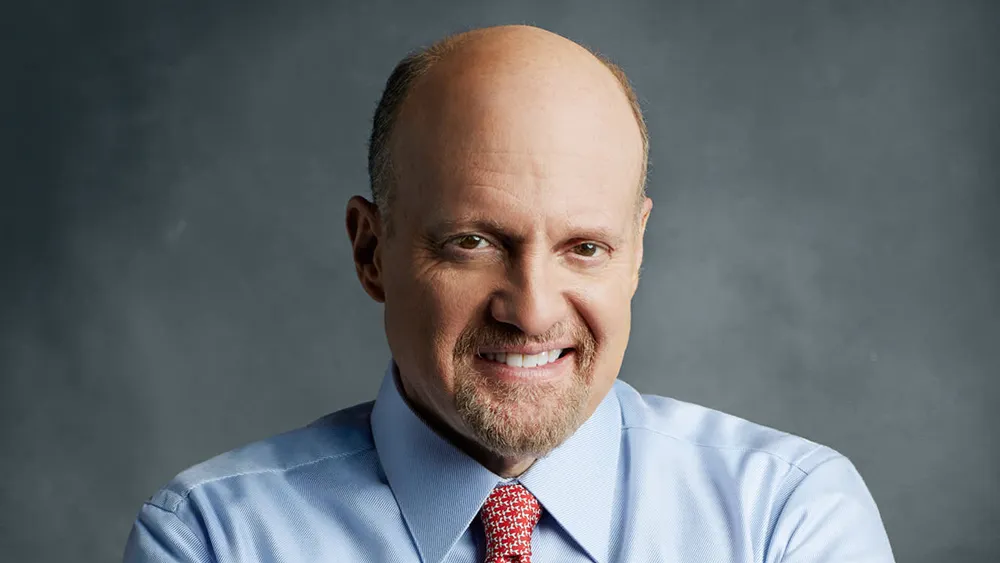
GE Vernova Inc. (NYSE: GEV) and NuScale Power Corporation (NYSE: SMR) were thrust into the spotlight during a recent episode of Mad Money, where host Jim Cramer drew sharp contrasts between the two energy companies.
Cramer addressed a caller’s concerns about GE Vernova’s struggling wind business and the prospect of Elon Musk entering the generator market, offering a notably measured response.
“I think Elon’s doing it for his own businesses,” Cramer said, acknowledging that “the wind business has been a disappointment” before noting that GEV carries “the worst head and shoulders chart I have seen in a long time.”
Despite the technical weakness, Cramer expressed confidence in the company’s order pipeline, suggesting hyperscalers could help ease public resistance to data center construction by reducing local utility rates.
“I am not that worried about GEV because it has fallen so much from its high,” Cramer added, saying “maybe another hundred and we’ll keep buying.”
On NuScale Power, Cramer was more cautious, explaining to a caller why the stock has failed to recapture its previous highs by pointing to the inherent difficulty of nuclear construction.
“I think what’s happened is people recognize that it’s a lot harder to build a nuclear power plant, whether it be big or small or modular,” Cramer said, adding that GE Vernova remains the Trust’s preferred holding because “at least it’s got some nuclear.”
The financial fundamentals between the two companies highlight a stark divergence in commercial maturity and revenue generation capability.
GE Vernova posted $11.1 billion in second-quarter revenue, a 22% year-over-year increase, backed by $24.2 billion in new orders and a total backlog that expanded to $176 billion driven by utility demand for gas power equipment.
NuScale Power, by contrast, reported just $75,000 in second-quarter revenue, down sharply from $8.1 million in the same period a year earlier, underscoring the gap between the two companies’ commercial trajectories.
NuScale maintains approximately $1.9 billion in total liquidity to support its development runway, though it has yet to convert its small modular reactor technology into signed power purchase agreements or recurring revenue.
Execution risk also differs significantly, with NuScale facing complex regulatory licensing processes and construction cycles expected to run just under 40 months from first concrete to mechanical completion, not including prior licensing work.
To fund its long development timeline, NuScale registered a $750 million at-the-market equity offering on August 11, raising the prospect of meaningful share dilution for existing investors.
Hedge fund data tracked by Insider Monkey further reflects the confidence gap, with GE Vernova held by 106 hedge funds in Q2 versus NuScale’s 34, both figures representing declines from the prior quarter.
Short interest data reinforces that divide, with GE Vernova’s short percentage of float sitting at 2.98% compared to a notably higher 18.40% for NuScale, pointing to substantially more bearish positioning against the smaller nuclear developer.
For investors navigating the energy transition driven by AI data center demand, GE Vernova’s established revenue engine and diversified grid exposure stand in clear contrast to NuScale’s speculative, longer-dated commercialization story.
