
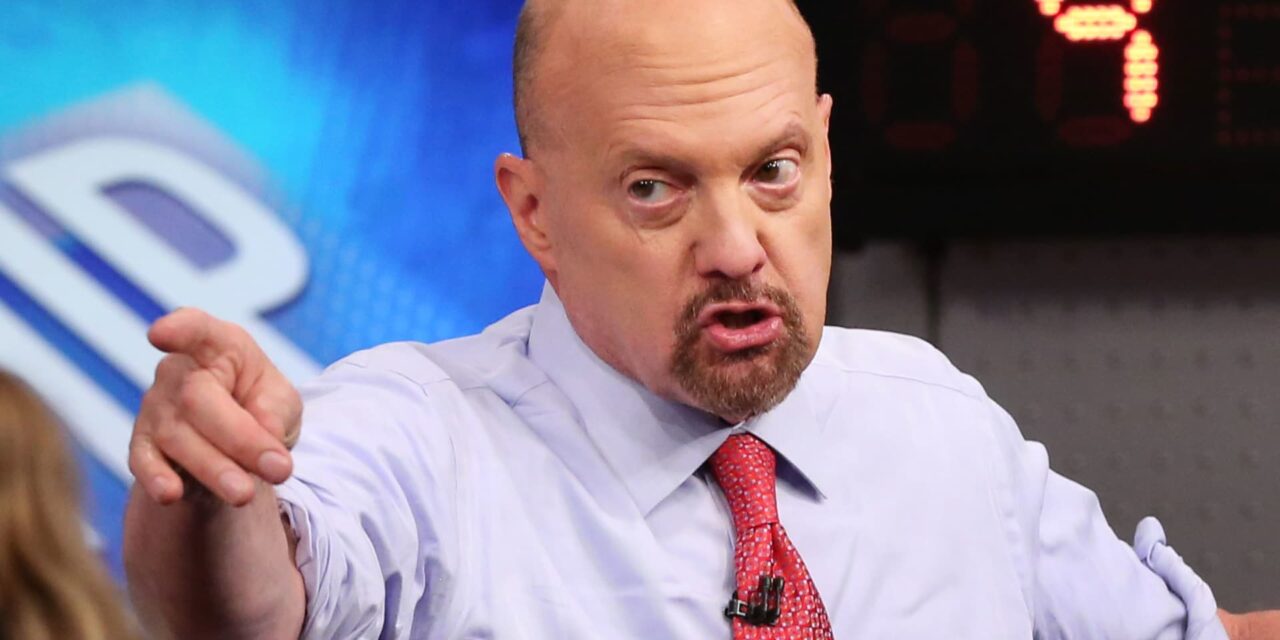
On CNBC’s Squawk on the Street, Jim Cramer declared that investor appetite has decisively turned against the trade that powered markets for much of the past year.
“We’re defaulting to all right, give me anything but tech, give me anything but data center. We’ve got. They dug their own graves,” Cramer said, describing capital moving away from hyperscaler capex plays.
Co-anchor David Faber identified software companies as the likely beneficiaries, arguing that slower data center construction would drive demand toward efficiency tools running on existing infrastructure.
“There is a part of tech that’s showing some momentum. And interestingly, it’s of course, well, if we don’t move as quickly as might otherwise be the case, because the data center opposition is such that things are not getting built as quickly. Well, who’s the potential beneficiary? Software companies,” Faber said.
The names circled during the segment included ServiceNow (NYSE: NOW), Salesforce (NYSE: CRM), Adobe (NASDAQ: ADBE), and Johnson & Johnson (NYSE: JNJ), spanning both enterprise software and pharmaceutical defense plays.
Political opposition to data center construction in states including Texas, Pennsylvania, and Virginia has added a legislative dimension to the slowdown, giving the rotation a policy-driven backdrop.
Colorado Legislative Council Staff cataloged 2026 state actions covering rate design, cost-shifting, and permitting for large-load projects, including California Senate Bill 57, Illinois Senate Bill 25 requiring Clean Air permits, and Maryland Senate Bill 937.
PJM Interconnection’s independent market monitor concluded that data center load growth is the primary reason for recent and expected capacity market conditions, a finding that hardens political opposition and slows project approvals.
Cramer argued the backlash is self-inflicted by the industry, stating “They fooled people. Some people thought it was good. Some people thought it was bad. Whatever they wanted to do, it was the wild west of data centers. It would have been better had they made an agreement ahead of time.”
ServiceNow’s most recent quarterly results offer concrete support for the software beneficiary thesis, with subscription revenue reaching $3.877 billion, up 23% year-over-year in constant currency.
Management also reported that ServiceNow AI ACV exceeded expectations, surpassing $1 billion, reinforcing the case that enterprise software demand is accelerating as compute capacity tightens.
Salesforce CEO Marc Benioff described Agentforce ARR surpassing $1 billion and combined AI and data ARR reaching $3.4 billion, alongside a $25 billion accelerated share repurchase disclosed in its Q1 FY2027 press release.
The market has already begun pricing in the rotation, with NOW up 29.63% over the past month, CRM up 27.74%, and ADBE up 22.73%, though all three remain in negative territory year-to-date.
A structural risk sits beneath the software insulation argument, as every platform ultimately runs on the same compute infrastructure currently facing community opposition and regulatory friction.
ServiceNow’s CFO flagged that accelerating AI adoption and growing hyperscale partnerships are already pressuring subscription gross margin, exposing the cost side of the same data center constraint.
On the pharmaceutical side, Johnson & Johnson CEO Joaquin Duato pointed to 28 products and platforms each generating more than $1 billion in annual sales, with worldwide Q2 sales of $25.3 billion, up 5.6% operationally.
JNJ carries a beta of 0.231 and is up 33.4% year-to-date, consistent with a rate-driven rotation into low-volatility healthcare names seeking balance sheet stability over pipeline risk.
Merck (NYSE: MRK) CEO Rob Davis pointed to “greater than $70 billion of commercial opportunity we have from over 20 new products,” with MRK up 45.25% year-to-date on pipeline momentum.
Moderna (NASDAQ: MRNA) represents the speculative edge of the pharma trade, surging 115.47% in a single week on melanoma vaccine data showing a 49% reduction in recurrence and death risk versus KEYTRUDA alone.
Cramer’s most durable observation may be his bluntest, calling this “an irrational market” where buyback size rather than fundamentals is determining stock performance, with Salesforce having retired 103 million shares representing 11% of shares outstanding through a debt-funded accelerated share repurchase.
