
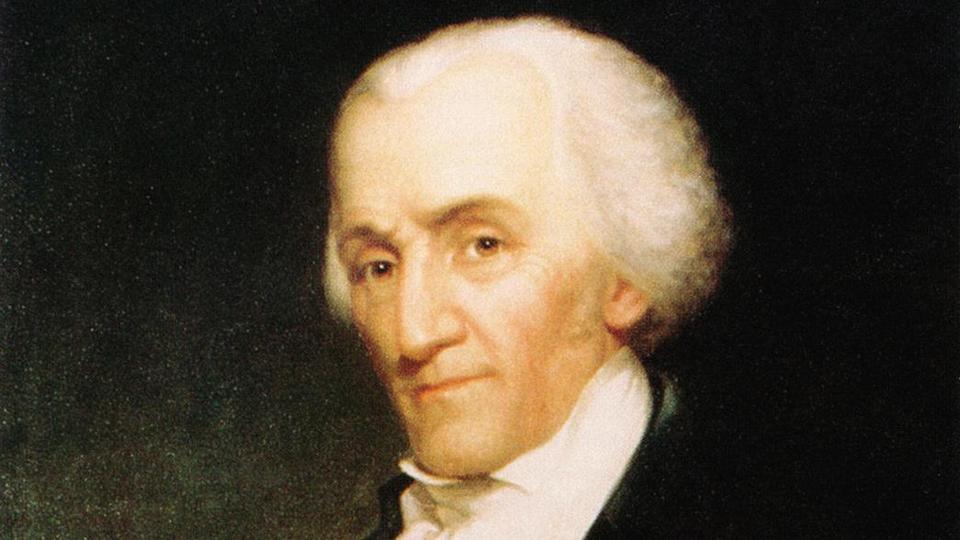
Elbridge Gerry is not a household name among America’s Founding Fathers, yet his legacy endures in one of the most contested terms in modern American politics.
Gerry, whose name is pronounced “Gary,” was among the earliest and most vocal advocates for American independence from Great Britain, standing alongside luminaries like Samuel Adams and John Hancock.
He was one of only three delegates to the Constitutional Convention who refused to sign the final document, objecting in part because it lacked a Bill of Rights at the time.
Gerry later served as President James Madison’s second vice president, though he died in office less than two years after taking the position.
Historian and author David O. Stewart describes Gerry as “a fiery guy,” though he was also physically unimposing, being “small and skinny,” with a “squint and a stutter.”
Gerry’s 20th-century biographer, George Athan Billias, described him as a “nervous, birdlike little person,” while John Adams noted that Gerry “will risk great things to secure small ones.”
His lasting contribution to the English language traces back to 1812, when, as governor of Massachusetts, he signed a redistricting bill that created a sprawling, contorted state senate district designed to benefit his Democratic-Republican Party against rival Federalists.
A newspaper published a cartoon depicting the misshapen district as a winged, clawed monster, and the image was labeled a “Gerry-mander,” a portmanteau combining “Gerry” and “salamander.”
Doug Harper, the founder of the etymology dictionary etymonline.com, finds the word’s origin particularly striking, noting: “What’s curious to me about it is that it’s a word, but it comes out of a visual image.”
Harper adds that “someone actually drew the picture and published it in the newspaper, along with the coining of the word,” but concedes that the district “doesn’t look like a salamander.”
The term “gerrymander” belongs to a linguistic category known as an eponym, derived from the ancient Greek epōnymos, meaning “giving one’s name to something.”
Harper points to other eponyms including “boycott,” “shrapnel,” “leotard,” and the more recent verb “MacGyver,” which Merriam-Webster defines as “to make, form, or repair (something) with what is conveniently on hand.”
Harper notes that future generations rarely connect such words to their origins, suggesting that by 2126, people will be unlikely to associate “MacGyvering” with an old television show.
He applies the same logic to Gerry, remarking: “If you ask people on the street today, they’d wonder if it was Jerry Seinfeld we were talking about.”
The practice of manipulating district boundaries for electoral gain did not begin with Gerry and has certainly not ended with him, with redistricting battles continuing to generate notoriously shaped districts across the country.
Among the more colorful examples are Pennsylvania’s “Goofy kicking Donald Duck,” Illinois’ “earmuffs,” and what are known as “bug splat” districts, which stretch for miles to encircle specific groups of voters.
The word “gerrymandering” has become inescapable in modern political discourse, particularly as redistricting fights intensify across the United States ahead of midterm elections.
Stewart, the historian, offers a philosophical conclusion about Gerry’s unusual immortality: “None of us picks how we’re going to be remembered in the world if we’re going to be remembered at all. So being remembered is, I suppose, better than not.”
