
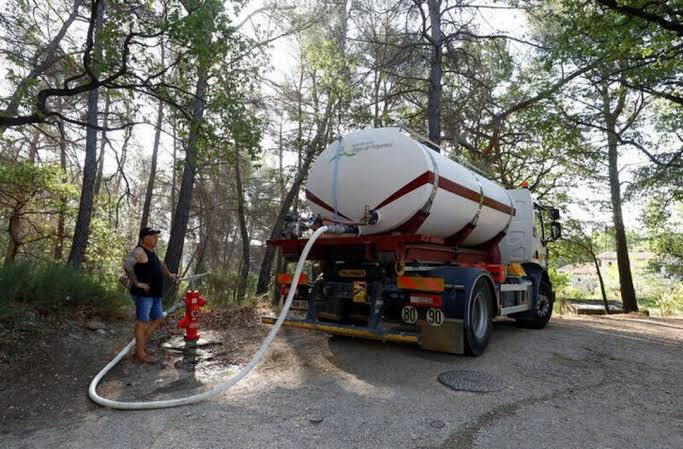
Twice a week, large silver tanker trucks make the short journey to Sainte-Marie-aux-Mines in Alsace, eastern France, carrying drinking water from the nearby town of Liepvre.
The town of roughly 5,000 residents normally draws water from around 20 mountain springs in the Vosges Mountains, but weeks of intense heat and drought have sharply reduced their flow.
Because no permanent pipeline connects Sainte-Marie-aux-Mines to Liepvre’s larger regional water network, tanker trucks are effectively serving as a mobile water supply system.
The French government reports that more than 40,000 people have already faced water cutoffs or supply disruptions, with 550,000 more at elevated risk of losing stable access.
Water restrictions have been introduced across many regions, though tanker deliveries are limited to municipalities that cannot easily switch to alternative sources or groundwater reserves.
More than a dozen municipalities in the Jura Mountains, in the department of Doubs, are also currently relying on tanker truck deliveries for their water supply.
France experienced a similar crisis during the dry summer of 2022, when tanker trucks served hundreds of municipalities and some communities depended entirely on bottled water.
Coucouron, a village of under 800 residents in the Massif Central region, was among the hardest hit that year, despite sitting above 1,000 meters in a region where the Loire, Allier, and Ardeche rivers have their sources.
Investigations into the Coucouron crisis revealed serious infrastructure failures, with major leaks in the local water network ultimately responsible for wasting around 40 cubic meters of water per day before repairs were completed.
Aging infrastructure is a nationwide problem, with only about 79% of water entering rural supply networks actually reaching consumers, and just 0.6% of pipes being replaced annually across the country.
Monique Barbut, France’s minister for the environmental transition, has estimated that the direct and indirect costs of this year’s heat waves could reach between 10 and 15 billion euros, equivalent to as much as $17.4 billion.
Following the 2022 drought, President Emmanuel Macron declared water a national priority, and a Water Plan introduced in spring 2023 outlined more than 50 measures, including a target of 10% reduced consumption by 2030.
Since the Water Plan’s launch, some 1.4 billion euros has been committed to the national effort, and authorities identified around 170 municipalities in 2023 whose networks were losing more than half of all water supplied to them.
Within three years of that identification effort, over 100 of those municipalities had managed to bring their losses down to acceptable levels, marking modest but meaningful progress.
Competition for scarce water is intensifying across sectors, with households, farmers, and industrial producers all drawing from shrinking reserves and forcing difficult decisions about which uses should be restricted during emergencies.
France is far from alone in facing this pressure, as the European Environment Agency estimates that seasonal water scarcity and water stress affect roughly 30% of the European Union’s land area and nearly one-third of its population.
In 2025, the European Commission presented its first European Water Resilience Strategy, which targets at least a 10% improvement in water efficiency and calls for modernizing aging infrastructure across member states.
Across the Rhine in Germany, spring and groundwater levels in the Black Forest region are showing signs of decline, and several municipalities in the Dreisam Valley have asked the Badenova service company to prepare for potential tanker deliveries.
Southern Europe has addressed long-term water scarcity through large reservoirs, extended pipelines, and seawater desalination, with Spain among the most advanced in deploying these systems across its most arid regions.
Even the Netherlands, which typically benefits from a sophisticated network of lakes, canals, locks, and pumps, declared an official water shortage this summer and began storing and distributing freshwater strategically to manage the strain.
