
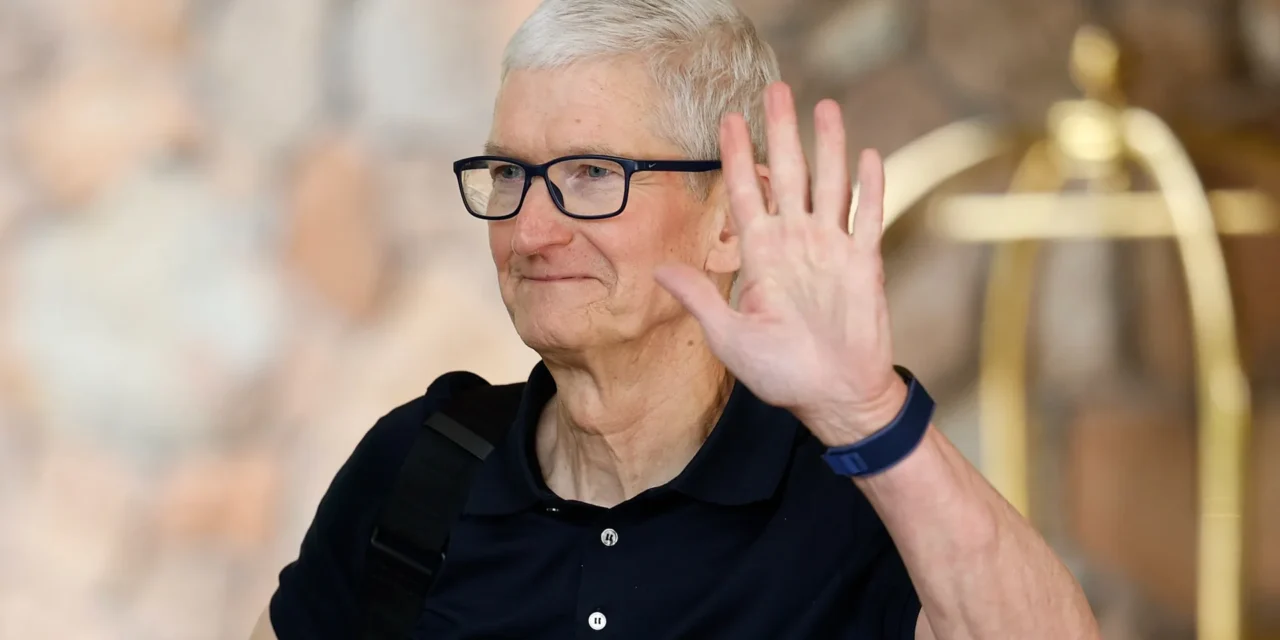
Apple (NASDAQ: AAPL) has received a striking endorsement from CNBC’s Jim Cramer, who argues that outgoing CEO Tim Cook achieved something no other executive in modern business history has managed.
Cramer made the comments on a recent episode of Mad Money, singling out Cook for building a company whose products consumers treat as personal companions rather than pieces of consumer electronics.
“He built the greatest consumer-based enterprise in history,” Cramer said, reflecting on Cook’s tenure as Apple prepares for a leadership transition later this year.
Cook is set to hand the CEO role to hardware engineering chief John Ternus in September, moving into an executive chairman position after more than a decade leading the company.
Cramer’s remarks came in response to Cook’s farewell letter, in which the departing CEO described beginning each morning by reading emails from customers around the world.
Cook cited messages crediting the Apple Watch with saving lives, writing: “In every one of those emails, I feel the beating heart of our shared humanity.”
That philosophy has translated into a valuation premium Wall Street once reserved exclusively for enterprise software firms, with Apple’s forward price-to-earnings multiple now sitting close to 30 times, compared to the low-to-mid teens when Cook took the helm in 2011.
Apple’s most recent quarterly results reinforce Cramer’s framing, with the company posting Q3 2026 revenue of $109.42 billion, exceeding analyst estimates of $109.04 billion, and earnings per share of $2.02, beating the consensus estimate of $1.89 by 13 cents.
The company’s active device count now stands above 2.5 billion, an all-time high that Cook himself described as “a testament to incredible customer satisfaction.”
That installed base drives Apple’s Services flywheel, where a growing number of active devices generates more subscribers, more recurring high-margin revenue, and ultimately funds the next hardware cycle.
Cramer drew a pointed comparison between Apple and enterprise software companies, arguing that Apple has achieved the same customer stickiness through emotional attachment rather than contractual lock-in.
The market appears to agree, with Apple carrying a trailing price-to-earnings ratio of 35 times and a forward multiple of 34.87 times, while 21 analysts have assigned a Buy rating against just four Sell ratings.
The analyst consensus price target stands at $328.60, representing more than 7% upside from the current price of $305.48, reflecting broad confidence in Apple’s durability beyond Cook’s direct leadership.
Investor reaction to the leadership transition itself has been notably calm, with Apple shares remaining largely steady in contrast to the sharp selloff that followed Steve Jobs’ departure in 2011.
Cook’s stock appreciation during his tenure reached roughly 1,900%, a figure that reflects both rigorous operational discipline and the kind of durable consumer relationships Cramer described on air.
Apple’s full fiscal year 2025 delivered $416.16 billion in revenue and $112.01 billion in net income, giving incoming CEO Ternus a formidable financial foundation from which to operate.
The central question for investors heading into the Ternus era is whether the emotional loyalty Cook spent 14 years cultivating is durable enough to outlast the leadership change that created it.
