
AST SpaceMobile, Inc. (NASDAQ: ASTS) shares closed 4.4% lower at $68.76 on August 10, ahead of the company releasing its second-quarter results.
Second-quarter revenue of $31.5 million fell short of the approximately $34.5 million consensus, while the net loss attributable to common stockholders widened to $230.9 million.
Investors appeared more focused on deployment progress than the earnings miss, with the company reporting approximately $1.3 billion of company-defined contracted backlog and an expanded network of 13 satellites.
AST reiterated its full-year 2026 revenue guidance of $150 million to $200 million, signaling confidence in a significant second-half ramp despite the slow first-half start.
The company separately reported approximately $1.2 billion of remaining performance obligations under accounting rules as of June 30, though it expected to recognize only 6.6% of that amount over the following 12 months.
That figure represents approximately $79 million, meaning the vast majority of contracted work is scheduled for later periods, offering longer-term visibility without resolving the near-term revenue question.
Second-quarter revenue was driven primarily by gateway equipment and government agreement milestones, with product revenue reaching $24.4 million and services revenue totaling $7.1 million across deliveries to customers on five continents.
AST generated $46.3 million of revenue in the first half of 2026, meaning the company must deliver between $103.7 million and $153.7 million in the second half to hit the low end of its guidance range.
Management expects revenue to increase sequentially each remaining quarter, with drivers including additional gateway deliveries, government milestones, consulting services for mobile operators, and possible limited commercial-service revenue late in 2026.
The company has relationships with more than 60 mobile-network operators collectively covering over three billion subscribers, including AT&T, Verizon Communications, Vodafone Group, Rakuten Group, stc Group, Bell Canada, and Telus.
These partnerships provide a distribution model that avoids the need for AST to build a consumer telecommunications brand from scratch, with mobile operators potentially embedding satellite connectivity directly into their own service plans.
AST reported multiple U.S. government awards with an aggregate value exceeding $125 million, with three recent awards carrying more than $100 million of funded near-term value expected during 2026 and 2027.
The August 5 launch of BlueBirds 11, 12, and 13 brought the constellation to 13 spacecraft, with BlueBirds 14 through 16 approaching shipment and BlueBirds 17 through 46 in various stages of production and assembly.
Management said AST has 10 launches booked with two providers and is targeting an average cadence of one launch every one to two months, aiming for approximately 45 satellites in orbit by early 2027.
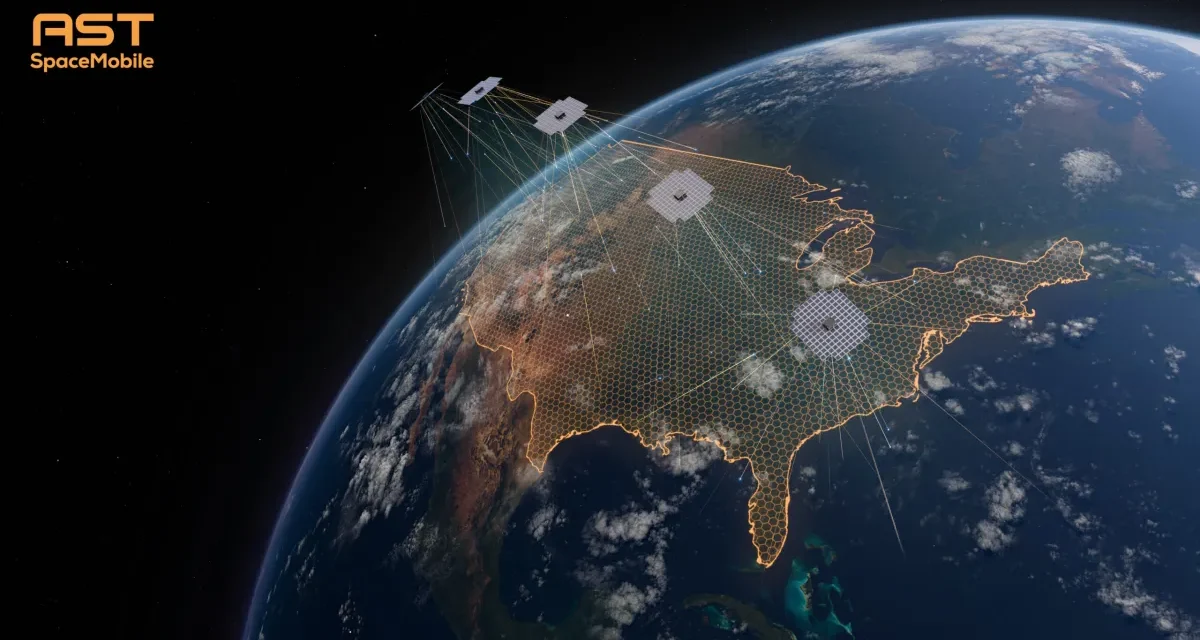
Management estimates that approximately 25 satellites would provide coverage for around half of the day from a typical U.S. location, while 45 to 60 satellites could support continuous service in key markets.
AST ended June with approximately $2.7 billion of cash, cash equivalents, and restricted cash, before raising a further $1.15 billion of gross proceeds through 1.625% convertible senior notes due in 2034 in July.
Including that financing, AST reported more than $3.7 billion of pro forma cash, equivalents, and restricted cash, with management stating the company is fully funded to manufacture and launch approximately 90 satellites.
AST estimates average direct-material and launch costs of $21 million to $23 million per Block 2 satellite, though achieving those figures depends on securing favorable launch contracts and realizing manufacturing efficiencies.
Capital expenditures reached approximately $610 million in the second quarter, up from approximately $257 million in the first quarter, with third-quarter capex expected to remain between $350 million and $425 million.
The company recorded a $125.9 million loss on involuntary conversion during the quarter after BlueBird 7 was placed into an unsustainable orbit during an April launch and subsequently de-orbited, with insurance covering part of the asset value but not the lost time.
The deployment timetable has already shifted, with management now targeting approximately 45 satellites by early 2027 rather than by the end of 2026, a delay that could materially affect when commercial-service revenue begins to flow.
Insider Monkey’s hedge fund database shows that 39 hedge funds held positions in ASTS at the end of the first quarter of 2026, up from 33 funds at the end of the preceding quarter.
The restrained initial earnings reaction suggests investors were willing to look past the revenue miss and the BlueBird 7 charge, with patience now dependent on visible deployment progress throughout the remainder of the year.
If AST reaches scaled beta service during 2026 and approaches 45 satellites in early 2027, the $1.3 billion backlog can begin converting into a recurring-revenue business, but another launch delay could force a return to capital markets before the commercial model is fully proven.
