
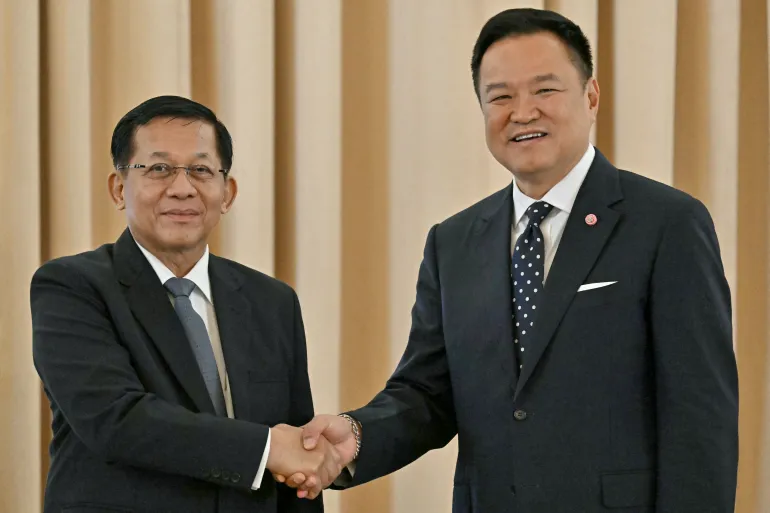
Myanmar’s junta chief turned president Min Aung Hlaing concluded a two-day visit to Thailand on Friday, his first official trip to the neighboring country as civilian leader.
The visit was designed to recast Min Aung Hlaing as the head of a legitimate civilian government, following years of diplomatic isolation, according to regional experts.
His arrival in Bangkok on Thursday was met with full state honors, including a red carpet, an honor guard, national anthems, and a formal meeting with Thai Prime Minister Anutin Charnvirakul.
“Naypyidaw equates engagement with acceptance,” said Moe Thuzar, head of the Myanmar Studies Program at Singapore’s ISEAS-Yusof Ishak Institute, referring to Myanmar’s capital.
“Min Aung Hlaing is seeking to leverage Naypyidaw’s space in bilateral relations with neighbours’ specific interests to secure greater acceptance of his administration from external partners,” Moe Thuzar added.
Since the retired general seized power in a 2021 coup that toppled a democratically elected government, a brutal civil war has killed an estimated 100,000 people and displaced well over 3 million.
Western nations have imposed multiple rounds of sanctions on the regime over alleged war crimes and human rights abuses, while in 2024 the then-chief prosecutor of the International Criminal Court requested an arrest warrant for Min Aung Hlaing for crimes against humanity against Rohingya Muslims.
The Association of Southeast Asian Nations has barred him from attending its leaders’ summits, and elections held in December and January were widely condemned by the United Nations and Western governments as a sham.
The military-aligned Union Solidarity and Development Party won more than 80% of seats in those elections, paving the way for parliament to elect Min Aung Hlaing as president in April.
Since assuming the presidency, he has paid official visits to India, China, Laos, and now Thailand, as Bangkok has pushed for peace efforts and Myanmar’s reengagement with ASEAN.
“For Min Aung Hlaing, visiting Thailand is also finding legitimacy in the ASEAN region, because Thailand is a founder of ASEAN and has a big voice in ASEAN,” said Wai Yan Phyo Naing, a visiting scholar at Taiwan’s Academia Sinica who studies Myanmar.
“He can show the ASEAN members that Thailand is treating me like this, Laos already treated me like this. So, do you want to act based on the realistic point of view, or are you still wanting to argue I’m not the legitimate leader of Myanmar?” Wai Yan Phyo Naing said.
Both Moe Thuzar and Wai Yan Phyo Naing agreed that ASEAN was unlikely to invite Min Aung Hlaing back to its leaders’ summits any time soon, given the bloc’s continued insistence on meaningful progress toward peace.
ASEAN has maintained that Myanmar must first deliver on a peace plan agreed shortly after the coup, a plan that Min Aung Hlaing has repeatedly dismissed, most recently the week of the Thailand visit.
Still, Moe Thuzar noted that Min Aung Hlaing may hope his official foreign trips help convince ASEAN to accept his government “on its own terms.”
The visit also included a business forum on Thursday for Thai and Myanmar companies, with both governments prioritizing economic engagement alongside the diplomatic outreach.
“The focus on trade and economic deals reflects Naypyidaw’s and Bangkok’s interest in prioritising economic engagement and addressing concerns related to border trade,” Moe Thuzar said.
Thailand ranks among Myanmar’s top trade partners and foreign investors, with a Thai firm operating two of Myanmar’s main gas fields that supply a significant portion of Thailand’s natural gas supply.
David Mathieson, an independent Myanmar analyst based in Thailand, argued that securing investor support helps consolidate domestic backing for Min Aung Hlaing among powerful economic interests.
Regardless of the ex-general’s official title, Mathieson said, “he’s a military dictator, and to be a dictator you need a certain level of cooperation, and cooperation comes from economic elites.”
“He’s appealing to an incredibly cynical international system that’s like, hey, you did this. None of us buy it, but it’s good enough for us. You dressed up for the party, well done, and it’s business as usual,” Mathieson said.
“Does that help the 54 million people of Myanmar? No, it doesn’t. It helps him and it helps the system that props him up,” Mathieson concluded.
