
Rocket Lab (NASDAQ: RKLB) has revealed two separate U.S. Space Force contract wins totaling $663 million, announced within eight days of each other.
The awards split into two distinct categories: $266 million covering launch vehicles already in active service, and $397 million contingent on a rocket that has never left the ground.
The smaller but more immediately bankable of the two contracts covers 12 guaranteed suborbital missions for missile defense testing, with options that could expand the total to 18 missions.
Rocket Lab has not formally named the vehicle for those missions, but its current suborbital work flies on HASTE, a variant of the proven Electron rocket.
Electron and HASTE together flew a record 21 missions last year, achieving a 100% success rate, suggesting the suborbital contract rides on hardware with a well-established track record.
Launches will lift off from a new site at the Pacific Spaceport Complex in Alaska on Kodiak Island, with the first mission expected as soon as the end of 2026.
These wins arrive against an already strong financial backdrop, with Rocket Lab posting record first-quarter revenue of $200.3 million, up 63.5% year over year and an acceleration from the full-year 2025 growth rate of 38%.
The company’s backlog climbed 20.2% from the prior quarter to a record $2.2 billion, and Rocket Lab said it sold more launches in the first quarter of 2026 than in all of 2025, bringing its total manifest to more than 70 contracted missions.
The larger and more strategically significant of the two contracts, worth $397 million, was awarded by the U.S. Space Force on August 4, 2026, under the Space-Based Airborne Moving Target Indicator program.
Under that deal, Rocket Lab is not simply providing a launch vehicle but is developing, launching, and operating a constellation of “Flatellite” spacecraft, marking a meaningful expansion into full-service defense contracting.
The total contract value includes an option for additional Flatellites, further extending the potential scope of the program beyond the initial award.
Founder and CEO Sir Peter Beck said: “Rocket Lab is honored to play a key role in the SB-AMTI program, which is critical to expanding the Space Force’s layered, resilient tracking architecture.”
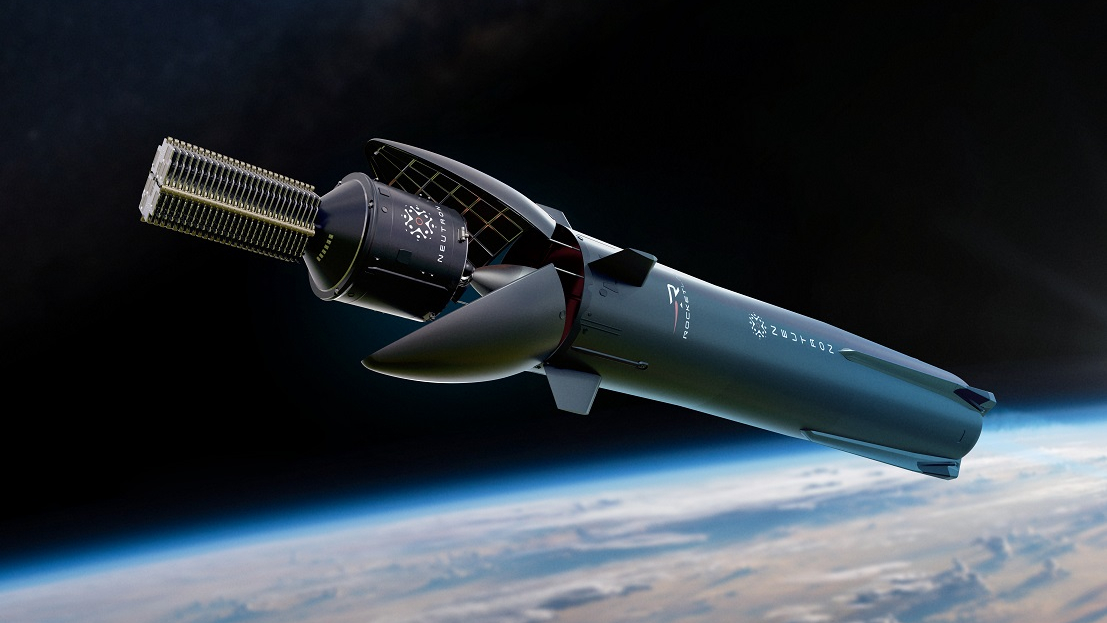
The contract also represents the first publicly confirmed payload for Neutron, Rocket Lab’s larger next-generation launch vehicle, which the company is targeting for a debut flight in the fourth quarter of 2026.
Neutron has not yet flown, meaning the $397 million award remains gated behind a successful maiden launch of hardware that has never been tested in flight conditions.
The milestone nonetheless validates the company’s long-term strategic pivot, positioning Rocket Lab as a vertically integrated defense contractor capable of building, launching, and operating its own orbital hardware at scale.
