
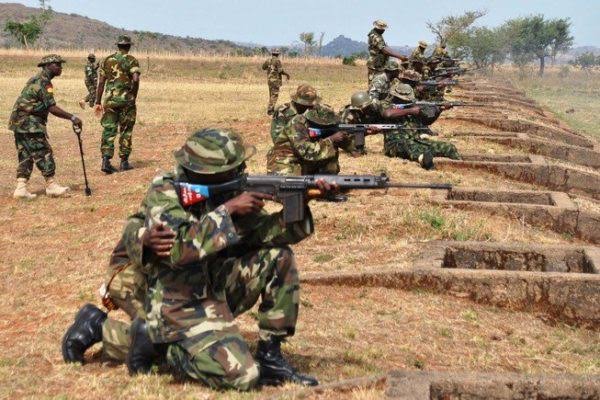
Niger’s military seized power on July 26, 2023, with General Abdourahamane Tiani justifying the coup by citing a deteriorating security situation that he claimed persisted despite international support.
The junta announced a transitional period of no more than three years following the takeover, but the political promises made at that time have gone largely unfulfilled.
The transitional government continues to hold unchallenged authority, while the security situation across this landlocked Sahel nation remains deeply fragile and worsening in key regions.
In the Tillabery region of southwestern Niger, jihadist attacks are increasing in frequency and lethality, forcing thousands of civilians from their villages and triggering a severe humanitarian crisis.
“Today, attacks on the armed forces and the civilian population are significantly more frequent and violent than they were three years ago,” said Maiga, a resident of the city of Tera, a town of 30,000 people, who spoke to DW anonymously for security reasons.
Maiga described how normal life has collapsed, saying that entire villages have fled and schools are now closed, whereas previously weekly markets operated and supplies arrived regularly despite underlying insecurity.
The conflict monitoring organization ACLED confirms that the security situation has deteriorated since the 2023 coup, identifying the Tillabery region as the primary flashpoint for clashes between rival Islamist groups JNIM and the Islamic State in the Sahel Province.
Nearly 1,200 deaths were recorded in the region in 2025 alone, with ACLED staff member Heni Nsaibia telling DW that “the situation in Niger has worsened, particularly in the Tillabery region, where the death toll is the highest in the central Sahel.”
The most recent major attack, on July 17, killed at least 16 soldiers according to Niger’s state media agency ANP, which also reported that 15 militants were killed during the same incident.
Ordinary civilians are bearing the heaviest burden, with one displaced woman telling DW, “We live in makeshift shelters and are defenseless against the elements; we take on small odd jobs to survive.”
A herder similarly described the collapse of his livelihood, saying, “I used to be able to live with dignity from my work, but right now it’s very difficult; even [portable] drinking water is a problem for us.”
Opinion among younger Nigeriens is divided, with some like Fadila expressing cautious optimism, telling DW, “For a while, it wasn’t easy at all: Salaries weren’t paid on time, food supplies… that wasn’t easy. But for some time now, things have been going pretty well overall.”
Tahirou Garka, spokesperson for the G25 movement advocating for a return to constitutional order and a close ally of ousted President Mohamed Bazoum, offered a sharper assessment of the junta’s record.
“They have failed economically and socially,” Garka told DW, adding that “people are struggling to find drinking water; there is no water, no electricity, no fuel.”
Hamani Oumarou of LASDEL, a social sciences research institute based in the capital Niamey, offered a contrasting view, suggesting that lower-income households outside the middle class and elite have seen modest improvements in their financial situations.
“Households with low incomes have more money left over to feed their families,” Oumarou told DW, though he acknowledged that Niger’s dependence on seasonal food imports continues to drive sharp price increases.
On the regional front, Niger, along with Mali and Burkina Faso, remains a founding member of the Alliance of Sahelian States, formed in 2023 after all three countries withdrew from the West African bloc ECOWAS and moved closer to Russia.
International organizations expert Pape Ibrahima Kane sees potential for rapprochement, pointing to the recent election of Guinean Prime Minister Lansana Kouyate as ECOWAS chief negotiator as a promising signal that both sides may be ready to engage.
“We are at the beginning of a promising process, as both sides are truly on the same page when it comes to starting talks,” Kane told DW, noting that economic factors, including Niger’s reliance on port access through Benin and electricity from Nigeria and Benin, add urgency to any diplomatic breakthrough.
