
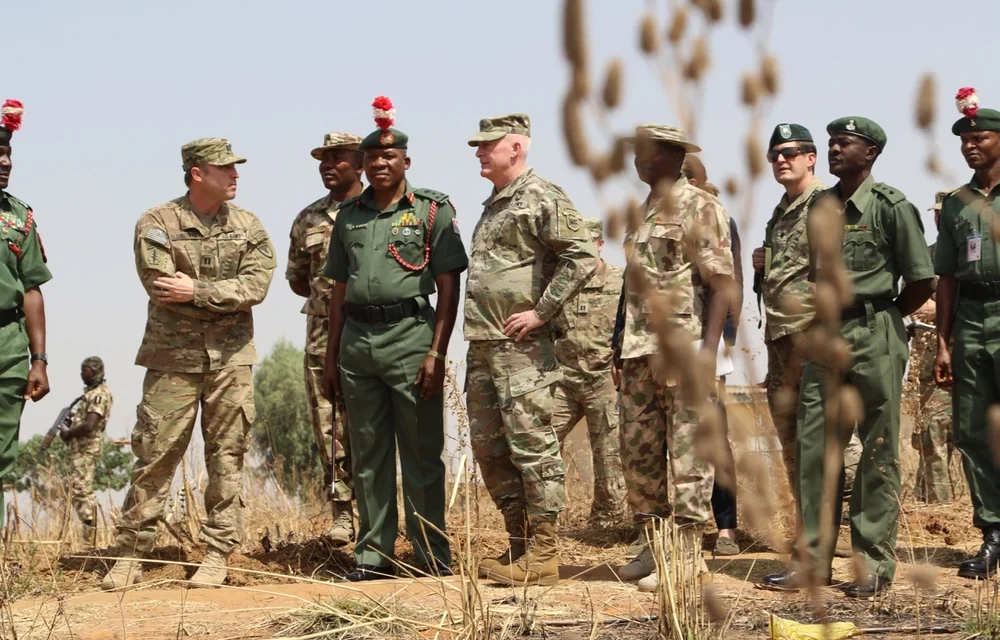
The United States has withdrawn most of its troops from a joint counterterrorism operation in northeastern Nigeria, a region long dominated by Boko Haram and its splinter factions.
The Islamic State West African Province, known as ISWAP, remains one of Islamic State’s most active affiliates globally, making the region a persistent security challenge for both local and international forces.
U.S. Africa Command’s General Dagvin Anderson described the joint operation as a model for future security cooperation across the African continent.
“We have withdrawn much of our forces that were just there for that operation,” Anderson told reporters at a conference of African defense chiefs held in Luanda, Angola.
Anderson added that the U.S. is “continuing the partnership that Nigeria has asked for to help continue with the intelligence sharing and the understanding that’s necessary to be able to prosecute these difficult tasks.”
The original deployment began in February, when the U.S. sent a small contingent to support Nigerian forces with intelligence, logistics, and training, following diplomatic tensions over religious violence.
The joint operation resulted in the killing of Abu Bilal al-Minuki, a senior Islamic State leader, along with 175 fighters and the destruction of weapon caches, checkpoints, logistics hubs, and financing networks.
The drawdown coincides with a broader U.S. push for burden sharing among its partners and allies, as Washington recalibrates its global military footprint amid competing geopolitical pressures.
James Barnett, a research fellow with the Hudson Institute specializing in conflict and militancy in Nigeria and Africa, offered a measured assessment of the strategic shift.
“The US military always talks about assisting capable African partners who lead, which is the general philosophy, but the Trump administration has shown it is willing if not often eager to flex US military muscle with airstrikes or raids, particularly against the Islamic State’s networks,” Barnett said.
On the continent’s eastern flank, approximately 600 U.S. military personnel remain active in Somalia, conducting a sustained air campaign against Islamic State fighters and al-Shabaab militants where local forces are considerably weaker.
Taiwo Adebayo, a researcher at the Institute for Security Studies, argued that Washington’s framing of Nigeria as a model reflects deeper strategic ambitions rather than a simple withdrawal.
“What’s more telling is that Washington is calling it a model for future cooperation across Africa, which means this fits a broader US foreign policy interest in dismantling Islamic State’s global network wherever it operates, and in re-establishing American relevance in African security after a period of reduced engagement,” Adebayo told DW.
“So, it’s less a retreat and more like America choosing a mode of involvement it can sustain and repeat, using Nigeria as the proof of concept,” Adebayo added, underlining the significance of the Nigerian operation as a strategic template.
The scale of the security challenge in Africa is underscored by the 2026 Global Terrorism Index, which found that more than half of the world’s terrorism-related deaths occurred in West Africa’s Sahel region.
Beverly Ochieng, senior analyst with Control Risks, cautioned that symbolic military wins do not necessarily translate into lasting security gains on the ground.
“The US has sought to intervene or support where it can demonstrate symbolic or quick wins, even if the insurgencies in those areas remain entrenched and unresolved,” Ochieng told DW.
She noted that U.S. airstrikes “in Nigeria and Somalia since Trump’s re-entry in office have not necessarily dislodged insurgent groups or discouraged their activities, and will not resolve the wider devastating impacts of insecurity in these countries.”
Both Adebayo and Ochieng agreed that while international cooperation is vital to dismantling insurgent networks, an exclusively military approach falls short of addressing the root conditions that sustain armed groups.
Ochieng concluded that African governments must also “limit dependence on increasingly unreliable international geopolitical partners,” pointing to the need for more self-reliant, long-term security frameworks across the continent.
