
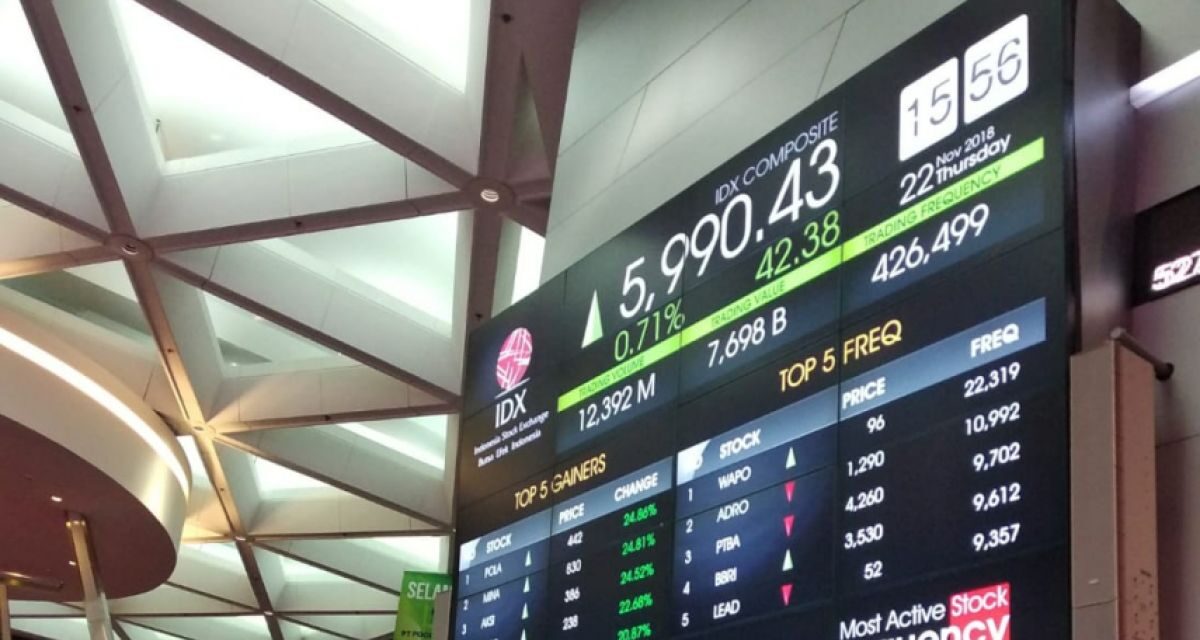
Indonesia’s Jakarta Composite Index managed to snap a three-day losing streak on Thursday, rallying 96.85 points or 1.34 percent to close at 7,321.07.
The index traded between 7,220.10 and 7,330.81 during the session, recovering more than 100 points that had been lost across the prior three trading days.
Gains were driven primarily by food, finance, and automobile stocks, while resource companies weighed on the broader market’s performance.
Bank Central Asia led the banking sector higher, surging 3.06 percent, while Bank Rakyat Indonesia soared 2.73 percent and Bank Mandiri strengthened 1.55 percent.
Bank Negara Indonesia rallied 1.50 percent and Bank CIMB Niaga collected 0.84 percent, though Bank Danamon Indonesia fell 0.76 percent against the broader positive trend.
Among other active names, Astra International jumped 1.79 percent, United Tractors improved 2.31 percent, and Indosat Ooredoo Hutchison spiked 1.94 percent on the day.
On the downside, Timah plunged 3.72 percent, Jasa Marga slumped 1.44 percent, Vale Indonesia dropped 0.78 percent, and Aneka Tambang shed 0.36 percent, reflecting continued weakness in resource-linked equities.
Despite Thursday’s rebound, the global forecast for Asian markets remains weak, with continued selling pressure expected among technology and semiconductor stocks heading into Friday’s session.
Wall Street provided a negative lead after major averages opened slightly higher before heading sharply lower, with the Dow plunging 533.06 points or 1.29 percent to finish at 40,665.02.
The NASDAQ lost 125.70 points or 0.70 percent to end at 17,871.22, while the S&P 500 sank 43.68 points or 0.78 percent to close at 5,544.59.
The sell-off on Wall Street was partly driven by concerns over potential tougher trade rules from the Biden administration targeting companies involved in chip exports to China.
The Labor Department released a report showing first-time claims for U.S. unemployment benefits climbed more than expected last week, adding to investor unease.
The Federal Reserve Bank of Philadelphia reported that growth in regional manufacturing was more widespread in July, while the Conference Board noted a modest decrease in its reading on leading U.S. economic indicators in June.
Oil futures edged lower as concerns over Chinese demand and a recovering U.S. dollar weighed on prices, with West Texas Intermediate Crude for August settling down $0.03 at $82.82 a barrel.
