
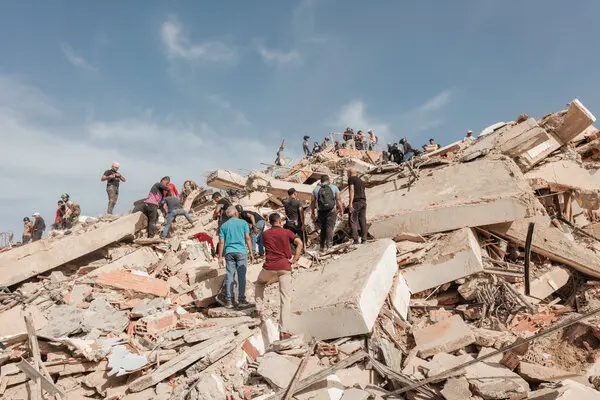
One week after Venezuela’s worst earthquake disaster in over a century, thousands remain unaccounted for and the death toll continues to rise with each passing day.
The twin earthquakes struck on June 24 at 6:04 p.m., measuring magnitudes of 7.2 and 7.5 within seconds of each other, with epicenters located in Yaracuy state west of the capital Caracas.
Venezuelan authorities have confirmed La Guaira state as the hardest-hit region, with tremors felt across the country and into neighboring nations.
As of Wednesday, Jorge Rodríguez, Venezuela’s National Assembly president, confirmed that 2,295 people had been killed and more than 11,200 injured by the disaster.
Gianluca Rampolla, the U.N. humanitarian coordinator in Venezuela, warned that the death toll “will unavoidably and sadly keep on growing as the search-and-rescue operation continues, and as we are able to detail further assessment of the impacts of the quakes.”
Rampolla confirmed the U.N. had agreed with Venezuela’s government to procure 10,000 body bags, while expressing hope the final figure would fall short of that number.
An analysis of satellite data by Corey Scher and Jamon Van Den Hoek of Oregon State University estimated that 58,870 buildings were likely damaged or destroyed by the earthquakes.
The U.N.’s International Organization for Migration warned that up to 6.8 million people could require shelter, water, sanitation, healthcare, and other relief items as a result of the disaster.
Public anger has mounted over the response from Venezuela’s U.S.-backed government, with many residents in devastated areas forced to conduct their own search-and-rescue operations without official support.
In Los Corales, a coastal community in La Guaira state, neighborhood volunteers have been pulling corpses from collapsed buildings using garbage bags and plastic sheets in the absence of proper body bags.
Resident Rosalia Bustamante told NPR that government delays in delivering rescue equipment to affected areas had cost lives, recounting the collapse of a 12-story building where friends were trapped.
“There were people in the ruins responding when we called out to them,” Bustamante said. “But now, they are dead.”
Construction worker Julio Meléndez described a two-day ordeal trying to bring a jackhammer into a disaster zone, as police demanded both a permit and a sales receipt before allowing him to proceed.
“The only thing the authorities do is get in the way,” Meléndez said.
Six days after the earthquakes, a 3-year-old boy named Klieber Morán was pulled alive from the rubble in La Guaira, with Interim President Delcy Rodríguez calling the rescue “a source of hope for our people.”
Among those lost were Venezuelans deported by the United States hours before the quakes struck, who died when the hotel where they were being processed collapsed, with 146 deportees on the flight and their survival status largely unknown.
Alonso Guanipa Toyo told NPR his 32-year-old brother Víctor is among the missing deportees, saying, “The government is not doing anything. My family is looking for him in the hospitals, in the shelters, in the morgues.”
Thousands of people are now sleeping on sidewalks, in parks, and on soccer fields, with many residents too afraid to return to structurally compromised buildings.
Mirna Castillo, sheltering in a tent camp in a park with her children, told NPR, “How are we going to live in a place that’s about to crack open,” adding that the government had offered her no help or direction.
“It’s just one chaos after another,” she said.
Karol Bassim, senior program manager with the International Medical Corps’ emergency response unit, told NPR the majority of people in the hardest-hit areas were now “without food, drinking water, shelter or access to basic healthcare.”
“Hospitals are overwhelmed. Some are operating far beyond capacity. Health workers are definitely exhausted,” Bassim said.
The United States announced a response that includes search and rescue teams, military logistics assets, and a commitment of $150 million to charities and U.N. agencies following the disaster.
The European Union pledged more than $5 million in humanitarian aid and deployed hundreds of responders from member countries, while also activating its Copernicus satellite imagery service to assist rescue teams.
The United Kingdom sent specialist search and rescue teams and announced more than $2 million in humanitarian funding, while Brazil, Chile, China, India, Japan, and Turkey also pledged support or deployed emergency crews.
César Jiménez, from the aid group Project Hope in Venezuela, captured the scale of the challenge facing the country’s shattered healthcare infrastructure in stark terms.
“We are doing our best as Venezuelans to support our people,” Jiménez said. “This is a unique moment in our history. Nobody saw this coming, and we need a lot of support.”
