
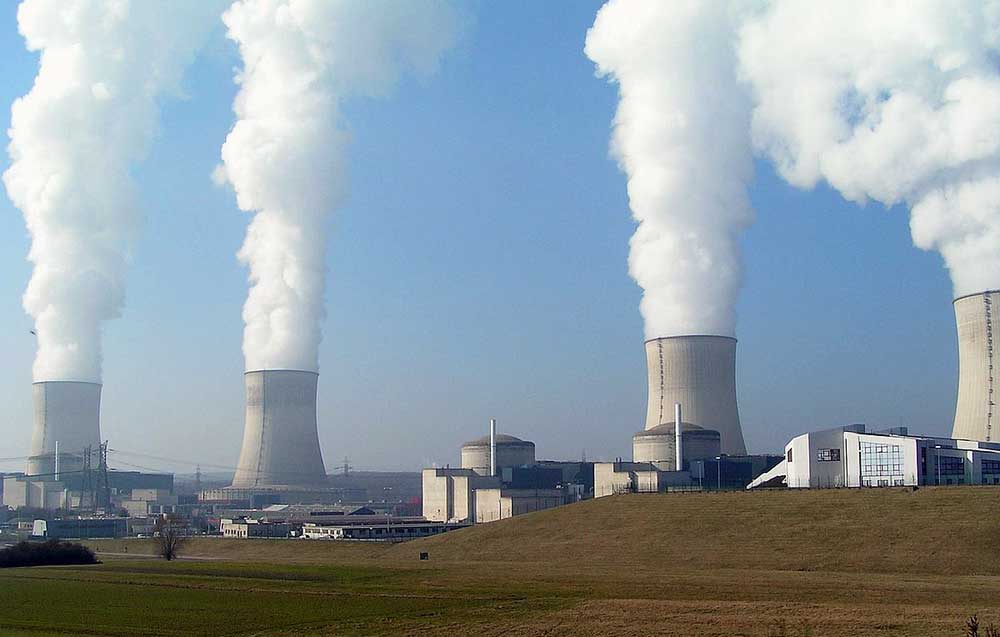
Power demand has become the defining bottleneck of the artificial intelligence buildout, and nuclear remains the only zero-carbon source capable of running a hyperscale facility around the clock without weather dependency.
Hyperscalers have already signed 20-year power purchase agreements with Constellation, Talen, and Vistra, locking in long-duration supply from existing reactor operators.
Small modular reactor designs from NuScale and X-energy are working through Nuclear Regulatory Commission review with Department of Energy backing, extending the investment runway well beyond current infrastructure.
For investors seeking a single-ticker expression of that thesis, three exchange-traded funds cover the trade at clearly different risk levels: the VanEck Uranium and Nuclear ETF (NYSEARCA: NLR), the Global X Uranium ETF (NYSE: URA), and the Sprott Uranium Miners ETF (NYSEARCA: URNM).
Lawrence Berkeley National Laboratory data shows that data center energy consumption rose by roughly 100 terawatt-hours between 2018 and 2023, lifting data centers from 1.9% to 4.4% of total U.S. electricity use.
That same report projects data centers’ share of total U.S. electricity consumption to reach between 6.7% and 12% by 2028, a range that underscores the scale of the demand problem facing grid operators.
A single hyperscale facility can draw over a gigawatt of power, equivalent to the load of roughly 750,000 homes, a figure that makes intermittent renewables an incomplete solution on their own.
Goldman Sachs Asset Management frames nuclear as a slower-to-deploy but durable option, with new plant timelines stretching to 2030 through 2035 in best-case scenarios, which is why uranium equities re-rate well before megawatts arrive.
NLR is the conservative leg of the trade, holding 27 positions across $4.6 billion in assets at a 0.52% expense ratio, pairing uranium miners with nuclear-tied utilities like Constellation and Vistra that earn regulated and contracted megawatt-hours.
The fund’s trailing yield of 2.7% reflects real utility dividends, and its total return of approximately 8% over the past year and 145% over five years came with milder drawdowns than the miner-heavy alternatives during recent pullbacks.
The tradeoff is upside compression, because when uranium spot prices surge, utility cash flows do not move in sync, meaning NLR will lag during a sharp miner rally.
URA sits in the middle of the risk ladder, holding $6.3 billion in assets with roughly $7.8 billion in net assets reported in its April NPORT filing, making it the largest and most liquid uranium-themed ETF in the U.S. market.
The fund reaches further down the fuel chain than URNM, incorporating fuel processors, conversion and enrichment names, and reactor component suppliers alongside major producers, at an expense ratio of 0.69% and a trailing yield of 4.7%.
URA’s one-year total return of 18% outpaced NLR, though it posted a steeper one-month decline of 13%, and its global holdings spanning Canadian, Kazakh, Australian, and Chinese names introduce currency and jurisdictional risks that a U.S. utility-heavy fund avoids.
URNM is the aggressive pure play, anchoring its exposure directly to the commodity through top holdings of Cameco at 21%, the Sprott Physical Uranium Trust at 14%, and NexGen Energy at 13%, with the top ten names accounting for roughly 79% of net assets.
The physical uranium sleeve through the Sprott trust means that when spot prices move, URNM moves with them directly, layered on top of the operating leverage already embedded in the miners themselves.
The fund runs $2 billion in assets at a 0.75% expense ratio across 30 holdings, with a trailing yield of 3.3% and a 52-week range of $43 to nearly $85 against a recent price near $53.
An investor who believes the AI power thesis but wants to avoid uranium spot price volatility should anchor with NLR, gaining ownership of the utilities actually selling power under long-dated contracts to major technology companies.
A blended allocation across all three funds remains the cleanest way to express the nuclear-for-AI thesis without forcing a choice among risk tiers, with the balance shaped by each investor’s tolerance for commodity sensitivity and drawdown.
