
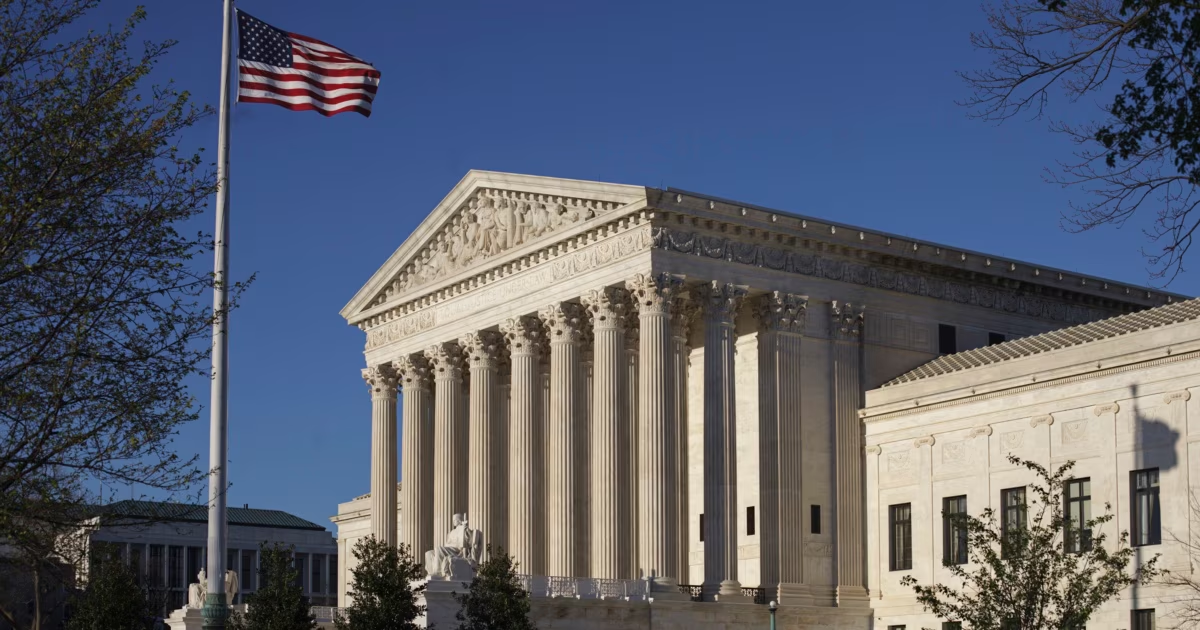
The Supreme Court handed President Donald Trump sweeping new authority over federal regulatory agencies Monday, overturning a 91-year-old precedent in one of the largest expansions of executive power in decades.
In a 6-3 decision authored by Chief Justice John Roberts, the court held that for-cause removal protections for Federal Trade Commission members violate the Constitution’s separation of powers.
The ruling effectively overturns the 1935 precedent set in Humphrey’s Executor v. United States, which had long shielded independent agency commissioners from presidential removal without cause.
Roberts wrote plainly in the majority opinion that “if anything more is left of Humphrey’s, we overrule it,” cementing the court’s decisive break from nearly a century of established administrative law.
The case arose after Trump fired FTC Commissioners Rebecca Kelly Slaughter and Alvaro Bedoya in March 2025, offering no statutory grounds for removal and telling Slaughter only that her “continued service on the FTC is inconsistent with this Administration’s priorities.”
Roberts noted in the majority opinion that the FTC in its current form enforces some 80 statutes covering nearly every facet of the American economy, writing that “the tasks it undertakes are the very essence of execution of the law.”
The ruling makes FTC commissioners effectively at-will employees serving at the president’s pleasure, and it dismantles Congress’s longstanding requirement that the commission maintain bipartisan membership.
The decision is expected to have wide-ranging implications across the federal government, including for cases involving the president’s removal of Gwynne Wilcox from the National Labor Relations Board.
Justice Sonia Sotomayor wrote a scathing dissent, warning that “perhaps worst of all, the Court today forgets its place,” and that “the majority reshapes our Government,” adding that “the Court gives the President a power unknown even to the English Crown against which the Founders revolted.”
The conservative majority did, however, draw a firm line at the Federal Reserve, issuing a separate 5-4 decision blocking Trump from immediately removing Fed Governor Lisa Cook.
Roberts acknowledged in the majority opinion that “not all offices created by Congress necessarily come with executive power,” citing the Federal Reserve Board of Governors as an example of such a constitutionally distinct institution.
The carve-out for the Federal Reserve is seen as a significant limitation on the ruling’s reach, preserving the independence of the central bank even as the broader regulatory state comes under direct presidential control.
The Slaughter case follows a pattern of the Supreme Court dismantling major administrative precedents, including its 2024 decision overturning the 1984 Chevron doctrine and its 2022 reversal of Roe v. Wade.
Trump celebrated the ruling on Truth Social, calling it a “BIG WIN” and writing that “90 years of precedent has been COMPLETELY AND UNEQUIVOCALLY OVERRULED, greatly increasing Presidential Power at a time when it is most needed.”
When asked at the White House whether he planned to fire additional officials as a result of the ruling, Trump told reporters: “I don’t think so. It gives me the right, and not me, it gives a president the right to do what the president should have the right to do, and it’s very interesting. It’s a big ruling.”
