
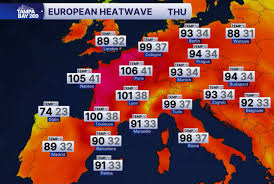
Millions of people across Europe are currently enduring temperatures exceeding 40 degrees Celsius (104 degrees Fahrenheit), as a heat dome grips the continent and hot nights hamper recovery.
Amid the sweltering conditions, social media users have been questioning whether sunscreen actually protects against skin cancer or whether it contributes to the disease.
The debate centers on a specific claim circulating across multiple platforms: that sunscreen increases the risk of melanoma rather than reducing it.
One widely shared post states that “according to the National Cancer Institute, since the introduction of sunscreen in 1940, melanoma has increased by over 200%,” and further describes sunscreen as a “poison” that prevents the body from absorbing sunlight properly.
Fact-checkers have rated that claim as misleading, and the evidence does not support the link it implies between sunscreen use and rising cancer rates.
Multiple studies have demonstrated that regular sunscreen use actually reduces the risk of developing melanoma, directly contradicting the premise of the viral posts.
“There is no scientific evidence that supports the association of sunscreen use with a higher risk of cancer,” said Brittany Schaefer, public information officer with the Connecticut State Department of Public Health.
The US National Cancer Institute has not stated that sunscreen caused a 200% rise in melanoma since 1940, and available data on new observed melanoma cases only dates back to 1975.
According to that data, the rate of newly diagnosed melanoma cases did increase by more than 220% from 1975 to 2023, but no evidence connects that rise to sunscreen use.
A 2023 study involving scientists from the United States, Germany, Switzerland, and Hungary identified several hypotheses to explain the upward trend in melanoma cases.
Those hypotheses include an increase in reporting and documenting cases, people spending more time exposed to the sun, and climate change affecting the ozone layer and UV index variations.
The study also flagged that sunscreen is not necessarily being used appropriately, a point reinforced by public surveys conducted across several countries in recent years.
In Germany, 51% of respondents said in 2024 that they only use sunscreen in summer or when directly exposed to sunlight, while 17% said they never use it at all.
A poll conducted in the United States in the same year found that 33% of adults admitted to never using sunscreen at all, suggesting widespread underuse of a proven protective measure.
The US Food and Drug Administration, which regulates sunscreens to ensure they meet safety and effectiveness standards, recommends using sunscreen regularly and even on cloudy days.
Public health experts emphasize that as global temperatures continue to rise and extreme heat events become more frequent, accurate guidance on sun protection is increasingly critical.
The resurgence of anti-sunscreen claims on social media during heat events underscores the broader challenge of combating health misinformation at precisely the moments when accurate advice matters most.
