
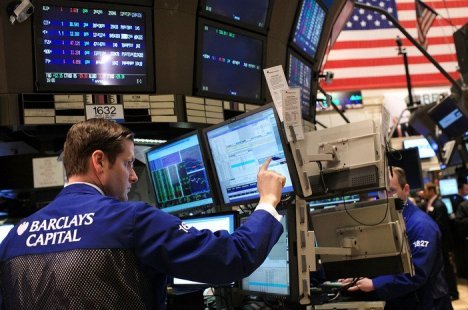
Markets closed Wednesday’s session firmly in the red after Federal Reserve officials unanimously voted to hold interest rates steady at the June FOMC meeting while signaling at least one possible rate hike ahead.
The decision marked Federal Reserve Chairman Kevin Warsh’s first FOMC meeting presiding over the central bank, and markets delivered a cautious verdict on his debut at the helm.
The Dow Jones Industrial Average (^DJI) fell roughly 500 points, or approximately 1%, while the Nasdaq Composite (^IXIC) dropped 1.34% and the S&P 500 (^GSPC) slid 1.21% by the close.
Markets had initially surged to new intraday highs immediately following the 2:00 p.m. Fed policy release, but those gains quickly evaporated as the press conference unfolded throughout the afternoon.
Yahoo Finance Markets and Data Editor Jared Blikre described the price action as “just kind of down and to the right,” with selling pressure intensifying across the major indexes as the session wore on.
All 11 S&P 500 sectors finished in negative territory, with communication services, consumer discretionary, and consumer staples among the worst performers, each falling more than 2%.
Mega-cap technology stocks bore a significant portion of the selling pressure, with Microsoft (NASDAQ: MSFT) dropping nearly 4%, Amazon (NASDAQ: AMZN) falling 3.5%, and Meta declining approximately 5%.
Small caps were not spared either, with the S&P 600 declining 1.3%, reflecting a broad-based risk-off mood that extended well beyond large-cap technology names.
Semiconductors stood out as one of the few bright spots in an otherwise bleak session, with the sector managing to hold onto gains of 1.38% as chip stocks attracted buyers amid the broader selloff.
Broadcom surged approximately 4%, Applied Materials posted similar gains, ARM Holdings climbed more than 5%, and Intel advanced more than 3%, providing a notable contrast to the rest of the technology sector.
Within the Dow, JP Morgan and Goldman Sachs each added roughly three-quarters of a percent, with Caterpillar rising 1%, as financials continued their run as one of the better-performing sectors this month.
On the software side, the picture was decidedly darker, with IBM falling 3% and Salesforce dropping 4%, while even traditionally defensive consumer staples like Walmart declined around 2%.
Blikre also flagged weakness in the transport sector as a point of concern, noting that in Dow Theory, transports and industrials are typically expected to move in tandem, but transports were leading to the downside Wednesday.
The Fed’s signal of a potential future rate increase reintroduced uncertainty into a market that had grown comfortable with the prospect of a prolonged pause in the current tightening cycle.
Warsh’s first meeting as Fed chair leaves investors with a clear message heading into the remainder of the week: the central bank is not yet ready to declare victory over inflation, and further policy tightening remains firmly on the table.
