
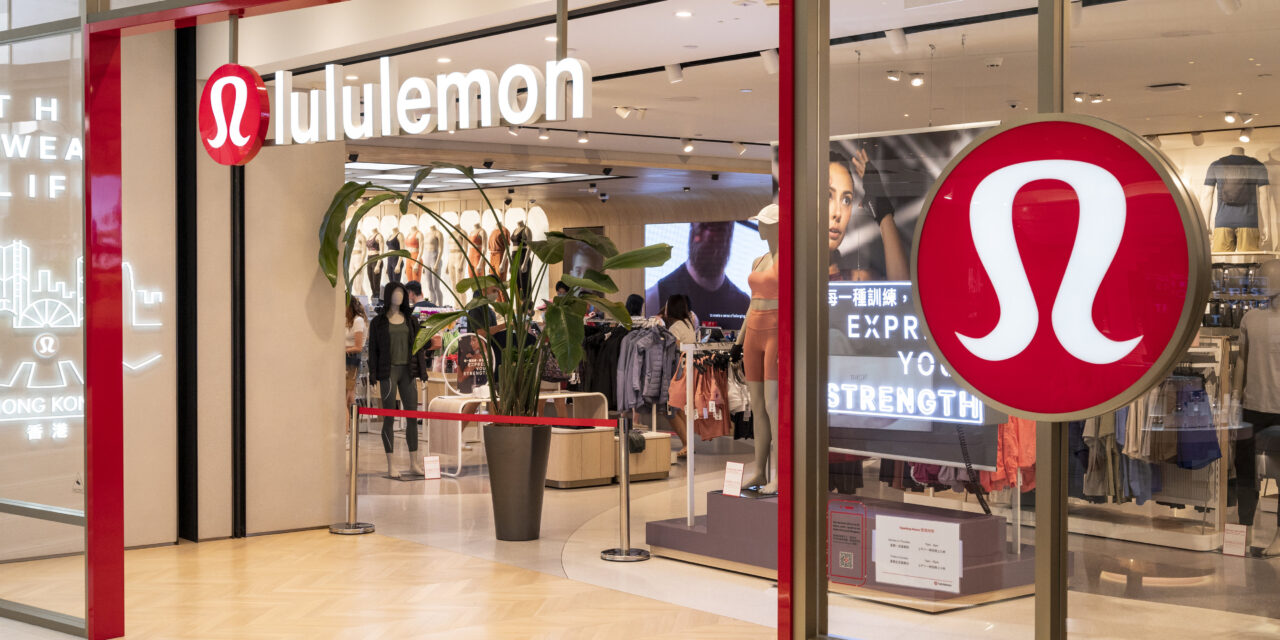
Lululemon Athletica Inc. (NASDAQ: LULU) is expected to report a year-over-year decline in earnings when it releases first-quarter fiscal 2026 results on June 4, after market close.
The Zacks Consensus Estimate for fiscal first-quarter revenues stands at $2.4 billion, reflecting 2.6% growth compared to the same period a year ago.
The consensus estimate for first-quarter earnings is $1.67 per share, representing a 35.8% decline from the prior-year quarter’s actual figure, with estimates moving down by a penny over the past seven days.
lululemon has posted a trailing four-quarter average earnings surprise of 7.9%, though the model does not conclusively predict an earnings beat for the upcoming quarter.
The company carries an Earnings ESP of -6.40% and a Zacks Rank of 3, a combination that does not meet the threshold typically associated with a predicted earnings beat.
lululemon continues to pursue its Power of Three X2 growth strategy, which targets revenue growth through product innovation, guest experience improvements and international market expansion.
International markets, led by Mainland China, are expected to grow 25-30% in the first quarter, while the Rest of World segment is projected to rise in the mid-teens.
Management noted that Mainland China trends have been strong in the first quarter of fiscal 2026, supported by a shift of the Chinese New Year into the quarter.
For the fiscal first quarter, management anticipates net revenues of $2.4 billion to $2.43 billion, indicating 1-3% year-over-year growth, with EPS expected between $1.63 and $1.68.
North America, lululemon’s largest market, is expected to see revenues decline in the mid-single digits, with the United States also projected to fall in the mid-single digits and Canada tracking slightly slower.
Uneven traffic trends and cautious consumer spending in discretionary categories have weighed on North America, with the women’s category being the most visibly impacted segment.
Increased promotional activity across the broader apparel space has intensified competition, making it harder for lululemon to drive full-price sales in its home market.
Gross margin is projected to decline 380 basis points year over year, driven by higher tariff rates and investments in store openings, optimizations and the distribution network.
Tariffs alone are expected to create a headwind of 290 basis points on gross margin, partially offset by 110 basis points of mitigating measures, while markdowns are projected to rise 30 basis points year over year.
SG&A, as a percentage of sales, is expected to deleverage 330 basis points year over year, driven by the timing of brand activations including the BNP Paribas Open, the Milan Olympics and Studio.
The company expects additional pressure from discrete costs related to a proxy contest, as well as the reintroduction of expenses reduced last year, particularly in store labor hours and incentive compensation.
lululemon expects its first-quarter fiscal 2026 operating margin to contract 710 basis points year over year, with SG&A costs projected to rise 11.1%.
LULU shares have declined 25.6% over the past three months, underperforming the industry’s fall of 10.1%, the Consumer Discretionary sector’s decline of 6.1% and the S&P 500’s gain of 10%.
The stock has also lagged peers, with V.F. Corporation (VFC) falling 8.1%, while Ralph Lauren Corporation (RL) and PVH Corp. (PVH) have rallied 6.2% and 44.5% respectively over the same period.
At a current price of $131.04, LULU trades at a forward 12-month price-to-earnings multiple of 10.38 times, well below the industry average of 17.38 times, suggesting the stock remains deeply discounted relative to its peers.
Investors may prefer to wait for clearer signs of demand stabilization in North America before taking a more constructive position, though existing shareholders can point to the company’s long-term strategy as a basis for staying the course.
