
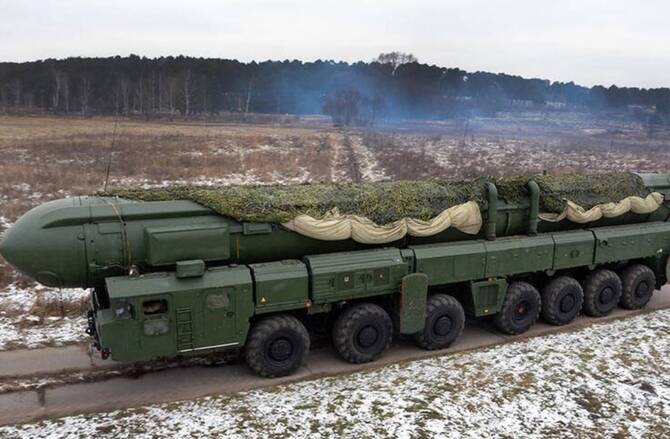
Russia deployed its Oreshnik intermediate-range ballistic missile against the Kyiv region of Ukraine for the third time on Sunday, targeting the city of Bila Tserkva in an overnight strike that Moscow said was a direct retaliation for a Ukrainian attack on a school in the Russian-occupied Luhansk region earlier in the week.
The Russian Defence Ministry confirmed the use of the Oreshnik system and said the strike was a proportional response to the Luhansk attack, in which Ukrainian forces hit a school building, killing 21 students and injuring dozens more, a casualty figure that Russian officials cited in their justification for the escalation.
Ukrainian authorities confirmed the Oreshnik struck Bila Tserkva, describing the strike as the first time the weapon had been used to target the capital region, a significant geographic escalation from the earlier attacks which targeted Dnipro further to the east.
The Oreshnik is a hypersonic intermediate-range ballistic missile capable of carrying multiple independently targetable reentry vehicles, with a design that gives it speeds exceeding Mach 10, approximately 12,300 kilometres per hour, making interception by existing Ukrainian air defence systems extremely difficult.
At those velocities the kinetic energy released on impact is so immense that Russian officials have claimed the heat generated rivals the surface of the sun, a characterisation that analysts say is hyperbolic but reflects the weapon’s genuine penetrating capability against hardened targets.
The missile has a range of between 3,000 and 5,000 kilometres, sufficient to strike targets anywhere in Europe from launch positions within Russian territory, and President Vladimir Putin revealed its first combat use in November 2024 during the strike on Dnipro that he described at the time as an experimental deployment.
The Sunday strike is the third time the system has been used in combat, and its deployment against the Kyiv region rather than eastern Ukraine represents a deliberate political signal from Moscow about its willingness to escalate geographically when it judges Ukrainian strikes have crossed a defined threshold.
Analysts have noted that the Bila Tserkva strike comes at a particularly sensitive moment, with US-Iran ceasefire negotiations drawing much of the diplomatic bandwidth of the American foreign policy establishment and with NATO members already deeply divided over the appropriate response to Russia’s conduct in Ukraine.
Ukraine’s air force said it detected and partially disrupted the broader missile and drone attack that accompanied the Oreshnik strike overnight, though it did not claim to have intercepted the Oreshnik itself, a weapon against which no deployed air defence system has demonstrated confirmed intercept capability.
The strike is likely to intensify pressure on Western governments to supply Ukraine with more capable long-range precision weapons, though the political dynamics within NATO and bilateral US-Ukraine defence cooperation channels remain constrained by the same factors that have produced stalemate in allied support discussions throughout 2025 and 2026.
