
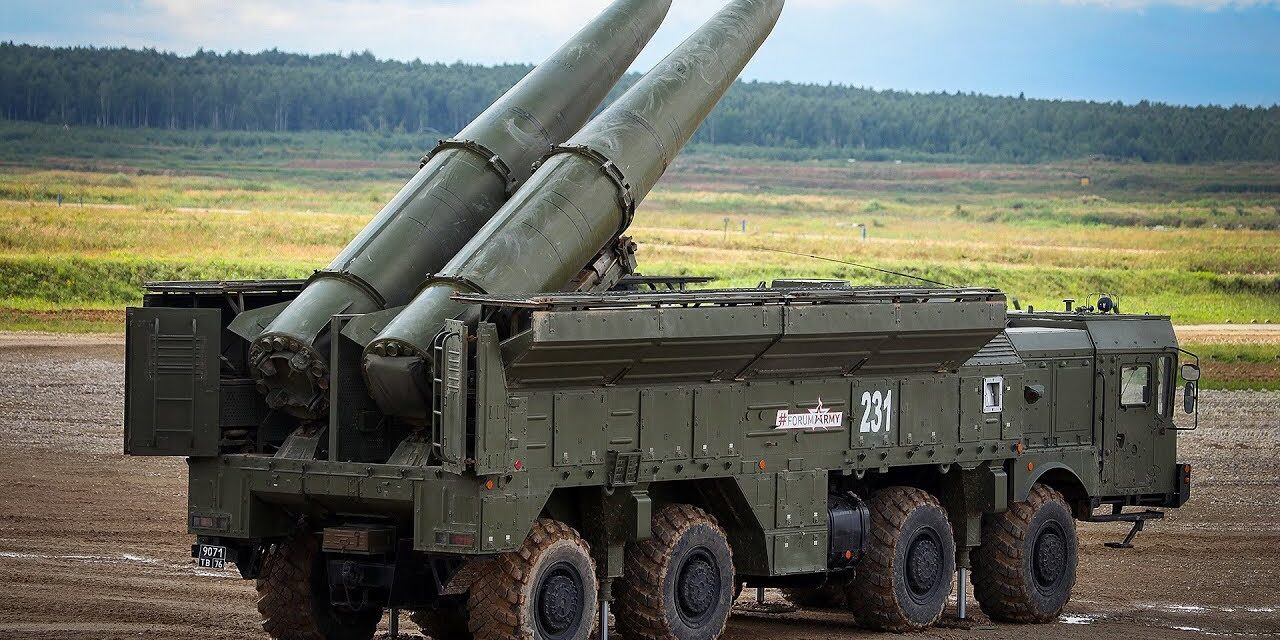
Russia announced on Thursday that it had transferred nuclear warheads to Belarusian forces as part of a large-scale joint strategic nuclear exercise, in a move that has drawn condemnation from Ukraine and sharp warnings from NATO.
The Russian Ministry of Defence confirmed that special nuclear warheads for Iskander-M tactical missile systems had been moved to a designated area for launcher preparation, marking the final phase of exercises that began on 18 May and involved approximately 64,000 military personnel and more than 7,800 pieces of equipment on the Russian and Belarusian side.
Russian and Belarusian defence ministries released video footage showing military vehicles transporting missiles into a forested area at an undisclosed location in Belarus, with the footage broadcast by TASS and other state media outlets as evidence of the exercise’s operational scope.
Belarusian forces conducted simulated Iskander missile launches and bombing runs against undisclosed targets during the same period, with the drills described by Minsk as “exclusively defensive” and intended to deter potential aggression.
The exercises also involved test launches of Russian intercontinental ballistic missiles as well as Zircon and Dagger class hypersonic missiles, all of which are capable of carrying nuclear warheads, according to Russian state media reports citing defence ministry statements.
Russia’s total active nuclear stockpile is estimated by the Federation of American Scientists at approximately 4,400 warheads, making it the largest such arsenal in the world, and the Kremlin has increasingly used references to that capability as a diplomatic and coercive tool since its full-scale invasion of Ukraine began in February 2022.
A new element of the drills was the explicit integration of Belarusian territory and forces, building on Russia’s earlier decision to station Oreshnik intermediate-range ballistic missiles in Belarus in 2025, following an agreement signed two years prior.
The Oreshnik system is capable of delivering either conventional or nuclear warheads, and its presence in Belarus places additional territory within its strike radius, a fact that has been noted repeatedly by NATO analysts.
NATO Secretary General Mark Rutte said the alliance was closely monitoring the exercises and warned that any Russian nuclear attack would be met with a “devastating” response, calibrating his language to convey resolve without publicly escalating the rhetorical confrontation.
Ukraine’s foreign ministry formally condemned the exercises as a violation of the Treaty on the Non-Proliferation of Nuclear Weapons, while the State Border Guard Service announced it was continuing to reinforce fortifications along the entire length of the Ukraine-Belarus border.
Ukrainian officials have warned for weeks that Russia could be planning a fresh offensive from the north using Belarus as a staging ground, echoing the pattern seen at the outset of the 2022 invasion.
The drills concluded on the same day that Russian President Vladimir Putin was in Beijing meeting with Chinese President Xi Jinping, with Ukraine among the topics on the agenda, a pairing of nuclear signalling and diplomatic engagement that analysts described as consistent with a pattern the Kremlin has used throughout the conflict to reinforce its strategic position while simultaneously engaging in high-level diplomacy.

